
Home / Birds / Ducks, geese and swans / Comb duck
No federal permit to keepComb duck
Sarkidiornis sylvicola
Birds › Ducks, geese and swans (Anseriformes) › Anatidae (Ducks, geese and swans)
The comb duck or American comb duck (Sarkidiornis sylvicola), is an unusual duck found in tropical wetlands in continental South America south to the Paraguay River region in eastern Paraguay, southeastern Brazil and extreme northeastern Argentina,…
From Wikipedia: Comb duck, CC BY-SA 4.0 (excerpt)

Care at a glance
Species-specific values
Values researched for this exact species. Air, surface and water temperatures are listed separately, and each source is kept as published rather than averaged.
| Social housing | Trio housing or three to four ducks per drake has been suggested. Source: sierwatervogels.nl | |
| Substrate | May nest in natural vegetation or use a raised or ground-level nest box or tunnel. Source: sierwatervogels.nl | |
| Egg incubation humidity (ground nesters) | 55 % Source: sierwatervogels.nl | |
| Egg incubation humidity (cavity nesters) | 40 % Source: sierwatervogels.nl | |
| Egg incubation temperature | 99 °F (37.4 °C) Source: sierwatervogels.nl | |
| Diet | Lundi Premium Floating or Lundi Exquisit Floatable complete feed are listed as maintenance food. Source: sierwatervogels.nl |
Understanding the animal
About this animal
About this animal
The comb duck is generally smaller in size when compared to the knob-billed duck, and flanks are darker (black in males, medium grey in females).
From Wikipedia: Comb duck, CC BY-SA 4.0 (excerpt)
In the wild
In the wild
| Overview | The comb duck or American comb duck (Sarkidiornis sylvicola), is an unusual duck found in tropical wetlands in continental South America south to the Paraguay River region in eastern Paraguay, southeastern Brazil and extreme northeastern Argentina, and as a vagrant on Trinidad. Most taxonomic authorities split this species and the knob-billed duck from each other. The comb duck is generally smaller in size when compared to the knob-billed duck, and flanks are darker (black in males, medium grey in females). — From Wikipedia: Comb duck, CC BY-SA 4.0 (excerpt) |
| Where it lives | It breeds in still freshwater swamps and lakes in the tropics. It is largely resident, apart from dispersion in the wet season. This duck feeds on vegetation by grazing or dabbling and to a lesser extent on small fish, invertebrates, and seeds. — From Wikipedia: Comb duck, CC BY-SA 4.0 (excerpt) |
| Reproduction | Comb ducks nest mainly in tree holes, also in tall grass. They line their nests with reeds, grass, or feathers, but not down. Males may have two mates at once or up to five in succession. — From Wikipedia: Comb duck, CC BY-SA 4.0 (excerpt) |
| Appearance and size | It is one of the largest species of duck. Length can range from 56 to 76 cm, wingspan ranges from 116 to 145 cm and weight from 1.03 to 2.9 kg. Adults have a white head freckled with dark spots, and a pure white neck and underparts. — From Wikipedia: Comb duck, CC BY-SA 4.0 (excerpt) |
| History and naming | Uncertainty surrounds the correct systematic placement of this species. Initially, it was placed in the dabbling duck subfamily Anatinae. Later, it was assigned to the "perching ducks", a paraphyletic assemblage of waterfowl most of which are intermediate between dabbling ducks and shelducks. — From Wikipedia: Comb duck, CC BY-SA 4.0 (excerpt) |
Native climate (measured)
Native climate (measured)
| Warm-season highs | about 89°F (up to 94°F in the hottest sampled areas) |
| Cool-season lows | about 51°F (down to 41°F in the coldest sampled areas) |
| Average temperature | 63–78°F across sampled records |
| Relative humidity | 65–75% on average (driest month about 64%) |
| Rainfall | about 989 mm a year |
Measured at 554 wild occurrence records sampled against WorldClim 2.1 climate data (1970–2000 averages). Air conditions in the range are ecological context, not enclosure settings: microhabitats such as burrows, leaf litter or basking rocks can be cooler, warmer or more humid.
Profile
Profile
Researched for this exact species. Sources are listed under In the wild above.
History
Uncertainty surrounds the correct systematic placement of this species. Initially, it was placed in the dabbling duck subfamily Anatinae. Later, it was assigned to the "perching ducks", a paraphyletic assemblage of waterfowl most of which are intermediate between dabbling ducks and shelducks.
From Wikipedia: Comb duck, CC BY-SA 4.0 (excerpt)
Data and studies
The numbers
The numbers
Each bar is what one source reports. Where several sources weigh in, the dashed gold band marks their average.
Typical adult weight
Average adult body mass in each database (FishBase gives the maximum recorded weight).
Incubation
Sources for this sheet
- Myhrvold et al. (2015). An amniote life-history database. Ecology 96: 3109 Peer-reviewed researchPeer-reviewed compilation of life-history data for over 21,000 birds, mammals and reptiles.
- GBIF Backbone Taxonomy (Global Biodiversity Information Facility) (CC BY 4.0) Peer-reviewed researchInternational scientific taxonomy used here for classification. GBIF Secretariat (2023). GBIF Backbone Taxonomy. Checklist dataset https://doi.org/10.15468/39omei, accessed via GBIF.org.
- Wikipedia (species article) (CC BY-SA 4.0) Community referenceFree encyclopedia; useful overviews with their own citations. Short excerpts are quoted under CC BY-SA 4.0, each credited with a link to its article.
- The eBird/Clements Checklist of Birds of the World (Cornell Lab of Ornithology) Peer-reviewed researchThe standard global bird checklist maintained by the Cornell Lab of Ornithology; used here for complete species lists of widely kept bird families.
- iNaturalist (captive observations) Community referenceCommunity observation platform run by the California Academy of Sciences and National Geographic; observations marked captive show animals living in homes, zoos and aquariums.
More ducks, geese and swans
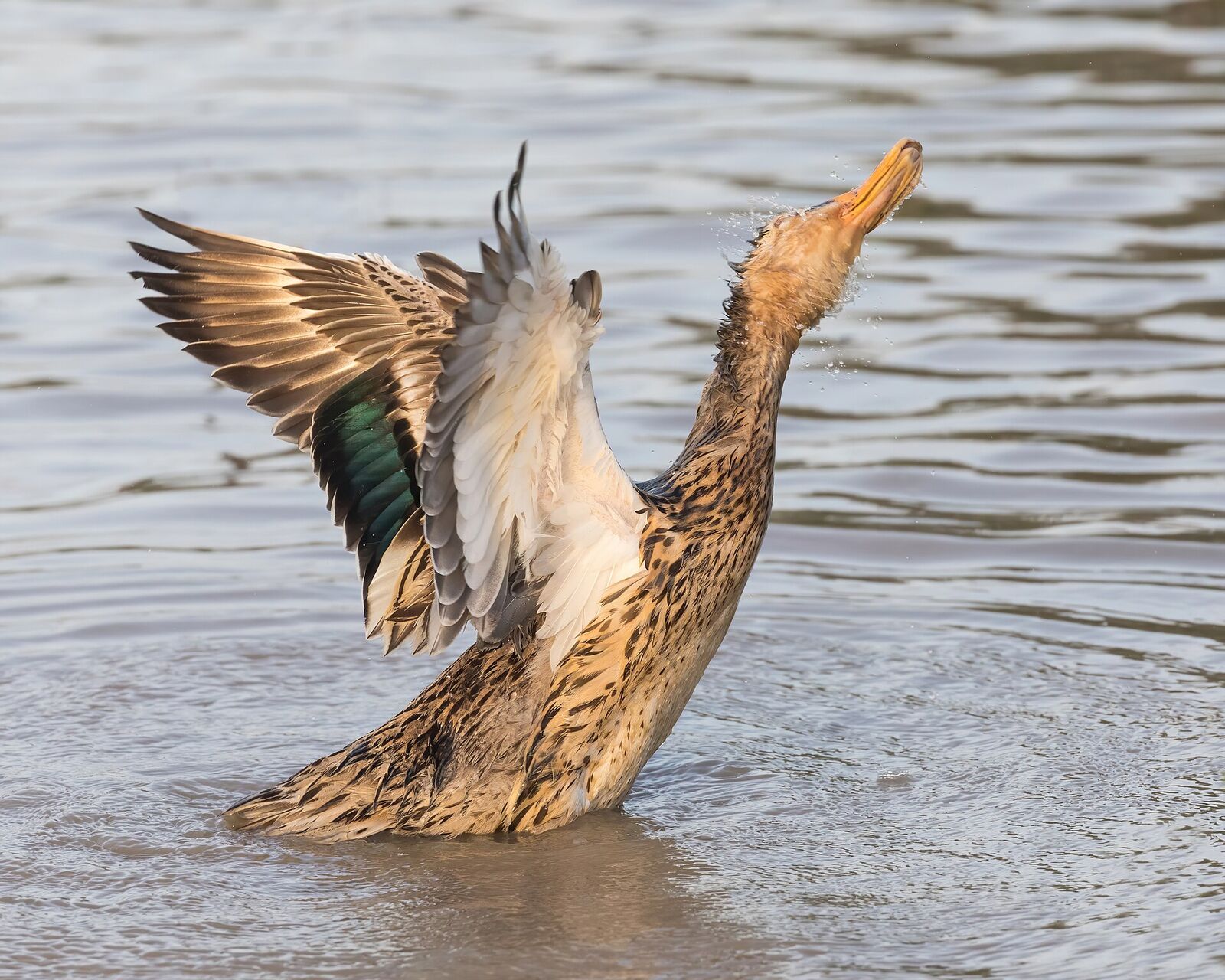
Domestic duck (mallard)
Anas platyrhynchos
Messy, hardy and happiest near water.
Farm & ranch

Baer's pochard
Aythya baeri
Aviary

Bernier's teal
Anas bernieri
Aviary

Black scoter
Melanitta americana
Aviary

Brazilian teal
Amazonetta brasiliensis
Aviary

Common shelduck
Tadorna tadorna
Farm & ranch