Home / Fishes / Carp, barbs, minnows, loaches / Leuciscidae / Common nase
No federal permit to keepCommon nase
Chondrostoma nasus
Fishes › Carp, barbs, minnows, loaches (Cypriniformes) › Leuciscidae (Minnows and shiners)
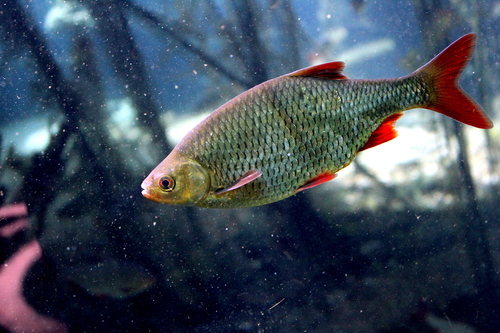
The common nase (Chondrostoma nasus) is a European potamodromous cyprinid fish.

Care at a glance
Species-specific values
Values researched for this exact species. Air, surface and water temperatures are listed separately, and each source is kept as published rather than averaged.
| Minimum enclosure | Minimum tank volume is 800 L. Source: aqua-pedia.com | |
| Water temperature | 50–68 °F (10–20 °C) Source: aqua-pedia.com | |
| Diet | Herbivorous diet, mainly plant-based, including algae wafers, blanched vegetables, and some invertebrate matter. Source: aqua-pedia.com | |
| Social housing | Keep in a shoal of at least six. Source: aqua-pedia.com |
Species-specific aquarium care
- Tank: At least 48 in long and 21 in front to back for one adult (adults commonly reach about 9.8 in / 25 cm; the largest recorded was 19.7 in).
- Water: Freshwater.
- Layout: Uses both the bottom and open water: give open swimming space plus cover near the substrate.
- Diet: A grazer on plants and algae: base the diet on vegetable foods (algae wafers, blanched vegetables, spirulina). FishBase classes it as a herbivore.
- Availability: Mostly kept by public aquariums; private keeping is uncommon.
Calculated from this species' own FishBase record: tank size from its typical adult length and swimming zone, water values from its recorded ranges. The group guide below fills in general care.
Understanding the animal
About this animal
About this animal
It is often simply called the nase, but that can refer to any species of its genus Chondrostoma. Another name is sneep.
From Wikipedia: Common nase, CC BY-SA 4.0 (excerpt)
In the wild
In the wild
From this species’ own FishBase record (habitat, bottom type, water and breeding data), not its family. Wild conditions are context, not enclosure settings.1
| Where it lives | Lives in freshwater, in rivers and streams. Uses both the bottom and open water. |
| Climate | Temperate climate. |
| Wild diet | Grazing on aquatic plants. |
| Behavior to plan for | Breeding: open water/substratum egg scatterers. |
Data and studies
The numbers
The numbers
Each bar is what one source reports. Where several sources weigh in, the dashed gold band marks their average.
Maximum recorded lifespan
Longest recorded lifespan reported by each database; typical lifespans are usually shorter.
Typical adult weight
Average adult body mass in each database (FishBase gives the maximum recorded weight).
Adult length
Common length to maximum recorded length. Measured as total length. Fish in home aquariums often stay smaller than wild records.
Sources for this sheet
- AnAge: The Animal Ageing and Longevity Database (Human Ageing Genomic Resources) (CC BY 3.0) Peer-reviewed researchCurated, referenced longevity and life-history records for thousands of species; maximum lifespans are often from zoo animals.
- FishBase (Froese & Pauly, eds.), version 24.07 (CC BY-NC 4.0) Peer-reviewed researchThe global scientific database on fishes, maintained by a consortium of research institutions; every value is referenced.
- Wikipedia (species article) (CC BY-SA 4.0) Community referenceFree encyclopedia; useful overviews with their own citations. Short excerpts are quoted under CC BY-SA 4.0, each credited with a link to its article.
- iNaturalist (captive observations) Community referenceCommunity observation platform run by the California Academy of Sciences and National Geographic; observations marked captive show animals living in homes, zoos and aquariums.