Home / Reptiles / Snakes / Corn snake
No federal permit to keep In-depth sheetCorn snake
Pantherophis guttatus
Reptiles › Snakes (Serpentes) › Colubridae (Colubrid snakes)
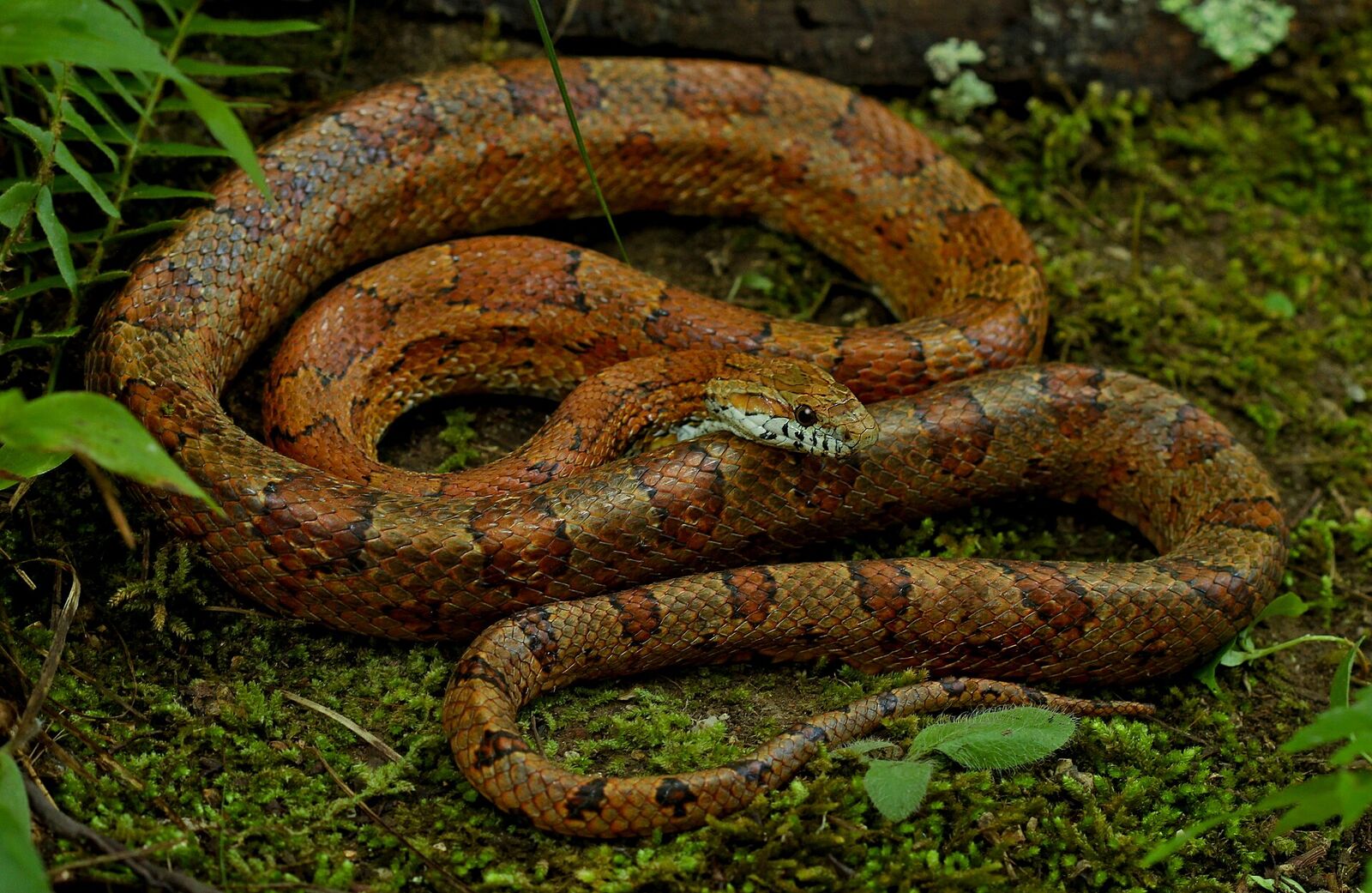
Corn snakes are hardy, easy-going colubrids that come in countless colors. Clint's Reptiles scores them 4.8 out of 5, one of his highest ratings.
Care at a glance
Species-specific values
Values researched for this exact species. Where they differ from the group guide below, follow these. Air, surface and water temperatures are listed separately, and each source is kept as published rather than averaged.
| Basking surface temperature | 90 °F | 208 |
| Cool surface temperature | 75–82 °F Source locates cool probe on substrate | 208 |
| Humidity | 65–75 % RH Author recommendation; retain separately from other sourced humidity ranges | 208 |
| Enclosure minimum | length: 48 in; width: 24 in; height: 24 in Source baseline; scale up for a longer individual | 209 |
| Preferred air temperature zone | 77–86 °F (25–30 °C) Veterinary POTZ; not water or basking surface. | 218 |
| Relative humidity | 30–70 % Veterinary table; corn snake, leopard gecko, bearded dragon and savannah monitor require more humidity during shedding. | 218 |
Care guide
Enclosure
- Minimum 48×24×24 in so they can stretch out; humidity 50–60%.
Sources 36
Feeding
- Adults every 1–2 weeks; thawed prey warmed to blood temperature.
Sources 36
Show the group care guide for colubrids (rat snakes, kingsnakes and relatives)
Colubrids (rat snakes, kingsnakes and relatives)
Applies to most species in this group. Habitat: Temperate to tropical; mostly terrestrial. Individual species can differ, so compare with the species numbers above and the linked sources.
Housing & setup
- A secure enclosure about as long as the adult snake, with hides at both ends and climbing branches for rat snakes.
- Choose substrate and moisture by species; ReptiFiles recommends moisture-retaining substrate for corn snakes.
Climate & lighting
Starting point only: The family-wide humidity default would overwrite a materially different corn-snake recommendation. Check the species-specific values for this animal where shown.
| Warm side / daytime | 82–88°F |
| Cool side | 70–76°F |
| Humidity | 40–60% |
Diet
- Mice or rats every 5–10 days for young snakes, every 10–14 days for adults.
- Kingsnakes eat other snakes in the wild; always house them alone.
Social life
- Solitary (kingsnakes are cannibalistic).
Handling
- Usually calm; hatchlings may musk or nip but settle with gentle handling.
Health watch
- Generally hardy; watch for mites, respiratory infections and stuck sheds.
- Many species brumate in winter; a cooler period is natural but not required.
Understanding the animal
In the wild
In the wild
Researched for this exact species, not its family. Good care copies these conditions.1234
| Where it lives | Woodlands, forest openings, fields and farm buildings of the southeastern United States. It uses rodent burrows, tree-root passages, logs and crevices for shelter and foraging. |
| Ground it lives on | Soil and woodland litter with underground rodent passages and fallen wood; also climbs vegetation. |
| Climate | Temperate to subtropical, with winter cooling and seasonal dormancy in colder populations. No species-wide wild temperature or relative-humidity range was established. |
| Active | Cathemeral with regional variation: daytime activity occurs, while warmer conditions favor crepuscular or nocturnal activity; winter brumation occurs in colder areas. |
| Social life | Usually solitary. |
| Wild diet | Small mammals, especially rodents; also birds, eggs and small reptiles. |
| Behavior to plan for | Forages both underground and in trees or shrubs. It kills prey by constriction and readily uses narrow sheltered passages. |
What this means for care
- Provide both burrowing cover and usable branches.
- Secure small gaps around doors and ventilation openings.
- Account for locality-dependent winter inactivity rather than assuming year-round tropical activity.
Native climate (measured)
Native climate (measured)
| Warm-season highs | about 91°F (up to 92°F in the hottest sampled areas) |
| Cool-season lows | about 51°F (down to 39°F in the coldest sampled areas) |
| Average temperature | 67–75°F across sampled records |
| Relative humidity | 72–74% on average (driest month about 68%) |
| Rainfall | about 1309 mm a year |
Measured at 92 wild occurrence records sampled against WorldClim 2.1 climate data (1970–2000 averages). Air conditions in the range are ecological context, not enclosure settings: microhabitats such as burrows, leaf litter or basking rocks can be cooler, warmer or more humid.
Profile
Profile
Researched for this exact species. Sources are listed under In the wild above.
History
Pantherophis guttatus was formerly classified in the genus Elaphe. Taxonomic work subsequently placed it in Pantherophis, and forms once treated as corn snake subspecies, including the Great Plains rat snake, have been separated by some treatments into distinct species.
Keeper tips
- Captive-bred corn snakes are recommended over wild-caught animals because they are more likely to be healthy and parasite-free and usually have known age, history, and parentage.
- Provide a temperature gradient with a warm end around 85 F and a cool end in the low 70s F.
- Do not place the enclosure where direct sunlight can cause dangerous overheating.
- A long hide such as a hollow log or PVC pipe can span the temperature gradient so the snake can remain concealed while choosing warmer or cooler conditions.
Behaviors reported
- Activity peaks around dawn and dusk.
- They kill small prey by constriction.
- Males engage in dominance fights.
Unique adaptations
- Their brighter coloration, slender build, slim head, round pupils, and absence of heat-sensing pits distinguish them from copperheads.
- The belly bears alternating black-and-white markings forming a checker pattern.
Remarkable facts
- Adult total length is reported as 61–182 cm, or about 2–6 ft.
- Juveniles are fully developed when they hatch.
- Corn snakes are non-venomous.
- The species was formerly placed in the genus Elaphe.
- Molecular studies indicate corn snakes are more closely related to kingsnakes than to the Old World rat snakes with which they were formerly classified.
- Corn snakes have been crossed in captivity with California kingsnakes to produce fertile hybrids called jungle corn snakes.
Stories
- Corn snakes have been bred with California kingsnakes in captivity, producing fertile hybrids known as jungle corn snakes.
From the sources
From the sources
Quoted from the matching sections of reputable sources for this exact species. Specialist databases are used first; Wikipedia (community-edited, CC BY-SA 4.0) only fills gaps. Other sources are short credited quotes.
| Overview | The corn snake (Pantherophis guttatus), sometimes called the red rat snake, is a species of North American rat snake in the family Colubridae. The species subdues its small prey by constriction. It is found throughout the southeastern and central United States. Though superficially resembling the venomous copperhead (Agkistrodon contortrix) and often killed as a result of this mistaken identity, the corn snake lacks functional venom and is harmless to humans. — Wikipedia (community-edited) |
| Where it lives | partly arboreal (Harrington et al. 2018). — The Reptile Database |
| Social life and communication | Corn snakes have rather poor eyesight and depend mainly on olfaction to perceive their environment. — Animal Diversity Web |
| Wild diet | Like all snakes, corn snakes are carnivorous and, in the wild, they eat every few days and consume anything smaller than they are, including other corn snakes. Over half of their diet consists of rodents, such as hispid cotton rats, white-footed mice and other mammal prey, such as eastern moles. — Wikipedia (community-edited) |
| Behavior | Corn snakes climb trees or bushes to hunt for prey. — Animal Diversity Web |
| Reproduction | Not much is known about the mating systems of corn snakes. — Animal Diversity Web |
| Lifespan | The longest recorded lifespan of this species in captivity was just over 32 years. — Animal Diversity Web |
| Appearance and size | Corn snakes are mild-tempered, non-venomous snakes. — Animal Diversity Web |
| History and naming | Named after Latin guttatus, a, um, ‘spotted, speckled’, in reference to the spotted coloration of this taxon. — The Reptile Database |
Data and studies
Researched care notes
Researched care notes
Findings checked against veterinary, zoo, welfare, keeper and peer-reviewed sources. Air, basking-surface and water temperatures are kept separate, and where sources disagree both are shown. “Study” notes report what a paper measured, not a universal rule.
Corn Snake (species)
- RSPCA gives a 28–30°C basking zone, 20–24°C cool end, and 16–20°C night drop under appropriate room conditions. Keep day-zone and night measurements separate.1
- The enclosure should permit full extension, with hides and climbing opportunities.1
- RSPCA advises waiting 48 hours after a meal before handling.1
- ReptiFiles recommends 65–75% RH measured centrally, with part of its argument based on regional weather averages. Weather stations do not measure every occupied snake microhabitat. Confidence: LOW.2
- Use suitable whole pre-killed prey; adjust prey size and feeding intervals with growth and body condition.1
- Provide clean drinking water and renew it promptly when soiled.1
The numbers
The numbers
Each bar is what one source reports. Where several sources weigh in, the dashed gold band marks their average.
Basking temperature
Night no lower than about 75°F.
Lifespan
Maximum recorded lifespan
Longest recorded lifespan reported by each database; typical lifespans are usually shorter.
Typical adult weight
Average adult body mass in each database (FishBase gives the maximum recorded weight).
Incubation
Female maturity
Night temperature
Species-specific values from keeper care sheets. Basking figures are often surface readings taken with an infrared thermometer, which run hotter than air.
Humidity
Species-specific values from keeper care sheets. Basking figures are often surface readings taken with an infrared thermometer, which run hotter than air.
Daytime air temperature
Species-specific values from keeper care sheets. Basking figures are often surface readings taken with an infrared thermometer, which run hotter than air.
Care articles for this species
Care articles for this species
- Corn Snake Care Guide (ReptiFiles)
- Corn Snake Care Sheet (Reptiles Magazine)
- Feeding Your Corn Snake (ReptiFiles)
- Has Keeping Kingsnakes And Corn Snakes In Florence, SC Been Banned? (Reptiles Magazine)
- How To Choose And Care For A Corn Snake (Reptiles Magazine)
- Minot, North Dakota Votes To Allow Keeping Of Corn Snakes, And Other Small Constricting Snakes As Pets (Reptiles Magazine)
Veterinary & husbandry research
Veterinary & husbandry research
- Pet snakes illegally marketed in Brazil: Climatic viability and establishment risk Fonseca É et al., PloS one 2017
- Recovery of Aeromonas hydrophila associated with bacteraemia in captive snakes Orozova P et al., FEMS microbiology letters 2012
- Evaluating the efficacy of alfaxalone in corn snakes (Pantherophis guttatus) Rockwell K et al., Veterinary anaesthesia and analgesia 2021
- Standardisation of electrocardiographic examination in corn snakes (Pantherophis guttatus) Lewis M et al., The Veterinary record 2020
Peer-reviewed papers that mention this species alongside captivity, zoos, veterinary care or aquaculture. Some cover several species or mention it only in passing, so check the abstract. See all 16 on PubMed → 170
Sources for this sheet
- Royal Veterinary College Exotics Service: Corn snake care Zoo, university or veterinaryVet-school exotics hospital factsheet, reviewed 2021–2024.
- ReptiFiles: Corn snake care Experienced keeper or breederWell-researched care guide.
- Clint's Reptiles (YouTube): Corn Snake, The Best Pet Reptile? Expert educator & keeperClint Laidlaw, PhD in Biology Education and MS in Evolutionary Ecology; owner of Clint's Reptile Room and a longtime keeper. Rates each species on handleability, care, hardiness, availability and upfront cost.
- Myhrvold et al. (2015). An amniote life-history database. Ecology 96: 3109 Peer-reviewed researchPeer-reviewed compilation of life-history data for over 21,000 birds, mammals and reptiles.
- ReptiFiles (care guides) Experienced keeper or breederWell-researched reptile care guides that cite herpetological literature and experienced keepers.
- Reptiles Magazine (care articles) Experienced keeper or breederEstablished reptile and amphibian hobby magazine; care articles are written by breeders, keepers and veterinarians.
- Merck Veterinary Manual: Management and husbandry of reptiles Zoo, university or veterinaryThe Merck Veterinary Manual: a standard veterinary reference written and reviewed by veterinary specialists.
- Merck Veterinary Manual: Nutritional, metabolic and endocrine diseases of reptiles Zoo, university or veterinaryThe Merck Veterinary Manual: a standard veterinary reference written and reviewed by veterinary specialists.
- ReptiFiles: Corn snake temperatures, lighting and humidity Experienced keeper or breederAdded in the 2026 source-checked care-guide review.
- Clint's Reptiles (YouTube): Corn Snake, The Best Pet Reptile? Expert educator & keeperClint Laidlaw, PhD in Biology Education and MS in Evolutionary Ecology; owner of Clint's Reptile Room and a longtime keeper. His "Best Pet?" series reviews each species' care in depth.
- The Reptile Database Peer-reviewed researchScientist-curated catalog of every reptile species, with taxonomy and literature.
- GBIF Backbone Taxonomy (Global Biodiversity Information Facility) Peer-reviewed researchInternational scientific taxonomy used here for classification.
- Wikipedia (species article) Community referenceFree encyclopedia; useful overviews with their own citations. Intro text is quoted under CC BY-SA 4.0.
- PubMed (U.S. National Library of Medicine) Peer-reviewed researchIndex of peer-reviewed veterinary, zoo and husbandry research.
- iNaturalist (captive observations) Community referenceCommunity observation platform run by the California Academy of Sciences and National Geographic; observations marked captive show animals living in homes, zoos and aquariums.