Home / Reptiles / Lizards / Crested gecko
No federal permit to keep In-depth sheetCrested gecko
Correlophus ciliatus
Reptiles › Lizards (Lacertilia) › Diplodactylidae (Crested and related geckos)
Crested geckos are easygoing tree geckos that eat a fruit-based diet and need only a mild warm spot; overheating is the main risk.
Care at a glance
Species-specific values
Values researched for this exact species. Where they differ from the group guide below, follow these. Air, surface and water temperatures are listed separately, and each source is kept as published rather than averaged.
| Basking zone temperature | 82–85 °F Basking area is source wording; not asserted to be air or surface | 202 |
| Cool zone temperature | 70–75 °F Basking area is source wording; not asserted to be air or surface | 202 |
| Air temperature night | 65–72 °F Basking area is source wording; not asserted to be air or surface | 202 |
| Humidity after misting | 60–80 % RH Basking area is source wording; not asserted to be air or surface | 202 |
| Humidity before remisting | 40–50 % RH Basking area is source wording; not asserted to be air or surface | 202 |
| Uv index basking | 1–2 UVI Basking area is source wording; not asserted to be air or surface | 202 |
| Enclosure minimum | length: 18 in; width: 18 in; height: 36 in Source baseline for geckos over 12 g; source also lists differently proportioned 24-inch-high products | 203 |
| Social | Single housing is the source preference. | 203 |
Care guide
Enclosure
- Tall vivarium, at least 18×18×24 in, with climbing branches and plants.
Sources 37
Diet
- Mostly a commercial fruit-based diet with occasional insects.
Sources 63
Show the group care guide for new caledonian and australian geckos
New Caledonian and Australian geckos
Applies to most species in this group. Habitat: Humid forest canopy or arid scrub. Individual species can differ, so compare with the species numbers above and the linked sources.
Housing & setup
- Crested geckos need a usable thermal gradient and abundant climbing cover; room temperature alone may be inadequate.
- Australian knob-tailed and spiny-tailed geckos: drier, warmer setups with sand-soil substrate.
Climate & lighting
Starting point only: Crested-gecko parameters cannot be assigned to all Australian diplodactylids. Check the species-specific values for this animal where shown.
| Warm side / daytime | 75–80°F |
| Cool side | 68–74°F |
| Humidity | 60–80% |
Diet
- Complete powdered gecko diets (fruit-based) plus insects for New Caledonian species.
- Insects only for knob-tailed geckos.
Health watch
- Avoid sustained excessive heat; a localized crested-gecko basking area differs from whole-enclosure air temperature.
- Floppy tail syndrome is linked to cramped vertical space and too little climbing.
Understanding the animal
In the wild
In the wild
Researched for this exact species, not its family. Good care copies these conditions.1234
| Where it lives | Forests of southern Grande Terre and the Isle of Pines, New Caledonia. It rests in dense low vegetation and forages in shrubs and lower canopy branches at night. |
| Ground it lives on | Mostly arboreal in low vegetation; also uses cover close to the forest floor. |
| Climate | The species account reports regional temperatures of about 52–82°F, commonly 72–75°F, in rainy forest habitat. These are regional climate values, not measured enclosure targets; numeric wild relative humidity was not supplied. |
| Active | Nocturnal. |
| Social life | Usually solitary; wild territorial boundaries are poorly documented. |
| Wild diet | Insects, fruit and nectar. |
| Behavior to plan for | A defensively dropped tail does not regrow. |
What this means for care
- Provide a dense network of small branches and leafy daytime shelters.
- Use a nutritionally complete omnivorous-gecko diet rather than insects alone.
- Allow shaded, cooler retreats rather than a uniformly hot enclosure.
- Avoid restraining the tail or startling it during handling.
Native climate (measured)
Native climate (measured)
| Warm-season highs | about 83°F (up to 89°F in the hottest sampled areas) |
| Cool-season lows | about 50°F (down to 39°F in the coldest sampled areas) |
| Average temperature | 60–71°F across sampled records |
| Relative humidity | 62–80% on average (driest month about 62%) |
| Rainfall | about 1050 mm a year |
Measured at 6 wild occurrence records sampled against WorldClim 2.1 climate data (1970–2000 averages). Air conditions in the range are ecological context, not enclosure settings: microhabitats such as burrows, leaf litter or basking rocks can be cooler, warmer or more humid.
Profile
Profile
Researched for this exact species. Sources are listed under In the wild above.
History
Crested geckos were thought to be extinct before being rediscovered in the 1990s; one provided source specifically describes their rediscovery in 1994 after a tropical storm. Since then they have become one of the most widely bred and common geckos in the pet trade.
Keeper tips
- Prioritize enclosure height and climbing structure because the species is primarily arboreal.
- Adults should have at least the 18 by 18 by 36 inch enclosure described in the provided care source.
- Provide conditions that allow the gecko to use vertical surfaces and climbing structures.
- Expect most activity around dawn and dusk.
- Be careful to prevent tail loss because a lost tail will not regenerate.
Behaviors reported
- Becomes most active around dawn and dusk.
- Can darken and intensify its coloration in a process called 'firing up.'
- Periodically licks its eyes to keep them clean and moist.
- Uses a semi-prehensile tail for climbing and leaping.
- Can walk on vertical surfaces using microscopic setae on its toe pads.
Unique adaptations
- Millions of microscopic setae on the toe pads allow adhesion to many vertical surfaces.
- Small claws provide additional grip where the toe-pad setae are ineffective.
- A semi-prehensile tail assists with climbing and leaping and also bears adhesive setae at its tip.
- Lacking eyelids, the gecko maintains its eyes by licking them.
Remarkable facts
- Adults are about 8 inches long from snout to tail and weigh approximately 35 to 45 grams.
- Sexual maturity occurs at roughly 15 to 18 months.
- The reported captive lifespan under proper care is 15 to 20 years.
- Crested geckos were once considered among the rarest lizards in captivity but are now bred in large numbers.
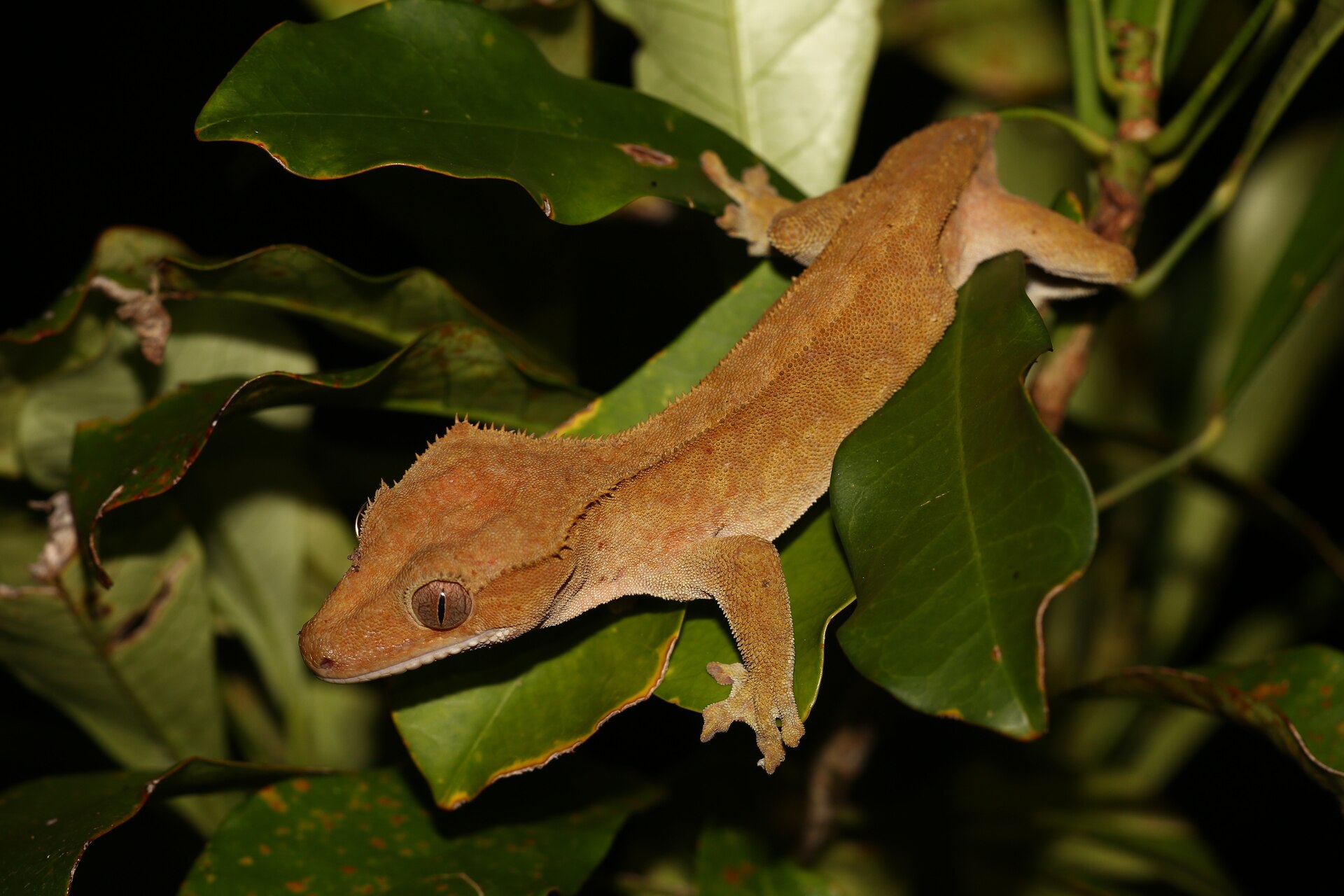
- They are named for the eyelash-like crests on their heads.
- A lost tail does not grow back.
Stories
- The species was believed extinct until populations were rediscovered in the 1990s, with ReptiFiles describing a 1994 tropical storm as revealing that surviving populations were still present.
From the sources
From the sources
Quoted from the matching sections of reputable sources for this exact species. Specialist databases are used first; Wikipedia (community-edited, CC BY-SA 4.0) only fills gaps. Other sources are short credited quotes.
| Overview | The crested gecko (Correlophus ciliatus), also known commonly as the eyelash gecko, is a species of lizard in the family Diplodactylidae. The species is native to southern New Caledonia. Originally described in 1866 by French zoologist Alphonse Guichenot, the species was thought to be extinct until it was rediscovered in 1994 during an expedition led by German herpetologist Robert Seipp. Along with several other New Caledonian gecko species, it is being considered for protected status by the Convention on the International Trade in Endangered Species of Wild Flora and Fauna. — Wikipedia (community-edited) |
| Where it lives | The crested gecko is endemic to South Province, New Caledonia. There are three disjunct populations: one on the Isle of Pines and surrounding islets, and two on the main island of Grande Terre. On Grande Terre, one population is around the Blue River protected provincial park, and the other is farther north, just south of Mount Dzumac. — Wikipedia (community-edited) |
| Wild diet | The crested gecko is an omnivore and will opportunistically feed on fruit, nectar, pollen, and a variety of insects. — Wikipedia (community-edited) |
| Behavior | The crested gecko is a mostly arboreal species, preferring to inhabit the lower canopy and understory of the New Caledonia rainforests. It is able to jump long distances between branches to move to new locations. It is nocturnal and will generally spend the daylight hours sleeping in secure spots in high branches. — Wikipedia (community-edited) |
| Reproduction | Little is known about the wild reproductive behavior of the crested gecko. Available information has been obtained from captive animals. Females generally lay two eggs per clutch, which hatch 60–150 days after they are laid. — Wikipedia (community-edited) |
| Appearance and size | Correlophus may be distinguished from all other New Caledonian diplodactylid geckos by the following combination of character states: body large (to 135 mm SVL); head large; tail approximately 80–92% of SVL; dorsal scalation granular, homogeneous or mostly so; extensive skin folds lacking, but small ventrolateral folds and folds on the posterior margins of the limbs present in some species; a pair of crests comprised of enlarged triangular scales extending from behind orbits and onto body dorsum, or pale markings delimiting the equivalent area; expanded undivided subdigital lamellae under all toes; webbing between digits weakly to moderately developed; claw of digit I of manus and pes positioned lateral to a single, undivided apical lamella; precloacal pores in two to three rows in males (40–60 pores in total), extending on to basal 40% of thighs; dorsal color pattern brown, olive, yellowish, reddish, or orangey usually with or without contrasting markings on the crown, vertebral area or on flanks; venter beige to color of dorsum. — The Reptile Database |
| History and naming | Named after Latin cilium = eyelash, referring to shape of the scales above the eye and along the dorsal side of the body. — The Reptile Database |
| Conservation | The crested gecko was believed to be extinct prior to rediscovery in 1994. The species is currently being assessed for CITES protection and vulnerable status. The biggest single threat to the wild population appears to be the introduction of the little fire ant (Wassmania auropunctata) to New Caledonia. — Wikipedia (community-edited) |
Data and studies
Researched care notes
Researched care notes
Findings checked against veterinary, zoo, welfare, keeper and peer-reviewed sources. Air, basking-surface and water temperatures are kept separate, and where sources disagree both are shown. “Study” notes report what a paper measured, not a universal rule.
Crested Gecko (species)
- RSPCA gives 26–28°C warm-zone, 20–24°C coolest-area, and 18–20°C night temperatures.1
- ReptiFiles gives a 28–29°C top basking area, 21–24°C cool bottom, and 18–22°C night range. These describe a vertical gradient.2
- Both sources describe misting peaks followed by drying toward 40–50% RH rather than continuous saturation.1
- RSPCA publishes a tall adult minimum of 45 × 45 × 60 cm, width × depth × height, with ventilation.1
- RSPCA treats formulated gecko diet as supplementary and proposes separate weeks rotating fruit, insects, and formulated food. This is disputed guidance and is not the adopted diet model. Confidence: LOW.1
- The DVM-authored PetMD guide recommends nutritionally complete crested-gecko powder as the dietary base, with prepared insects and occasional fruit.3
- ReptiFiles also supports suitable complete prepared gecko diets, with insects and small occasional fruit portions.4
- Remove uneaten wet food and maintain fresh drinking water.1
The numbers
The numbers
Each bar is what one source reports. Where several sources weigh in, the dashed gold band marks their average.
Temperature
Avoid long stretches in the 80s.
Humidity
Incubation
Night temperature
Species-specific values from keeper care sheets. Basking figures are often surface readings taken with an infrared thermometer, which run hotter than air.
Care articles for this species
Care articles for this species
- Crested Gecko Care Sheet (Reptiles Magazine)
- Crested Gecko Care Manual (ReptiFiles)
- How To Build A Bioactive Enclosure For Your Crested Gecko (Reptiles Magazine)
- Crested Gecko Care And Information (Reptiles Magazine)
- Keeping And Breeding Crested Geckos (Reptiles Magazine)
- Crested Gecko Care (Reptiles Magazine)
Veterinary & husbandry research
Veterinary & husbandry research
- Thermoregulation and thermal performance of crested geckos (Correlophus ciliatus) suggest an extended optimality hypothesis for the evolution of thermoregulatory set-points Aparicio Ramirez A et al., Journal of experimental zoology. Part A, Ecological and integrative physiology 2021
- High-quality genome assembly and annotation of the crested gecko (Correlophus ciliatus) Huang R et al., G3 (Bethesda, Md.) 2025
- Infection of Hexametra angusticaecoides Chabaud & Brygoo, 1960 (Nematoda: Ascarididae) in a population of captive crested geckoes, Correlophus ciliatus Guichenot (Reptilia: Diplodactylidae) Barton DP et al., Parasitology 2020
- Reaction to Novel Objects and Fecal Glucocorticoid Metabolite Levels in Two Species of Nocturnal Geckos Fernández-Lázaro G et al., Animals: an open access journal from MDPI 2023
Peer-reviewed papers that mention this species alongside captivity, zoos, veterinary care or aquaculture. Some cover several species or mention it only in passing, so check the abstract. 170
Sources for this sheet
- Royal Veterinary College Exotics Service: Crested gecko care Zoo, university or veterinaryVet-school exotics hospital factsheet, reviewed 2021–2024.
- ReptiFiles: Crested gecko care Experienced keeper or breederWell-researched care guide.
- Clint's Reptiles (YouTube): Crested Gecko, The Best Pet Reptile? Expert educator & keeperClint Laidlaw, PhD in Biology Education and MS in Evolutionary Ecology; owner of Clint's Reptile Room and a longtime keeper. Rates each species on handleability, care, hardiness, availability and upfront cost.
- Myhrvold et al. (2015). An amniote life-history database. Ecology 96: 3109 Peer-reviewed researchPeer-reviewed compilation of life-history data for over 21,000 birds, mammals and reptiles.
- Reptiles Magazine (care articles) Experienced keeper or breederEstablished reptile and amphibian hobby magazine; care articles are written by breeders, keepers and veterinarians.
- Merck Veterinary Manual: Management and husbandry of reptiles Zoo, university or veterinaryThe Merck Veterinary Manual: a standard veterinary reference written and reviewed by veterinary specialists.
- Merck Veterinary Manual: Nutritional, metabolic and endocrine diseases of reptiles Zoo, university or veterinaryThe Merck Veterinary Manual: a standard veterinary reference written and reviewed by veterinary specialists.
- ReptiFiles: Crested gecko lighting, heating and humidity Experienced keeper or breederAdded in the 2026 source-checked care-guide review.
- ReptiFiles: Crested gecko terrarium size and cohabitation Experienced keeper or breederAdded in the 2026 source-checked care-guide review.
- Clint's Reptiles (YouTube): Crested Gecko, The Best Pet Reptile? Expert educator & keeperClint Laidlaw, PhD in Biology Education and MS in Evolutionary Ecology; owner of Clint's Reptile Room and a longtime keeper. His "Best Pet?" series reviews each species' care in depth.
- The Reptile Database Peer-reviewed researchScientist-curated catalog of every reptile species, with taxonomy and literature.
- GBIF Backbone Taxonomy (Global Biodiversity Information Facility) Peer-reviewed researchInternational scientific taxonomy used here for classification.
- Species+ (UNEP-WCMC and the CITES Secretariat) Zoo, university or veterinaryThe official database of species listed under CITES.
- Wikipedia (species article) Community referenceFree encyclopedia; useful overviews with their own citations. Intro text is quoted under CC BY-SA 4.0.
- PubMed (U.S. National Library of Medicine) Peer-reviewed researchIndex of peer-reviewed veterinary, zoo and husbandry research.
- iNaturalist (captive observations) Community referenceCommunity observation platform run by the California Academy of Sciences and National Geographic; observations marked captive show animals living in homes, zoos and aquariums.
- ReptiFiles (care guides) Experienced keeper or breederWell-researched reptile care guides that cite herpetological literature and experienced keepers.