
Home / Reptiles / Lizards / Diplodactylidae / Crested gecko
No federal permit to keepCrested gecko
Correlophus ciliatus
Reptiles › Lizards (Lacertilia) › Diplodactylidae (Crested and related geckos)
Crested geckos are easygoing tree geckos that eat a fruit-based diet and need only a mild warm spot; overheating is the main risk.
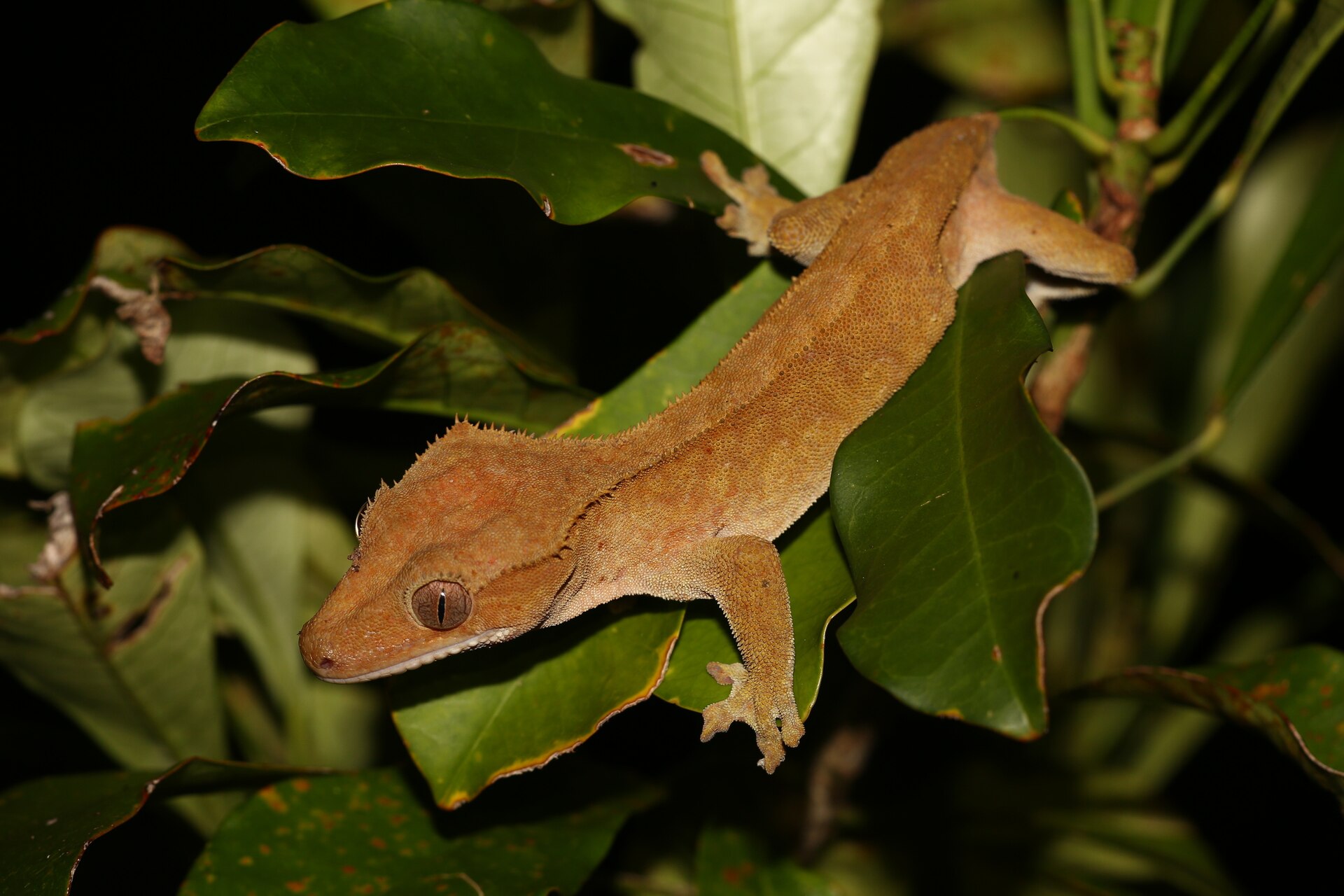
Care at a glance
Species-specific values
Values researched for this exact species. Air, surface and water temperatures are listed separately, and each source is kept as published rather than averaged.
| Basking zone temperature | 82–85 °F | reptifiles.com |
| Cool zone temperature | 70–75 °F | reptifiles.com |
| Air temperature night | 65–72 °F | reptifiles.com |
| Humidity after misting | 60–80 % RH | reptifiles.com |
| Humidity before remisting | 40–50 % RH | reptifiles.com |
| UV index basking | 1–2 UVI | reptifiles.com |
| Enclosure minimum | length: 18 in; width: 18 in; height: 36 in Source baseline for geckos over 12 g | reptifiles.com |
| Social | Single housing is the source preference. | reptifiles.com |
Care guide
Enclosure
- Tall vivarium, at least 18×18×24 in, with climbing branches and plants.
Sources rvc.ac.uk
Diet
- Mostly a commercial fruit-based diet with occasional insects.
Sources reptifiles.com
Understanding the animal
In the wild
In the wild
Researched for this exact species, not its family. Wild conditions are context, not enclosure settings.1234
| Where it lives | Forests of southern Grande Terre and the Isle of Pines, New Caledonia. It rests in dense low vegetation and forages in shrubs and lower canopy branches at night. |
| Ground it lives on | Mostly arboreal in low vegetation; also uses cover close to the forest floor. |
| Climate | The species account reports regional temperatures of about 52–82°F, commonly 72–75°F, in rainy forest habitat. These are regional climate values, not measured enclosure targets; numeric wild relative humidity was not supplied. |
| Active | Nocturnal. |
| Social life | Usually solitary; wild territorial boundaries are poorly documented. |
| Wild diet | Insects, fruit and nectar. |
| Behavior to plan for | A defensively dropped tail does not regrow. |
Native climate (measured)
Native climate (measured)
| Warm-season highs | about 83°F (up to 89°F in the hottest sampled areas) |
| Cool-season lows | about 50°F (down to 39°F in the coldest sampled areas) |
| Average temperature | 60–71°F across sampled records |
| Relative humidity | 62–80% on average (driest month about 62%) |
| Rainfall | about 1050 mm a year |
Measured at 6 wild occurrence records sampled against WorldClim 2.1 climate data (1970–2000 averages). Air conditions in the range are ecological context, not enclosure settings: microhabitats such as burrows, leaf litter or basking rocks can be cooler, warmer or more humid.
Profile
Profile
Researched for this exact species. Sources are listed under In the wild above.
History
Crested geckos were thought to be extinct before being rediscovered in the 1990s; one provided source specifically describes their rediscovery in 1994 after a tropical storm. Since then they have become one of the most widely bred and common geckos in the pet trade.
Data and studies
Researched care notes
Researched care notes
Findings checked against veterinary, zoo, welfare, keeper and peer-reviewed sources. Air, basking-surface and water temperatures are kept separate, and where sources disagree both are shown. “Study” notes report what a paper measured, not a universal rule.
Crested Gecko (species)
- RSPCA gives 26–28°C warm-zone, 20–24°C coolest-area, and 18–20°C night temperatures.1
- ReptiFiles gives a 28–29°C top basking area, 21–24°C cool bottom, and 18–22°C night range. These describe a vertical gradient.2
- Both sources describe misting peaks followed by drying toward 40–50% RH rather than continuous saturation.1
- RSPCA publishes a tall adult minimum of 45 × 45 × 60 cm, width × depth × height, with ventilation.1
- RSPCA treats formulated gecko diet as supplementary and proposes separate weeks rotating fruit, insects, and formulated food. This is disputed guidance and is not the adopted diet model. Confidence: LOW.1
- The DVM-authored PetMD guide recommends nutritionally complete crested-gecko powder as the dietary base, with prepared insects and occasional fruit.3
- ReptiFiles also supports suitable complete prepared gecko diets, with insects and small occasional fruit portions.4
- Remove uneaten wet food and maintain fresh drinking water.1
The numbers
The numbers
Each bar is what one source reports. Where several sources weigh in, the dashed gold band marks their average.
Temperature
Avoid long stretches in the 80s.
Humidity
Incubation
Night temperature
Species-specific values from keeper care sheets. Basking figures are often surface readings taken with an infrared thermometer, which run hotter than air.
Care articles for this species
Care articles for this species
- Crested Gecko Care Sheet (Reptiles Magazine)
- Crested Gecko Care Manual (ReptiFiles)
- How To Build A Bioactive Enclosure For Your Crested Gecko (Reptiles Magazine)
- Crested Gecko Care And Information (Reptiles Magazine)
- Keeping And Breeding Crested Geckos (Reptiles Magazine)
- Crested Gecko Care (Reptiles Magazine)
Written by keepers, breeders and vets Reptiles MagazineReptiFiles
Veterinary & husbandry research
Veterinary & husbandry research
- Thermoregulation and thermal performance of crested geckos (Correlophus ciliatus) suggest an extended optimality hypothesis for the evolution of thermoregulatory set-points Aparicio Ramirez A et al., Journal of experimental zoology. Part A, Ecological and integrative physiology 2021
- High-quality genome assembly and annotation of the crested gecko (Correlophus ciliatus) Huang R et al., G3 (Bethesda, Md.) 2025
- Infection of Hexametra angusticaecoides Chabaud & Brygoo, 1960 (Nematoda: Ascarididae) in a population of captive crested geckoes, Correlophus ciliatus Guichenot (Reptilia: Diplodactylidae) Barton DP et al., Parasitology 2020
Peer-reviewed papers that mention this species alongside captivity, zoos, veterinary care or aquaculture. Some cover several species or mention it only in passing, so check the abstract. See all 4 on PubMed → PubMed
Sources for this sheet
- Royal Veterinary College Exotics Service: Crested gecko care Zoo, university or veterinaryVet-school exotics hospital factsheet, reviewed 2021–2024.
- ReptiFiles: Crested gecko care Experienced keeper or breederWell-researched care guide.
- Clint's Reptiles (YouTube): Crested Gecko, The Best Pet Reptile? Expert educator & keeperClint Laidlaw, PhD in Biology Education and MS in Evolutionary Ecology; owner of Clint's Reptile Room and a longtime keeper. His "Best Pet?" series reviews each species' care in depth.
- Myhrvold et al. (2015). An amniote life-history database. Ecology 96: 3109 Peer-reviewed researchPeer-reviewed compilation of life-history data for over 21,000 birds, mammals and reptiles.
- Reptiles Magazine (care articles) Experienced keeper or breederEstablished reptile and amphibian hobby magazine; care articles are written by breeders, keepers and veterinarians.
- Clint's Reptiles (YouTube): Crested Gecko, The Best Pet Reptile? Expert educator & keeperClint Laidlaw, PhD in Biology Education and MS in Evolutionary Ecology; owner of Clint's Reptile Room and a longtime keeper. His "Best Pet?" series reviews each species' care in depth.
- The Reptile Database Peer-reviewed researchScientist-curated catalog of every reptile species, with taxonomy and literature.
- GBIF Backbone Taxonomy (Global Biodiversity Information Facility) (CC BY 4.0) Peer-reviewed researchInternational scientific taxonomy used here for classification. GBIF Secretariat (2023). GBIF Backbone Taxonomy. Checklist dataset https://doi.org/10.15468/39omei, accessed via GBIF.org.
- Species+ (UNEP-WCMC and the CITES Secretariat) Zoo, university or veterinaryThe official database of species listed under CITES. UNEP (2026). The Species+ Website. Nairobi, Kenya. Compiled by UNEP-WCMC, Cambridge, UK. Available at: www.speciesplus.net. [Accessed 04/10/2026].
- Wikipedia (species article) (CC BY-SA 4.0) Community referenceFree encyclopedia; useful overviews with their own citations. Short excerpts are quoted under CC BY-SA 4.0, each credited with a link to its article.
- PubMed (U.S. National Library of Medicine) Peer-reviewed researchIndex of peer-reviewed veterinary, zoo and husbandry research.
- iNaturalist (captive observations) Community referenceCommunity observation platform run by the California Academy of Sciences and National Geographic; observations marked captive show animals living in homes, zoos and aquariums.
- ReptiFiles (care guides) Experienced keeper or breederWell-researched reptile care guides that cite herpetological literature and experienced keepers.
More crested and related geckos

Bauer's chameleon gecko
Eurydactylodes agricolae
Pet trade

Chahoua gecko
Mniarogekko chahoua
Pet trade
Dotted Velvet Gecko
Oedura gemmata
Pet trade

Gargoyle gecko
Rhacodactylus auriculatus
Pet trade

Golden-tailed gecko
Strophurus taenicauda
Pet trade

Helmeted Gecko
Diplodactylus galeatus
Pet trade