Home / Invertebrates / Praying mantises / Dead leaf mantis
No federal permit to keepDead leaf mantis
Deroplatys desiccata
Invertebrates › Praying mantises (Mantodea) › Deroplatyidae (Dead leaf mantises)
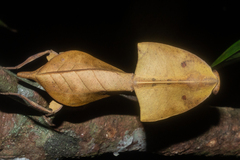
Deroplatys desiccata, known by the common name giant dead leaf mantis, is a praying mantis from Southeast Asia.
From Wikipedia: Deroplatys desiccata, CC BY-SA 4.0 (excerpt)

Care at a glance
Species-specific values
Values researched for this exact species. Air, surface and water temperatures are listed separately, and each source is kept as published rather than averaged.
| Minimum enclosure | Terrarium should be at least 200 mm long and 300 mm high. Source: reptilecentre.com | |
| Warm side air temperature | 73–80 °F Source: reptilecentre.com | |
| Humidity | Allow at least 2 inches to retain enough water after morning spraying. Source: reptilecentre.com | |
| Substrate | The recommended substrate is a soil mix called Spider Life. Source: reptilecentre.com | |
| Diet | Live insects; brown crickets are readily accepted. Source: reptilecentre.com | |
| Feeding frequency | Feed 1 or 2 appropriately sized crickets every other day when small. Source: reptilecentre.com | |
| Enclosure temperature | 75–86 °F Source: appalachiantarantulas.com | |
| Humidity | 60–80 % Source: appalachiantarantulas.com | |
| Minimum enclosure | Adult enclosure is 8x8x12 inches and tall. Source: appalachiantarantulas.com | |
| Substrate | Use coco fiber, misting daily; substrate depth is 1–2 inches. Source: appalachiantarantulas.com | |
| Feeding frequency | Adults should be fed every 2–3 days. Source: appalachiantarantulas.com |
Understanding the animal
About this animal
About this animal
This is the type species of genus Deroplatys.
From Wikipedia: Deroplatys desiccata, CC BY-SA 4.0 (excerpt)
In the wild
In the wild
| Overview | Deroplatys desiccata, known by the common name giant dead leaf mantis, is a praying mantis from Southeast Asia. This is the type species of genus Deroplatys. — From Wikipedia: Deroplatys desiccata, CC BY-SA 4.0 (excerpt) |
| Appearance and size | D. desiccata takes its common name from its resemblance to dead, leafy vegetation including having a flattened, greatly extended thorax and "intricate leaf patterns" on its wings. This insect varies in color from mottled brown through "pale orangey brown" to a very dark brown that is almost black. This creature's camouflage is aided by its movements as well as its appearance. — From Wikipedia: Deroplatys desiccata, CC BY-SA 4.0 (excerpt) |
Native climate (measured)
Native climate (measured)
| Warm-season highs | about 84°F (up to 89°F in the hottest sampled areas) |
| Cool-season lows | about 68°F (down to 58°F in the coldest sampled areas) |
| Average temperature | 68–80°F across sampled records |
| Relative humidity | 82–86% on average (driest month about 81%) |
| Rainfall | about 2392 mm a year, spread fairly evenly |
Measured at 92 wild occurrence records sampled against WorldClim 2.1 climate data (1970–2000 averages). Air conditions in the range are ecological context, not enclosure settings: microhabitats such as burrows, leaf litter or basking rocks can be cooler, warmer or more humid.
Sources for this sheet
- GBIF Backbone Taxonomy (Global Biodiversity Information Facility) (CC BY 4.0) Peer-reviewed researchInternational scientific taxonomy used here for classification. GBIF Secretariat (2023). GBIF Backbone Taxonomy. Checklist dataset https://doi.org/10.15468/39omei, accessed via GBIF.org.
- Wikipedia (species article) (CC BY-SA 4.0) Community referenceFree encyclopedia; useful overviews with their own citations. Short excerpts are quoted under CC BY-SA 4.0, each credited with a link to its article.
- iNaturalist (captive observations) Community referenceCommunity observation platform run by the California Academy of Sciences and National Geographic; observations marked captive show animals living in homes, zoos and aquariums.