
Home / Reptiles / Lizards / Phrynosomatidae / Desert spiny lizard
No federal permit to keepDesert spiny lizard
Sceloporus magister
Reptiles › Lizards (Lacertilia) › Phrynosomatidae (Spiny and horned lizards)
Sceloporus magister, also known as the desert spiny lizard, is a lizard species of the family Phrynosomatidae, native to the Chihuahuan Desert and Sonoran Desert of North America.
From Wikipedia: Sceloporus magister, CC BY-SA 4.0 (excerpt)

Care at a glance
Species-specific values
Values researched for this exact species. Air, surface and water temperatures are listed separately, and each source is kept as published rather than averaged.
| Feeding frequency | Feed babies and adults daily; some keepers feed adults every other day. Source: thetyedyediguana.com | |
| Minimum enclosure | An adult's minimum cage size is 30 inches long × 12 inches deep × 12 inches high. Source: thetyedyediguana.com | |
| Substrate | Ground walnut shell, sand, or cage carpet work well; the shop prefers walnut. Source: thetyedyediguana.com | |
| Basking surface temperature | 95–100 °F Source: thetyedyediguana.com | |
| Cool side air temperature | at least 70 °F Source: thetyedyediguana.com | |
| Humidity | 30–50 % Source: thetyedyediguana.com | |
| Uvb lighting | As a diurnal species, it requires a heat lamp that emits UVA and a UVB lamp. Source: thetyedyediguana.com | |
| Diet | Strict insectivore; offer small crickets, mealworms, waxworms, and cockroach nymphs. Source: thetyedyediguana.com | |
| Social housing | May be kept alone or in pairs; do not house two males together. Source: thetyedyediguana.com |
Understanding the animal
In the wild
In the wild
| Overview | Sceloporus magister, also known as the desert spiny lizard, is a lizard species of the family Phrynosomatidae, native to the Chihuahuan Desert and Sonoran Desert of North America. — From Wikipedia: Sceloporus magister, CC BY-SA 4.0 (excerpt) |
| Where it lives | Biotic communities including Sonoran Desertscrub, Great Basin Desertscrub, Semidesert Grassland, Interior Chaparral, and woodlands are home to this lizard. It is usually encountered on lower slopes, bajadas, plains, and low valleys, often in the branches of trees or in the vicinity of ground cover such as wood piles, rock piles, and pack rat nests. — From Wikipedia: Sceloporus magister, CC BY-SA 4.0 (excerpt) |
| Wild diet | The desert spiny lizard feeds on a variety of insects including ants, beetles, and caterpillars. It also feeds on spiders, centipedes, and small lizards. — From Wikipedia: Sceloporus magister, CC BY-SA 4.0 (excerpt) |
| Behavior | Like many desert lizards, desert spiny lizards adjust their internal temperature by changing color so they are darker during cool times, which allows them to absorb more heat from the sun, and become lighter during warm times so they reflect more solar radiation. The desert spiny lizard also uses camouflage so it is not so easily seen by predators. — From Wikipedia: Sceloporus magister, CC BY-SA 4.0 (excerpt) |
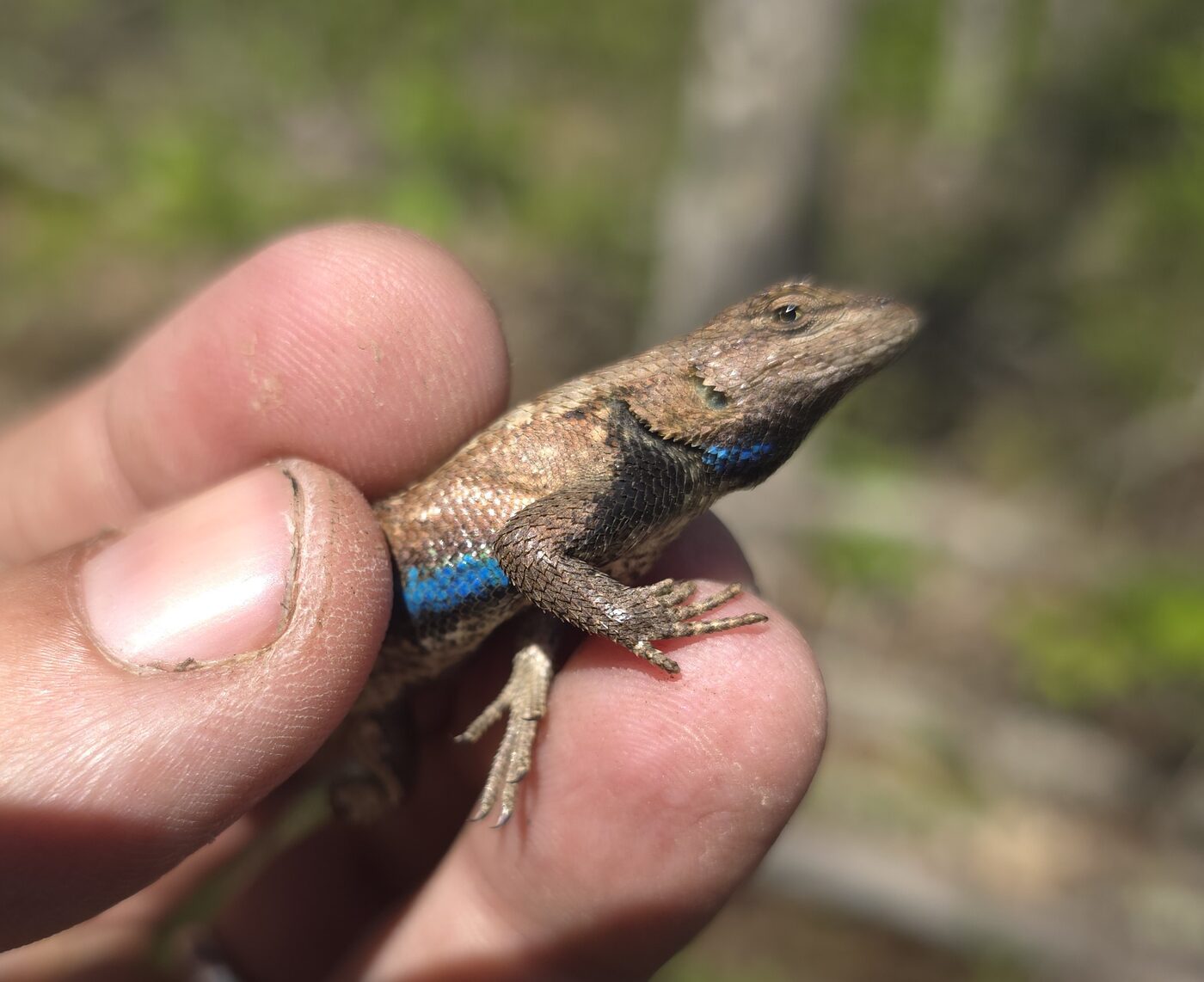
| Appearance and size | An adult male desert spiny lizard usually have conspicuous blue/violet patches on the belly and throat, and a green/blue color on their tails and sides. Females and juveniles have large combined dark spots on their back and belly areas, and the blue/violet and green/blue coloring is absent. Both sexes have brownish/yellow triangular spots on their shoulders. — From Wikipedia: Sceloporus magister, CC BY-SA 4.0 (excerpt) |
Read about this species in the wild at The Reptile Database.
Native climate (measured)
Native climate (measured)
| Warm-season highs | about 100°F (up to 105°F in the hottest sampled areas) |
| Cool-season lows | about 38°F (down to 30°F in the coldest sampled areas) |
| Average temperature | 60–72°F across sampled records |
| Relative humidity | 33–36% on average (driest month about 21%) |
| Rainfall | about 298 mm a year |
| Winters | Cool to cold winters (lows around 38°F) in much of its native range. Seasonal slowdown may be relevant, but species-specific biology determines whether brumation or hibernation occurs. |
Measured at 115 wild occurrence records sampled against WorldClim 2.1 climate data (1970–2000 averages). Air conditions in the range are ecological context, not enclosure settings: microhabitats such as burrows, leaf litter or basking rocks can be cooler, warmer or more humid.
Profile
Profile
Researched for this exact species. Sources are listed under In the wild above.
Data and studies
The numbers
The numbers
Each bar is what one source reports. Where several sources weigh in, the dashed gold band marks their average.
Maximum recorded lifespan
Longest recorded lifespan reported by each database; typical lifespans are usually shorter. The AnAge record comes from an animal in human care.
Typical adult weight
Average adult body mass in each database (FishBase gives the maximum recorded weight).
Adult snout-to-vent length
Body length without the tail.
Incubation
Sources for this sheet
- AnAge: The Animal Ageing and Longevity Database (Human Ageing Genomic Resources) (CC BY 3.0) Peer-reviewed researchCurated, referenced longevity and life-history records for thousands of species; maximum lifespans are often from zoo animals.
- Myhrvold et al. (2015). An amniote life-history database. Ecology 96: 3109 Peer-reviewed researchPeer-reviewed compilation of life-history data for over 21,000 birds, mammals and reptiles.
- The Reptile Database Peer-reviewed researchScientist-curated catalog of every reptile species, with taxonomy and literature.
- GBIF Backbone Taxonomy (Global Biodiversity Information Facility) (CC BY 4.0) Peer-reviewed researchInternational scientific taxonomy used here for classification. GBIF Secretariat (2023). GBIF Backbone Taxonomy. Checklist dataset https://doi.org/10.15468/39omei, accessed via GBIF.org.
- Wikipedia (species article) (CC BY-SA 4.0) Community referenceFree encyclopedia; useful overviews with their own citations. Short excerpts are quoted under CC BY-SA 4.0, each credited with a link to its article.
- iNaturalist (captive observations) Community referenceCommunity observation platform run by the California Academy of Sciences and National Geographic; observations marked captive show animals living in homes, zoos and aquariums.
More spiny and horned lizards

Baja blue rock lizard
Petrosaurus thalassinus
Pet trade

Blue spiny lizard
Sceloporus cyanogenys
Pet trade

Coast horned lizard
Phrynosoma coronatum
Pet trade

Crevice spiny lizard
Sceloporus poinsettii
Zoos & aquariums
Eastern fence lizard
Sceloporus undulatus
Pet trade

Emerald swift
Sceloporus malachiticus
Pet trade