
Home / Invertebrates / Beetles / Eastern Hercules beetle
No federal permit to keepEastern Hercules beetle
Dynastes tityus
Invertebrates › Beetles (Coleoptera) › Scarabaeidae (Scarab and rhinoceros beetles)
Dynastes tityus, the eastern Hercules beetle, is a species of rhinoceros beetle native to the Eastern United States.
From Wikipedia: Dynastes tityus, CC BY-SA 4.0 (excerpt)

Care at a glance
Species-specific values
Values researched for this exact species. Air, surface and water temperatures are listed separately, and each source is kept as published rather than averaged.
| Minimum enclosure | House adult beetles in 3–4 inches of a sphagnum moss and soil blend. Source: uky.edu | |
| Feeding frequency | An occasional orange can be provided to adults. Source: uky.edu | |
| Social housing | Multiple females may share a container with one male; males should be housed separately from one another. Source: uky.edu | |
| Substrate | Adult housing substrate should preferably be a sphagnum moss soil mixture. Source: uky.edu | |
| Substrate | Egg-laying and larval rearing substrate should use potting soil and rotten wood in a 2:1 soil-to-wood ratio. Source: uky.edu | |
| Substrate | Keep the egg-laying and rearing substrate moist to the touch. Source: uky.edu | |
| Seasonal cooling | 40 °F Source: uky.edu | |
| Humidity | 65–75 % Source: scuttleandsqueak.com | |
| Diet | Larvae need fermented hardwood flake soil; adults eat beetle jelly and ripe fruit. Source: scuttleandsqueak.com | |
| Feeding frequency | Replace adult food daily. Source: scuttleandsqueak.com | |
| Social housing | Males may be housed together if space allows, though sparring may occur. Source: scuttleandsqueak.com | |
| Substrate | Use 10 cm coconut fibre for adult enclosures. Source: scuttleandsqueak.com |
Understanding the animal
About this animal
About this animal
The adult's elytra are green, gray or tan, with black markings, and the whole animal, including the male's horns, may reach 60 mm (2.4 in) in length. The larvae feed on decaying wood from various trees.
From Wikipedia: Dynastes tityus, CC BY-SA 4.0 (excerpt)
In the wild
In the wild
| Overview | Dynastes tityus, the eastern Hercules beetle, is a species of rhinoceros beetle native to the Eastern United States. The adult's elytra are green, gray or tan, with black markings, and the whole animal, including the male's horns, may reach 60 mm in length. The larvae feed on decaying wood from various trees. — From Wikipedia: Dynastes tityus, CC BY-SA 4.0 (excerpt) |
| Where it lives | The genus Dynastes is theorized to originate in South America. The North American lineage appeared after the closure of the Panama Isthmus 3.5 million years ago. This lineage has been further dispersed by the Transverse Volcanic Belt and the Sierra Madre del Sur into eastern and western species in North America. — From Wikipedia: Dynastes tityus, CC BY-SA 4.0 (excerpt) |
| Appearance and size | Adults of both sexes are 20–27 mm wide, and males are 40–60 mm long, including a long horn (the pronotal horn) which projects forwards from the thorax of the male; a second horn (the clypeal horn) projects upwards from the head. Dynastes tityus is therefore "among the longest and heaviest beetles in the United States". — From Wikipedia: Dynastes tityus, CC BY-SA 4.0 (excerpt) |
| History and naming | Dynastes tityus is known by a number of common names, including eastern Hercules beetle, elephant beetle and ox beetle. It was first given a scientific name by Carl Linnaeus, in his 1763 work Centuria Insectorum, where it was called Scarabaeus tityus; when Linnaeus' genus Scarabaeus was divided into smaller genera, S. tityus was renamed Dynastes tityus. — From Wikipedia: Dynastes tityus, CC BY-SA 4.0 (excerpt) |
Native climate (measured)
Native climate (measured)
| Warm-season highs | about 90°F (up to 95°F in the hottest sampled areas) |
| Cool-season lows | about 32°F (down to 25°F in the coldest sampled areas) |
| Average temperature | 56–68°F across sampled records |
| Relative humidity | 66–70% on average (driest month about 61%) |
| Rainfall | about 1202 mm a year, spread fairly evenly |
| Winters | Cool to cold winters (lows around 32°F) in much of its native range. Seasonal slowdown may be relevant, but species-specific biology determines whether brumation or hibernation occurs. |
Measured at 123 wild occurrence records sampled against WorldClim 2.1 climate data (1970–2000 averages). Air conditions in the range are ecological context, not enclosure settings: microhabitats such as burrows, leaf litter or basking rocks can be cooler, warmer or more humid.
Profile
Profile
Researched for this exact species. Sources are listed under In the wild above.
History
Dynastes tityus is known by a number of common names, including eastern Hercules beetle, elephant beetle and ox beetle. It was first given a scientific name by Carl Linnaeus, in his 1763 work Centuria Insectorum, where it was called Scarabaeus tityus; when Linnaeus' genus Scarabaeus was divided into smaller genera, S. tityus was renamed Dynastes tityus.
From Wikipedia: Dynastes tityus, CC BY-SA 4.0 (excerpt)
Sources for this sheet
- GBIF Backbone Taxonomy (Global Biodiversity Information Facility) (CC BY 4.0) Peer-reviewed researchInternational scientific taxonomy used here for classification. GBIF Secretariat (2023). GBIF Backbone Taxonomy. Checklist dataset https://doi.org/10.15468/39omei, accessed via GBIF.org.
- Wikipedia (species article) (CC BY-SA 4.0) Community referenceFree encyclopedia; useful overviews with their own citations. Short excerpts are quoted under CC BY-SA 4.0, each credited with a link to its article.
- iNaturalist (captive observations) Community referenceCommunity observation platform run by the California Academy of Sciences and National Geographic; observations marked captive show animals living in homes, zoos and aquariums.
More scarab and rhinoceros beetles
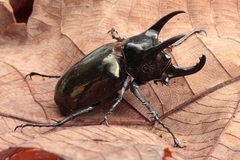
Chiron Beetle
Chalcosoma chiron
Pet trade
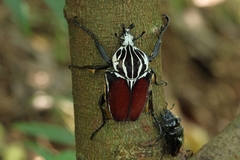
Goliath beetle
Goliathus goliatus
Pet trade

Hercules beetle
Dynastes hercules
Pet trade

Japanese rhinoceros beetle
Trypoxylus dichotomus
Pet trade

Megasoma mars
Megasoma mars
Pet trade

Neptune Beetle
Dynastes neptunus
Pet trade