
Home / Reptiles / Turtles and tortoises / Florida box turtle
Some federal rules applyFlorida box turtle
Terrapene bauri
Reptiles › Turtles and tortoises (Testudines) › Emydidae (Pond turtles and box turtles)
The Florida box turtle (Terrapene carolina bauri) is a subspecies of turtle belonging to the family Emydidae and is one of six extant subspecies of the common box turtle (T. carolina).
From Wikipedia: Florida box turtle, CC BY-SA 4.0 (excerpt)

Care at a glance
Species-specific values
Values researched for this exact species. Air, surface and water temperatures are listed separately, and each source is kept as published rather than averaged.
| Humidity | 75–85 % Source: boxturtles.com | |
| Warm side air temperature | 75–81 °F (24–27 °C) Source: boxturtles.com | |
| Basking surface temperature | 90–95 °F (32–35 °C) Source: boxturtles.com | |
| Seasonal cooling | Brumation is generally unnecessary; keep warm and feeding year-round. Source: boxturtles.com | |
| Diet | Adults receive a 50/50 animal-plant diet, with extra fruit and fungi. Source: boxturtles.com | |
| Humidity | 80–90 % | boxturtles.com |
| Uvb lighting | Hatchlings need T5 HO UVB from day one. | boxturtles.com |
| Seasonal cooling | Hatchlings should not brumate during their first winter. | boxturtles.com |
| Note: more detail at boxturtles.com. | ||
Understanding the animal
In the wild
In the wild
Researched for this exact species, not its family. Wild conditions are context, not enclosure settings.1234
| Where it lives | The Florida box turtle inhabits peninsular Florida and nearby islands, including wooded hammocks, coastal scrub and dune-associated vegetation. Studies under Terrapene carolina bauri document extensive use of covered ground microhabitats. |
| Ground it lives on | soil, sand and shell-rich ground beneath litter and underbrush |
| Climate | At one Volusia County site, no activity was recorded below 57.2°F (14°C), with greatest activity at 78.8–86°F (26–30°C); these are activity observations, not survival limits. Seasonal rain and flooding affect activity; numerical relative-humidity ranges were not established. |
| Active | Diurnal, with weather-dependent and seasonal activity; a uniform northern-style winter brumation schedule is not supported for all Florida populations. |
| Wild diet | Wild fruits including seagrape and Scaevola berries, along with animal foods; Florida studies characterize it as an omnivore. |
| Behavior to plan for | Spends much time concealed beneath vegetation or buried; coastal populations forage on fruiting shrubs and disperse seeds. |
Profile
Profile
Researched for this exact species. Sources are listed under In the wild above.
History
The subspecific name bauri was given in honor of German herpetologist Georg Baur.
Data and studies
The numbers
The numbers
Each bar is what one source reports. Where several sources weigh in, the dashed gold band marks their average.
Maximum recorded lifespan
Longest recorded lifespan reported by each database; typical lifespans are usually shorter.
Typical adult weight
Average adult body mass in each database (FishBase gives the maximum recorded weight).
Incubation
Female maturity
Daytime air temperature
Species-specific values from keeper care sheets. Basking figures are often surface readings taken with an infrared thermometer, which run hotter than air.
Humidity
Species-specific values from keeper care sheets. Basking figures are often surface readings taken with an infrared thermometer, which run hotter than air.
Care articles for this species
Care articles for this species
- Eastern Box Turtle Care Sheet (ReptiFiles)
- Eastern Box Turtle Care Sheet (Reptiles Magazine)
- Rockalina The Eastern Box Turtle Left On House Floor For 48 Years Getting Care She Needs (Reptiles Magazine)
- Eastern Box Turtle Care (Reptiles Magazine)
Written by keepers, breeders and vets Reptiles MagazineReptiFiles
Sources for this sheet
- AnAge: The Animal Ageing and Longevity Database (Human Ageing Genomic Resources) (CC BY 3.0) Peer-reviewed researchCurated, referenced longevity and life-history records for thousands of species; maximum lifespans are often from zoo animals.
- Myhrvold et al. (2015). An amniote life-history database. Ecology 96: 3109 Peer-reviewed researchPeer-reviewed compilation of life-history data for over 21,000 birds, mammals and reptiles.
- ReptiFiles (care guides) Experienced keeper or breederWell-researched reptile care guides that cite herpetological literature and experienced keepers.
- Species+ (UNEP-WCMC and the CITES Secretariat) Zoo, university or veterinaryThe official database of species listed under CITES. UNEP (2026). The Species+ Website. Nairobi, Kenya. Compiled by UNEP-WCMC, Cambridge, UK. Available at: www.speciesplus.net. [Accessed 04/10/2026].
- USFWS International Affairs: CITES Zoo, university or veterinaryFederal agency that issues CITES permits.
- 21 CFR 1240.62: Turtles under 4 inches (FDA) Zoo, university or veterinaryFederal ban on selling small turtles.
- Clint's Reptiles (YouTube): Box Turtle, The Best Pet Turtle? Expert educator & keeperClint Laidlaw, PhD in Biology Education and MS in Evolutionary Ecology; owner of Clint's Reptile Room and a longtime keeper. His "Best Pet?" series reviews each species' care in depth.
- The Reptile Database Peer-reviewed researchScientist-curated catalog of every reptile species, with taxonomy and literature.
- GBIF Backbone Taxonomy (Global Biodiversity Information Facility) (CC BY 4.0) Peer-reviewed researchInternational scientific taxonomy used here for classification. GBIF Secretariat (2023). GBIF Backbone Taxonomy. Checklist dataset https://doi.org/10.15468/39omei, accessed via GBIF.org.
- Wikipedia (species article) (CC BY-SA 4.0) Community referenceFree encyclopedia; useful overviews with their own citations. Short excerpts are quoted under CC BY-SA 4.0, each credited with a link to its article.
- Reptiles Magazine (care articles) Experienced keeper or breederEstablished reptile and amphibian hobby magazine; care articles are written by breeders, keepers and veterinarians.
More pond turtles and box turtles
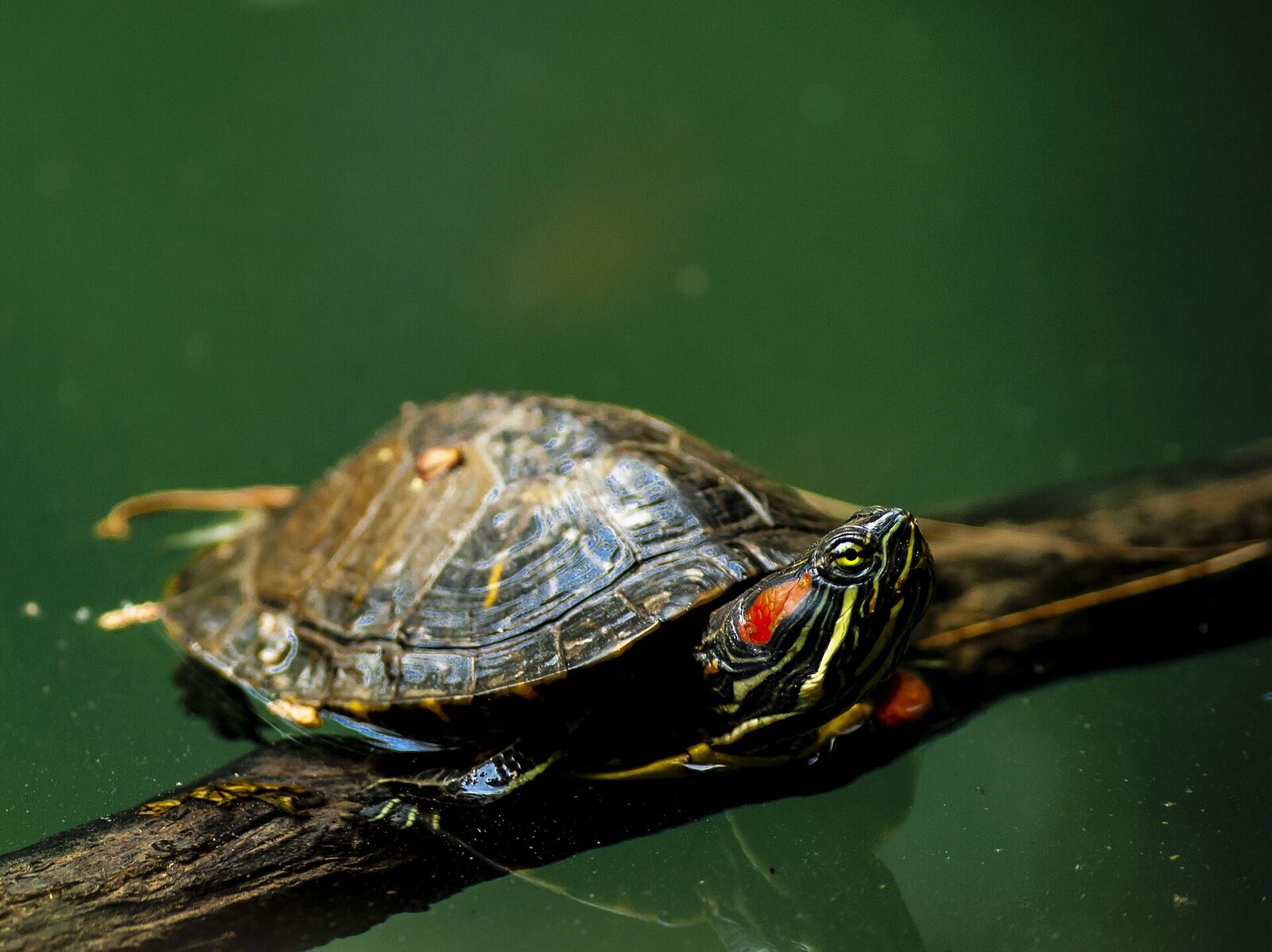
Red-eared slider
Trachemys scripta elegans
America's classic pet turtle, built to last decades.
Pet trade

Alabama map turtle
Graptemys pulchra
Zoos & aquariums

Baja California slider
Trachemys nebulosa
Pet trade

Barbour's map turtle
Graptemys barbouri
Zoos & aquariums

Black-knobbed map turtle
Graptemys nigrinoda
Pet trade

Blanding's turtle
Emydoidea blandingii
Pet trade