Home / Mammals / Rodents / Groundhog (woodchuck)
No federal permit to keep In-depth sheetGroundhog (woodchuck)
Marmota monax
Mammals › Rodents (Rodentia) › Sciuridae (Squirrels and ground squirrels)
Groundhogs are large ground squirrels that dig extensive burrows and are true hibernators across most of their range. They're solitary, active by day, and almost entirely vegetarian.
Care guide
Housing
- Burrowers need deep substrate or secure dig boxes, a den and dig-proof flooring or wire under outdoor pens.
- Separate shelter areas mirror their summer and winter dens.
Sources 12
Diet
- Herbivores: favorite plants include alfalfa, clover and dandelion, plus leaves and occasional insects.
- Feed generously in late summer and fall as they build fat for winter.
Sources 12
Hibernation
- True hibernators in most of the north. Talk to your vet about safe seasonal changes; don't force or prevent torpor without guidance.
Sources 12
Health & vet care
- Rodent incisors grow continuously; provide safe things to gnaw. Groundhog teeth are unusually white.
- Find a vet who sees rodents and wildlife species.
Sources 12
Show the group care guide for squirrels, chipmunks and marmots
Squirrels, chipmunks and marmots
Applies to most species in this group. Habitat: Forests and grasslands. Individual species can differ, so compare with the species numbers above and the linked sources.
Housing & setup
- Large, tall enclosures for tree squirrels; burrowing setups for ground squirrels and marmots.
- Sturdy, chew-proof construction.
Diet
- Rodent blocks, vegetables, nuts in moderation and calcium sources.
Health watch
- Metabolic bone disease on nut-heavy diets; many native squirrels need state permits.
Understanding the animal
In the wild
In the wild
Researched for this exact species, not its family. Good care copies these conditions.1
| Where it lives | Low-elevation woodland edges, fields, pastures and hedgerows across much of eastern and northern North America. Summer burrows are near forage, while winter dens have protective cover. |
| Ground it lives on | Well-drained soil suitable for deep multi-chamber burrows. |
| Climate | Temperate seasonal climates with winter cooling over much of the range; underground hibernation buffers exposure. Temperature and relative-humidity ranges were not found. |
| Active | Diurnal, especially morning and afternoon; true winter hibernation, though some southern populations remain active year-round. |
| Social life | Mostly solitary and territorial; male ranges can overlap female ranges. |
| Wild diet | Mainly clover, alfalfa, dandelion and other vegetation; also bark, leaves and occasional insects or bird eggs. |
| Behavior to plan for | Constructs large burrow systems with multiple entrances and escape holes. Threatened animals bare teeth and give alarm calls. |
What this means for care
- Provide substantial digging space with secure barriers below ground.
- Plan seasonal management around the population’s hibernation ecology.
- Emphasize leafy forage and allow individual retreat space.
Native climate (measured)
Native climate (measured)
| Warm-season highs | about 87°F (up to 90°F in the hottest sampled areas) |
| Cool-season lows | about 23°F (down to 15°F in the coldest sampled areas) |
| Average temperature | 48–59°F across sampled records |
| Relative humidity | 67–71% on average (driest month about 62%) |
| Rainfall | about 1133 mm a year, spread fairly evenly |
| Winters | Cool to cold winters (lows around 23°F) in much of its native range. Seasonal slowdown may be relevant, but species-specific biology determines whether brumation or hibernation occurs. |
Measured at 141 wild occurrence records sampled against WorldClim 2.1 climate data (1970–2000 averages). Air conditions in the range are ecological context, not enclosure settings: microhabitats such as burrows, leaf litter or basking rocks can be cooler, warmer or more humid.
Profile
Profile
Researched for this exact species. Sources are listed under In the wild above.
History
Forest clearing, road construction, and agriculture have increased food access and abundance, allowing the species to thrive in human-modified landscapes.
Keeper tips
- Include well-drained soil that allows digging and den construction.
- Provide both relatively open areas and areas with protective cover.
- Locate at least one denning area near feeding locations, reflecting the placement of summer dens in the wild.
- Provide a protected denning area associated with heavier cover, reflecting the placement of winter dens.
Behaviors reported
- Constructs underground dens.
- Often stands upright on its hind legs.
- Typically uses summer dens near food and winter dens near protective cover.
Unique adaptations
- Rounded ears can cover the external auditory canal and prevent dirt from entering.
- Seasonally different den placement puts summer dens near food resources and winter dens near protective cover.
Remarkable facts
- It is described as the most widespread North American marmot species.
- Adults weigh about 2 to 6 kg and measure 415 to 675 mm in total length.
- Males are larger than females.
- Woodchucks have 22 teeth, and their white teeth are described as unusual for rodents.
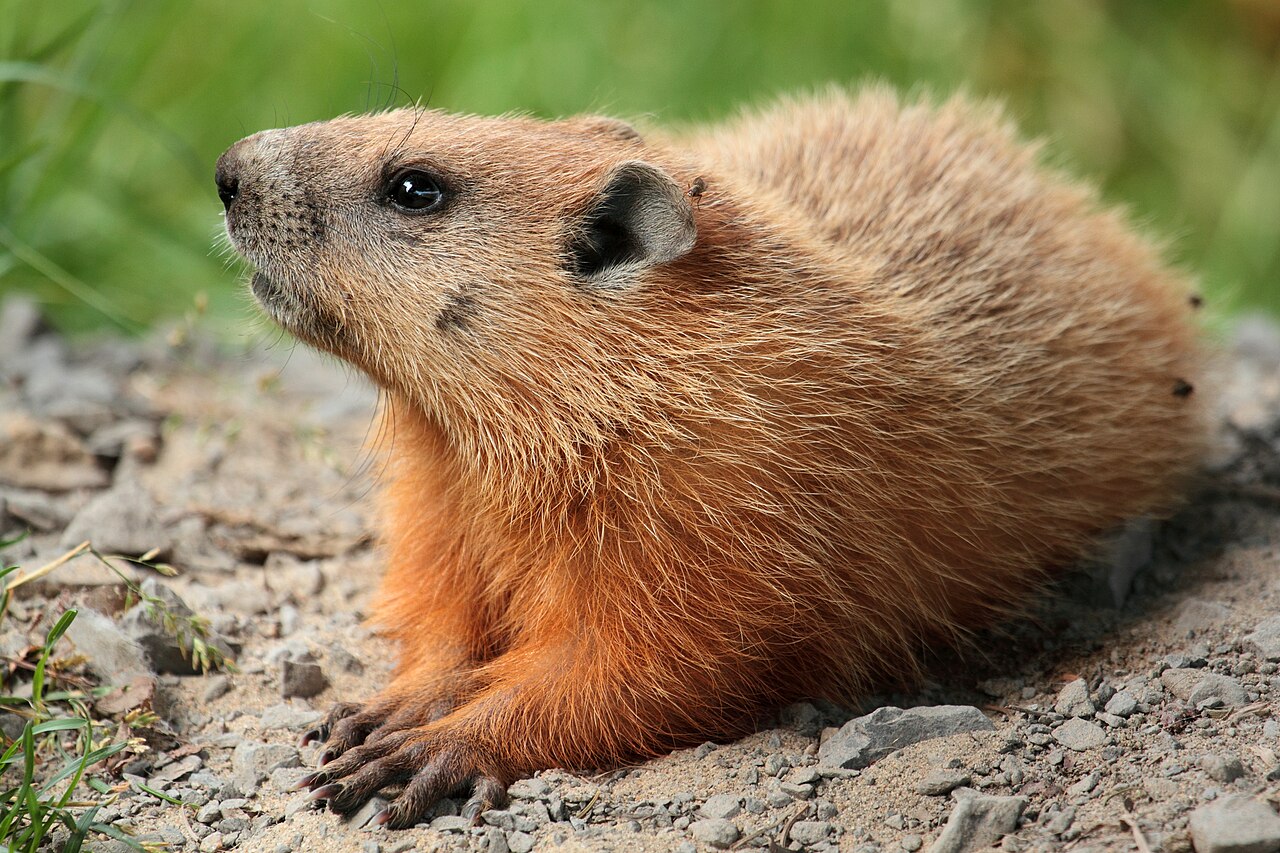
- Their coat can range from gray through cinnamon to dark brown and has white-tipped guard hairs that create a grizzled appearance.
From the sources
From the sources
Quoted from the matching sections of reputable sources for this exact species. Specialist databases are used first; Wikipedia (community-edited, CC BY-SA 4.0) only fills gaps. Other sources are short credited quotes.
| Overview | The groundhog (Marmota monax), also known as the woodchuck, is a rodent of the family Sciuridae, belonging to the group of large ground squirrels known as marmots. A lowland creature of North America, it is found through much of the Eastern United States, across Canada and into Alaska. It was given its scientific name as Mus monax by Carl Linnaeus in 1758, based on a description of the animal by George Edwards, published in 1743. The groundhog, being a lowland animal, is exceptional among marmots. — Wikipedia (community-edited) |
| Where it lives | Marmota monax has a wide geographic range and inhabits many different ecosystems. — Animal Diversity Web |
| Social life and communication | Woodchucks are territorial and non-social. — Animal Diversity Web |
| Wild diet | Woodchucks are diurnal and their feeding activity is highest during morning and afternoon. — Animal Diversity Web |
| Behavior | Woodchucks are diurnal, solitary animals. — Animal Diversity Web |
| Reproduction | Woodchucks are polygynous, with males having multiple mates per season. — Animal Diversity Web |
| Lifespan | Woodchucks live 4 to 6 years in the wild but, due to predation and disease, often do not live past age 3. — Animal Diversity Web |
| Appearance and size | Woodchucks are stocky in appearance and often stand up on their hind legs, making them look tall. — Animal Diversity Web |
| History and naming | Common names for the groundhog include chuck, wood-chuck, groundpig, whistle-pig, whistler, thickwood badger, Canada marmot, monax, moonack, weenusk, red monk, land beaver and, among French Canadians in eastern Canada, siffleux. The name "thickwood badger" was given in the Northwest to distinguish the animal from the prairie badger. Monax (Móonack) is an Algonquian name of the woodchuck, which means "digger" (cf. — Wikipedia (community-edited) |
Data and studies
The numbers
The numbers
Each bar is what one source reports. Where several sources weigh in, the dashed gold band marks their average.
Lifespan in care
Wild groundhogs often don't live past 3.
Maximum recorded lifespan
Longest recorded lifespan reported by each database; typical lifespans are usually shorter. The AnAge record comes from an animal in human care.
Typical adult weight
Average adult body mass in each database (FishBase gives the maximum recorded weight).
Litter size
Average per litter or clutch.
Veterinary & husbandry research
Veterinary & husbandry research
- Novel Hepatozoon in vertebrates from the southern United States Allen KE et al., The Journal of parasitology 2011
- Woodchuck hepatitis virus in natural woodchuck populations Tyler GV et al., Journal of wildlife diseases 1981
- Hexokinase and glucose-6-phosphatase activity in woodchuck model of hepatitis virus-induced hepatocellular carcinoma Kuang Y et al., Comparative biochemistry and physiology. Toxicology & pharmacology: CBP 2006
- Further observations on estrus and ovulation in woodchucks (Marmota monax) in captivity Hikim AP et al., Biology of reproduction 1992
Peer-reviewed papers that mention this species alongside captivity, zoos, veterinary care or aquaculture. Some cover several species or mention it only in passing, so check the abstract. See all 22 on PubMed → 170
Sources for this sheet
- Animal Diversity Web: Marmota monax Zoo, university or veterinaryUniversity-hosted species account.
- AnAge: The Animal Ageing and Longevity Database (Human Ageing Genomic Resources) Peer-reviewed researchCurated, referenced longevity and life-history records for thousands of species; maximum lifespans are often from zoo animals.
- Myhrvold et al. (2015). An amniote life-history database. Ecology 96: 3109 Peer-reviewed researchPeer-reviewed compilation of life-history data for over 21,000 birds, mammals and reptiles.
- 9 CFR 2.1: Animal Welfare Act licensing (USDA) Zoo, university or veterinaryWho needs a USDA license to breed, sell or exhibit animals.
- Merck Veterinary Manual: Overview of rodents Zoo, university or veterinaryThe Merck Veterinary Manual: a standard veterinary reference written and reviewed by veterinary specialists.
- Merck Veterinary Manual: Management of zoo animals Zoo, university or veterinaryThe Merck Veterinary Manual: a standard veterinary reference written and reviewed by veterinary specialists.
- Merck Veterinary Manual: Nutrition: exotic and zoo animals Zoo, university or veterinaryThe Merck Veterinary Manual: a standard veterinary reference written and reviewed by veterinary specialists.
- GBIF Backbone Taxonomy (Global Biodiversity Information Facility) Peer-reviewed researchInternational scientific taxonomy used here for classification.
- Wikipedia (species article) Community referenceFree encyclopedia; useful overviews with their own citations. Intro text is quoted under CC BY-SA 4.0.
- PubMed (U.S. National Library of Medicine) Peer-reviewed researchIndex of peer-reviewed veterinary, zoo and husbandry research.
- iNaturalist (captive observations) Community referenceCommunity observation platform run by the California Academy of Sciences and National Geographic; observations marked captive show animals living in homes, zoos and aquariums.