Home / Mammals / Cats, dogs and other carnivores / Black-backed jackal
No federal permit to keep In-depth sheetBlack-backed jackal
Lupulella mesomelas
Mammals › Cats, dogs and other carnivores (Carnivora) › Canidae (Dogs, wolves and foxes)
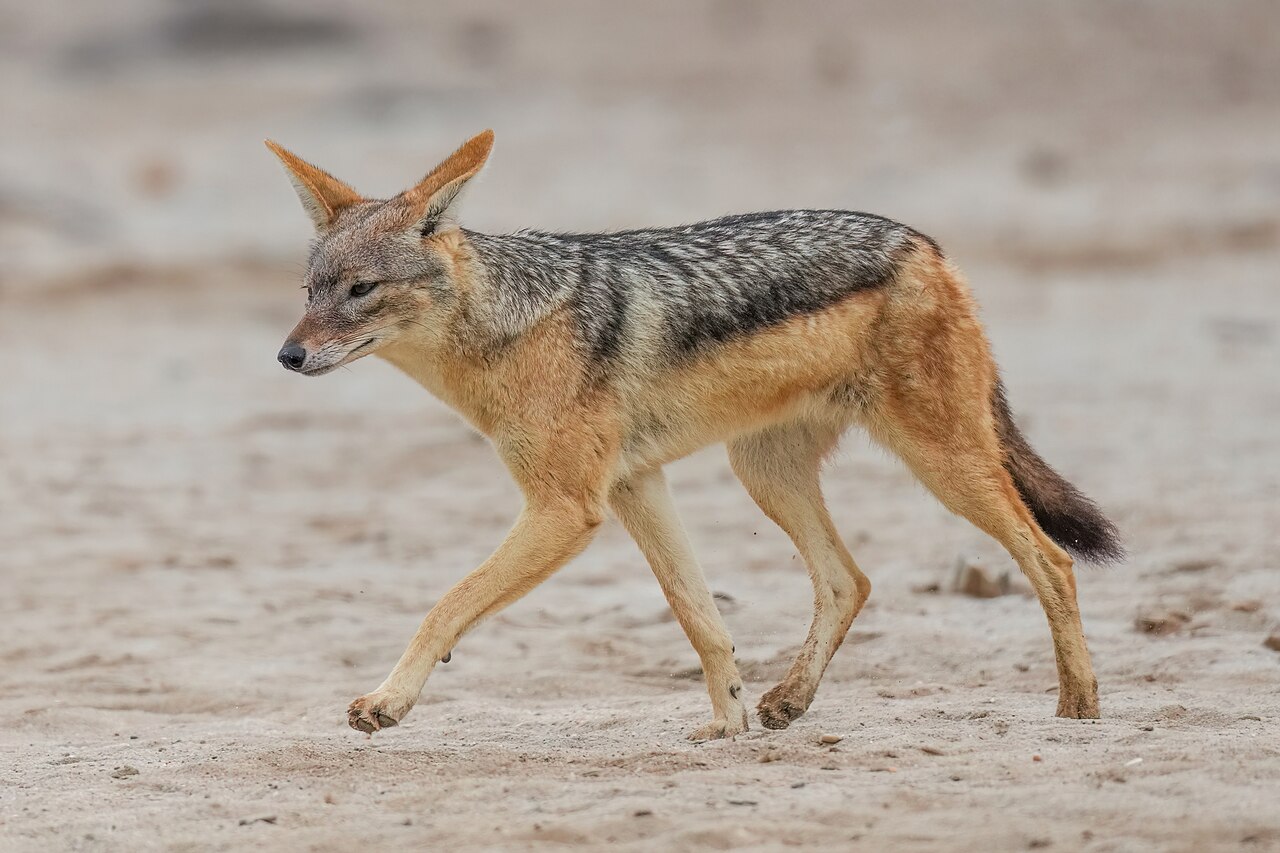
Black-backed jackals are small wild canids that live in long-term monogamous pairs and defend territories together. They are omnivores, active both day and night, and they stay wild animals even when raised by people.
Care guide
Housing
- Secure canid fencing with dig guards and a roof or inward overhang; they're territorial and agile.
- Dens or shelters for resting, and space to patrol.
Sources 7
Diet
- Omnivores: in a study of 96 stomachs, insects appeared most often, then mixed omnivorous remains, plus plant matter.
- In care, a balanced canid diet with whole-prey items and produce reflects that range.
Sources 7
Behavior & enrichment
- Pairs communicate with scent and touch; expect scent marking.
- Scatter feeding, scent trails and varied terrain help.
Sources 7
Health & vet care
- Work with a vet experienced in wild canids for vaccines and parasite control.
- Sexual maturity comes around 10 months; plan pairing and breeding carefully.
Sources 7
Show the group care guide for wild canids
Wild canids
Applies to most species in this group. Habitat: Desert to forest. Individual species can differ, so compare with the species numbers above and the linked sources.
Housing & setup
- Dig-proof and climb-proof fencing with a roof or inward overhang; dens and lots of space to run.
Diet
- Balanced canid diets plus whole prey, with produce for omnivorous species.
Health watch
- Strong scent marking; escape attempts; zoonotic disease.
Understanding the animal
In the wild
In the wild
Researched for this exact species, not its family. Good care copies these conditions.12
| Where it lives | Open savanna, grassland, scrub and desert in separate eastern and southern African ranges, including the Namib. Avoids dense forest and uses burrows or rock shelters for pups. |
| Ground it lives on | Open soil, sand and rocky terrain; denning in existing burrows or crevices. |
| Active | Cathemeral; often more nocturnal near human settlements. |
| Social life | Territorial breeding pairs with offspring; may aggregate around food or cooperate when hunting. |
| Wild diet | Insects, rodents, hares, small antelopes, birds, reptiles and carrion; also fruit and seeds. |
| Behavior to plan for | Uses keen smell and hearing to hunt and scavenge. Pairs defend territories and rear young in sheltered dens. |
What this means for care
- Provide open running space and secluded den sites.
- Favor compatible pair or family management over arbitrary large groups.
- Use scent trails and scattered food to support searching and scavenging.
Native climate (measured)
Native climate (measured)
| Warm-season highs | about 87°F (up to 95°F in the hottest sampled areas) |
| Cool-season lows | about 45°F (down to 34°F in the coldest sampled areas) |
| Average temperature | 62–73°F across sampled records |
| Relative humidity | 53–68% on average (driest month about 54%) |
| Rainfall | about 600 mm a year, with strong wet and dry seasons |
Measured at 103 wild occurrence records sampled against WorldClim 2.1 climate data (1970–2000 averages). Air conditions in the range are ecological context, not enclosure settings: microhabitats such as burrows, leaf litter or basking rocks can be cooler, warmer or more humid.
Profile
Profile
Researched for this exact species. Sources are listed under In the wild above.
History
Johann Christian Daniel von Schreber named the species Canis mesomelas in 1775, and Lupulella was later proposed as a genus by Hilzheimer in 1906. Fossils from Kenya, Tanzania, and South Africa show that the species has occupied eastern and southern Africa for at least 2 to 3 million years.
Keeper tips
- Account for monogamous pair bonds when planning social groups.
- Allow for the possibility that young may remain with their parents and participate in raising subsequent pups.
- Provide dietary variety while emphasizing animal foods because the species is more carnivorously adapted than other jackals.
Behaviors reported
- Forms monogamous pair bonds.
- Young may remain with the family and help raise later litters.
- Uses a broad variety of food sources.
- Predates livestock and consequently comes into conflict with people.
Unique adaptations
- Its kidneys are well adapted to water deprivation.
- A well-developed carnassial shear and longer cutting blade on the premolars reflect stronger adaptation to carnivory than in other jackals.
- Its relatively unspecialised form is associated with the ability to thrive across a wide variety of habitats.
Remarkable facts
- The species occurs in two African population regions separated by roughly 900 km.
- Its coat is reddish brown to tan with a black saddle extending from the shoulders to the base of the tail.
- It is listed as Least Concern in the source because of its broad range and adaptability.
- Fossil evidence indicates that black-backed jackals have lived in eastern and southern Africa for at least 2 to 3 million years.
- Fossil specimens from Transvaal are almost identical to modern individuals, although their nasal bones differ slightly.
- Despite persecution as a livestock predator and rabies vector, its populations are described as stable.
Stories
- The black-backed jackal has a prominent role in African folklore, where it is often portrayed as a cunning and adaptable trickster.
Data and studies
The numbers
The numbers
Each bar is what one source reports. Where several sources weigh in, the dashed gold band marks their average.
Sources for this sheet
- Animal Diversity Web: Canis mesomelas Zoo, university or veterinaryUniversity-hosted species account.
- 9 CFR 2.1: Animal Welfare Act licensing (USDA) Zoo, university or veterinaryWho needs a USDA license to breed, sell or exhibit animals.
- Animal Diversity Web (University of Michigan): Vulpes vulpes Zoo, university or veterinaryUniversity-hosted species account, mostly wild biology.
- Merck Veterinary Manual: Management of zoo animals Zoo, university or veterinaryThe Merck Veterinary Manual: a standard veterinary reference written and reviewed by veterinary specialists.
- Merck Veterinary Manual: Nutrition: exotic and zoo animals Zoo, university or veterinaryThe Merck Veterinary Manual: a standard veterinary reference written and reviewed by veterinary specialists.
- GBIF Backbone Taxonomy (Global Biodiversity Information Facility) Peer-reviewed researchInternational scientific taxonomy used here for classification.
- Wikipedia (species article) Community referenceFree encyclopedia; useful overviews with their own citations. Intro text is quoted under CC BY-SA 4.0.
- iNaturalist (captive observations) Community referenceCommunity observation platform run by the California Academy of Sciences and National Geographic; observations marked captive show animals living in homes, zoos and aquariums.