
Home / Reptiles / Snakes / Boidae / Jamaican boa
Federal restrictions applyJamaican boa
Chilabothrus subflavus
Reptiles › Snakes (Serpentes) › Boidae (Boas)
The Jamaican boa, Jamaican yellow boa, yellow snake or Jamaican green snake (Chilabothrus subflavus); in Jamaican Patois: nanka) is a boa species endemic to Jamaica.
From Wikipedia: Jamaican boa, CC BY-SA 4.0 (excerpt)
Care at a glance
Species-specific values
Values researched for this exact species. Air, surface and water temperatures are listed separately, and each source is kept as published rather than averaged.
| Minimum enclosure | Adults need an enclosure around 1.8 x 0.6 x 0.45 meters (6 x 2 x 2 feet). Source: reptiletalk.net | |
| Warm side air temperature | 75–81 °F (24–27 °C) Source: reptiletalk.net | |
| Night temperature | 73–75 °F (23–24 °C) Source: reptiletalk.net | |
| Basking surface temperature | 86–88 °F (30–31 °C) Source: reptiletalk.net | |
| Humidity | 40–60 % Source: reptiletalk.net | |
| Diet | Newborns eat appropriately sized anoles or mourning geckos, then can transition to pink mice; adults take large rats and fowl. Source: reptiletalk.net | |
| Substrate | Use shredded aspen for young boas; larger boas can be switched to paper or similar substrate. Source: reptiletalk.net | |
| Feeding frequency | Adults every 8 to 14 days; young every 6 to 7 days. Source: vhm-abc.com | |
| Diet | Rodents, mainly mice and rats; dead prey is recommended. Source: vhm-abc.com | |
| Minimum enclosure | Minimum enclosure size for one snake: 150 x 60 x 100. Source: vhm-abc.com | |
| Basking surface temperature | 81–90 °F (27–32 °C) Source: vhm-abc.com | |
| Night temperature | 72–77 °F (22–25 °C) Source: vhm-abc.com | |
| Humidity | 60–85 % Source: vhm-abc.com | |
| Uvb lighting | Provide 12 hours of light. Source: vhm-abc.com | |
| Substrate | Newspapers, bark, or peat litter. Source: vhm-abc.com |
Warnings
Understanding the animal
About this animal
About this animal
No subspecies are recognized. Like all other boas, it is not venomous.
From Wikipedia: Jamaican boa, CC BY-SA 4.0 (excerpt)
In the wild
In the wild
| Overview | The Jamaican boa, Jamaican yellow boa, yellow snake or Jamaican green snake (Chilabothrus subflavus); in Jamaican Patois: nanka) is a boa species endemic to Jamaica. No subspecies are recognized. Like all other boas, it is not venomous. — From Wikipedia: Jamaican boa, CC BY-SA 4.0 (excerpt) |
| Wild diet | The foraging behavior of the Jamaican boa is not extensively studied, but the species is known to be an ecological generalist. It employs constriction to subdue and consume a diverse range of prey. The snake utilizes both active and ambush foraging strategies, which vary depending on the habitat structure, available food resources, and its life stage. — From Wikipedia: Jamaican boa, CC BY-SA 4.0 (excerpt) |
| Behavior | The Jamaican boa is primarily nocturnal and arboreal. The species may also display crepuscular activity, influenced by factors such as environmental conditions, prey availability, and seasonal activities. During daytime, this species seeks shelter in various locations such as epiphytes, trees, rock crevices, termite nests, or caves. — From Wikipedia: Jamaican boa, CC BY-SA 4.0 (excerpt) |
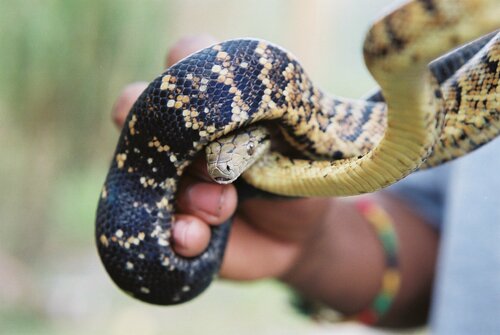
| Appearance and size | The Jamaican boa is golden-green around the head and along the anterior section of the body, with black zigzag crossbars, becoming black toward the posterior end of its body. The snake's body is quite long, up to 2 m in total length. — From Wikipedia: Jamaican boa, CC BY-SA 4.0 (excerpt) |
| Conservation | The Jamaican boa's natural populations greatly and constantly declined since the late 19th century, mainly because of predation by introduced species (such as mongooses), human persecution, and habitat destruction. — From Wikipedia: Jamaican boa, CC BY-SA 4.0 (excerpt) |
Read about this species in the wild at The Reptile Database.
Native climate (measured)
Native climate (measured)
| Warm-season highs | about 87°F (up to 90°F in the hottest sampled areas) |
| Cool-season lows | about 66°F (down to 63°F in the coldest sampled areas) |
| Average temperature | 73–80°F across sampled records |
| Relative humidity | 76–81% on average (driest month about 76%) |
| Rainfall | about 1772 mm a year |
Measured at 9 wild occurrence records sampled against WorldClim 2.1 climate data (1970–2000 averages). Air conditions in the range are ecological context, not enclosure settings: microhabitats such as burrows, leaf litter or basking rocks can be cooler, warmer or more humid.
Profile
Profile
Researched for this exact species. Sources are listed under In the wild above.
Data and studies
The numbers
The numbers
Each bar is what one source reports. Where several sources weigh in, the dashed gold band marks their average.
Maximum recorded lifespan
Longest recorded lifespan reported by each database; typical lifespans are usually shorter. The AnAge record comes from an animal in human care.
Veterinary & husbandry research
Veterinary & husbandry research
- Facultative parthenogenesis discovered for the first time in Jamaican boa (Chilabothrus subflavus) using novel microsatellite markers Bailey CA et al., Zoo biology 2024
Peer-reviewed papers that mention this species alongside captivity, zoos, veterinary care or aquaculture. Some cover several species or mention it only in passing, so check the abstract. PubMed
Sources for this sheet
- AnAge: The Animal Ageing and Longevity Database (Human Ageing Genomic Resources) (CC BY 3.0) Peer-reviewed researchCurated, referenced longevity and life-history records for thousands of species; maximum lifespans are often from zoo animals.
- Myhrvold et al. (2015). An amniote life-history database. Ecology 96: 3109 Peer-reviewed researchPeer-reviewed compilation of life-history data for over 21,000 birds, mammals and reptiles.
- Species+ (UNEP-WCMC and the CITES Secretariat) Zoo, university or veterinaryThe official database of species listed under CITES. UNEP (2026). The Species+ Website. Nairobi, Kenya. Compiled by UNEP-WCMC, Cambridge, UK. Available at: www.speciesplus.net. [Accessed 04/10/2026].
- USFWS International Affairs: CITES Zoo, university or veterinaryFederal agency that issues CITES permits.
- The Reptile Database Peer-reviewed researchScientist-curated catalog of every reptile species, with taxonomy and literature.
- Wikipedia (species article) (CC BY-SA 4.0) Community referenceFree encyclopedia; useful overviews with their own citations. Short excerpts are quoted under CC BY-SA 4.0, each credited with a link to its article.
- PubMed (U.S. National Library of Medicine) Peer-reviewed researchIndex of peer-reviewed veterinary, zoo and husbandry research.
- iNaturalist (captive observations) Community referenceCommunity observation platform run by the California Academy of Sciences and National Geographic; observations marked captive show animals living in homes, zoos and aquariums.
More boas
Common boa constrictor (red-tailed boa)
Boa constrictor
A powerful but famously steady big snake.
Pet trade
Green anaconda
Eunectes murinus
The heaviest snake on Earth, at home in the water.
Pet trade

Amazon basin emerald tree boa
Corallus batesii
Pet trade
Amazon tree boa
Corallus hortulana
Pet trade

Annulated tree boa
Corallus annulatus
Pet trade

Arabian sand boa
Eryx jayakari
Pet trade