Home / Mammals / Cats, dogs and other carnivores / Kinkajou
Some federal rules apply In-depth sheetKinkajou
Potos flavus
Mammals › Cats, dogs and other carnivores (Carnivora) › Procyonidae (Raccoons, coatis and kinkajous)
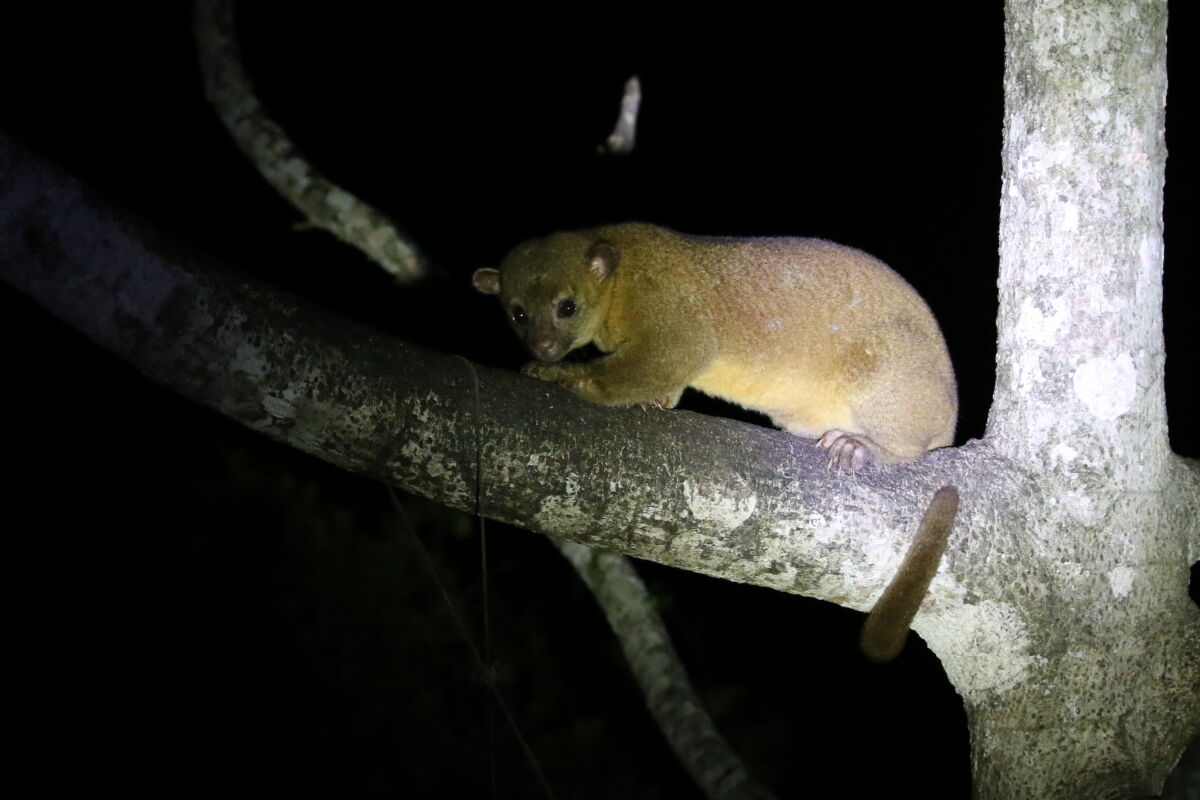
Kinkajous are nocturnal, tree-dwelling relatives of raccoons that eat mostly fruit. They can live 20–40 years in captivity.
Care guide
Housing
- Strictly arboreal: tall enclosures with branches and resting spots; fully prehensile tail and reversible hind feet.
Sources 70
Diet
- Mostly fruit, especially figs, plus insects, flowers and nectar.
Sources 70
Show the group care guide for raccoons, coatis and kinkajous
Raccoons, coatis and kinkajous
Applies to most species in this group. Habitat: Forests and suburbs. Individual species can differ, so compare with the species numbers above and the linked sources.
Housing & setup
- Large, climb-proof enclosures with lots of enrichment; very dexterous and destructive.
Diet
- Balanced omnivore diets with fruits, vegetables and protein; kinkajous are mostly fruit-eaters.
Health watch
- Raccoon roundworm (zoonotic) and rabies-vector rules for raccoons.
Understanding the animal
In the wild
In the wild
Researched for this exact species, not its family. Good care copies these conditions.1
| Where it lives | Forest canopies from southern Mexico through Central America into tropical South America, including rainforest, secondary forest and tropical dry forest. Sleeps in tree holes or branch crotches. |
| Ground it lives on | Arboreal; rarely on the ground. |
| Climate | Tropical; the provided source text does not give specific temperatures, humidity levels, or seasonal climate values. |
| Active | Nocturnal; daytime rest in tree dens. |
| Social life | Small territorial social units can share dens and groom together; individuals usually forage separately. |
| Wild diet | Mostly ripe fruit, especially figs; supplements with flowers, nectar and insects, including ants, according to season and locality. |
| Behavior to plan for | Travels along branches using a prehensile tail and returns to familiar fruiting trees. Scent marking maintains territorial boundaries. |
What this means for care
- Provide connected elevated climbing routes and enclosed elevated sleeping dens.
- Base dietary planning on frugivory rather than a meat-heavy carnivore template.
- Provide separate feeding stations because den sharing does not imply communal feeding.
- Schedule enrichment after dusk.
Native climate (measured)
Native climate (measured)
| Warm-season highs | about 88°F (up to 92°F in the hottest sampled areas) |
| Cool-season lows | about 64°F (down to 54°F in the coldest sampled areas) |
| Average temperature | 65–79°F across sampled records |
| Relative humidity | 80–85% on average (driest month about 78%) |
| Rainfall | about 2426 mm a year |
Measured at 107 wild occurrence records sampled against WorldClim 2.1 climate data (1970–2000 averages). Air conditions in the range are ecological context, not enclosure settings: microhabitats such as burrows, leaf litter or basking rocks can be cooler, warmer or more humid.
Profile
Profile
Researched for this exact species. Sources are listed under In the wild above.
History
Kinkajous were once placed in the order Primates as Lemur flavus because of their distinctive arboreal features. They are now classified within the carnivoran family Procyonidae.
Keeper tips
- Prioritize vertical and three-dimensional climbing space.
- Provide sturdy branches or comparable elevated structures that allow climbing and suspended postures.
- Design the environment around arboreal rather than primarily ground-based movement.
- Allow enough structural complexity for the animal to turn, climb, and maneuver using its highly flexible body.
Behaviors reported
- Hanging upside-down while feeding.
- Deliberate, adept climbing through tree limbs.
- Using extreme spinal flexibility to maneuver among branches and reach terminal branches.
Unique adaptations
- A long, fully prehensile tail.
- Nimble clawed fingers.
- Fully reversible hind feet.
- Extreme spinal flexibility allowing about 180-degree rotation between the pelvis and head.
Remarkable facts
- Kinkajous belong to the carnivoran family Procyonidae.
- Their arboreal characteristics once contributed to their classification as a primate under the name Lemur flavus.
- Adults described in the source weigh about 2.0 to 4.6 kg.
- They have thick, woolly, honey-brown fur, although regional color morphs occur.
- Their spinal flexibility distinguishes them from close relatives such as coatis and raccoons.
From the sources
From the sources
Quoted from the matching sections of reputable sources for this exact species. Specialist databases are used first; Wikipedia (community-edited, CC BY-SA 4.0) only fills gaps. Other sources are short credited quotes.
| Overview | The kinkajou (/ˈkɪŋkədʒuː/ KING-kə-joo; Potos flavus) is a mammal of the family Procyonidae, a relative to olingos, coatis, raccoons, and the ringtail and cacomistle. It is the only member of the genus Potos and is also known as the honey bear (a name shared with several unrelated species). Though kinkajous are arboreal, they are not closely related to any other tree-dwelling mammal group (primates, mustelids, etc.). Native to tropical rainforests of Mexico, Central and South America, this mostly frugivorous mammal is seldom seen by people because of its strict nocturnal habits. — Wikipedia (community-edited) |
| Where it lives | Kinkajous live in a variety of forest habitats including tropical dry forest, secondary forest, Amazonian rainforest, Atlantic coastal forest, tropical evergreen forest and forests of the savannah region in Suriname. — Animal Diversity Web |
| Social life and communication | The functions of kinkajou vocalizations have been poorly studied, yet there are a wide variety of vocalizations attributed to them (Ford and Hoffmann 1988). — Animal Diversity Web |
| Behavior | Kinkajous are strictly nocturnal and arboreal. — Animal Diversity Web |
| Reproduction | Originally, kinkajous were thought to be a solitary species that rarely exhibited sociality, but behavioral studies have revealed complex social interactions and an unusual mating system (Kays and Gittleman 2001). — Animal Diversity Web |
| Lifespan | Very little in known about the average life span in the wild, but they appear to be quite long-lived based on their low reproductive rates, low predation risks, and evidence from captive animals. — Animal Diversity Web |
| Appearance and size | Potos flavus is in the carnivoran family Procyonidae (raccoons, coatis, and their relatives). — Animal Diversity Web |
| Biology | Kinkajou spend most of their lives in trees, to which they are particularly well adapted. Like raccoons, kinkajous' remarkable manipulatory abilities rival those of primates. The kinkajou has a short-haired, fully prehensile tail (like some New World monkeys), which it uses as a "fifth hand" in climbing. — Wikipedia (community-edited) |
| History and naming | A. M. Husson, of the Rijksmuseum van Natuurlijke Historie (Leiden), discussed the rather complicated nomenclature of the kinkajou in The Mammals of Suriname (1978). — Wikipedia (community-edited) |
Data and studies
Researched care notes
Researched care notes
Findings checked against veterinary, zoo, welfare, keeper and peer-reviewed sources. Air, basking-surface and water temperatures are kept separate, and where sources disagree both are shown. “Study” notes report what a paper measured, not a universal rule.
Kinkajou (species)
- The manual describes tropical procyonids requiring protected warm accommodation during prolonged cold. A cold-protection threshold is not a routine optimum.1
- Strong frugivorous feeding tendencies are described, but fruit alone is not established as a balanced ration. A separately analysed complete diet is needed.1
Kinkajou
- Provide strong, connected elevated branches and other climbing structures that accommodate movement between levels.1
- Time important feeding and foraging opportunities for the animal's nocturnal activity period.1
- The name 'honey bear' does not justify routine honey or sweets; the manual warns against overindulgence in sugary foods.1
The numbers
The numbers
Each bar is what one source reports. Where several sources weigh in, the dashed gold band marks their average.
Lifespan in care
Maximum recorded lifespan
Longest recorded lifespan reported by each database; typical lifespans are usually shorter. The AnAge record comes from an animal in human care.
Typical adult weight
Average adult body mass in each database (FishBase gives the maximum recorded weight).
Veterinary & husbandry research
Veterinary & husbandry research
- Raccoon roundworms in pet kinkajous--three states, 1999 and 2010 Centers for Disease Control and Prevention (CDC) et al., MMWR. Morbidity and mortality weekly report 2011
- Prevalence of Baylisascaris Roundworm in Captive Kinkajous in Japan Tokiwa T et al., The Journal of parasitology 2016
- Binturong (Arctictis binturong) and Kinkajou (Potos flavus) digestive strategy: implications for interpreting frugivory in Carnivora and primates Lambert JE et al., PloS one 2014
- Baylisascaris potosis n. sp., a new ascarid nematode isolated from captive kinkajou, Potos flavus, from the Cooperative Republic of Guyana Tokiwa T et al., Parasitology international 2014
Peer-reviewed papers that mention this species alongside captivity, zoos, veterinary care or aquaculture. Some cover several species or mention it only in passing, so check the abstract. See all 9 on PubMed → 170
Sources for this sheet
- Animal Diversity Web (University of Michigan): Potos flavus Zoo, university or veterinaryUniversity-hosted species account, mostly wild biology.
- AnAge: The Animal Ageing and Longevity Database (Human Ageing Genomic Resources) Peer-reviewed researchCurated, referenced longevity and life-history records for thousands of species; maximum lifespans are often from zoo animals.
- Myhrvold et al. (2015). An amniote life-history database. Ecology 96: 3109 Peer-reviewed researchPeer-reviewed compilation of life-history data for over 21,000 birds, mammals and reptiles.
- Species+ (UNEP-WCMC and the CITES Secretariat) Zoo, university or veterinaryThe official database of species listed under CITES.
- USFWS International Affairs: CITES Zoo, university or veterinaryFederal agency that issues CITES permits.
- 9 CFR 2.1: Animal Welfare Act licensing (USDA) Zoo, university or veterinaryWho needs a USDA license to breed, sell or exhibit animals.
- Animal Diversity Web (University of Michigan): Procyon lotor Zoo, university or veterinaryUniversity-hosted species account, mostly wild biology.
- Smithsonian's National Zoo: White-nosed coati Zoo, university or veterinaryZoo with scientific staff and long experience keeping coatis.
- GBIF Backbone Taxonomy (Global Biodiversity Information Facility) Peer-reviewed researchInternational scientific taxonomy used here for classification.
- Wikipedia (species article) Community referenceFree encyclopedia; useful overviews with their own citations. Intro text is quoted under CC BY-SA 4.0.
- PubMed (U.S. National Library of Medicine) Peer-reviewed researchIndex of peer-reviewed veterinary, zoo and husbandry research.
- iNaturalist (captive observations) Community referenceCommunity observation platform run by the California Academy of Sciences and National Geographic; observations marked captive show animals living in homes, zoos and aquariums.