Home / Mammals / Cats, dogs and other carnivores / Raccoon
No federal permit to keepRaccoon
Procyon lotor
Mammals › Cats, dogs and other carnivores (Carnivora) › Procyonidae (Raccoons, coatis and kinkajous)
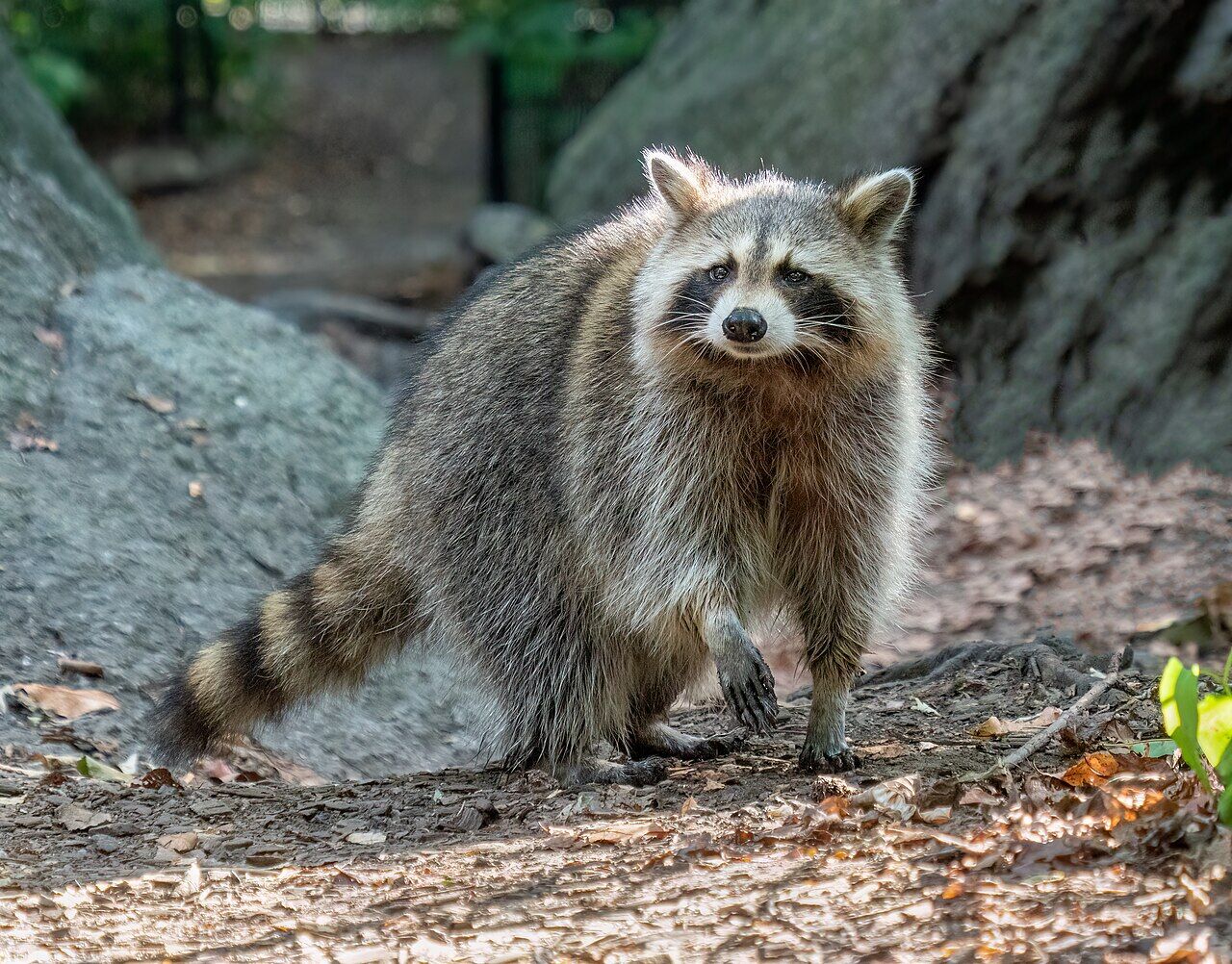
Raccoons are nocturnal, highly intelligent omnivores with famously sensitive, almost human-like forepaws. Hand-raised raccoons can bond closely with their people, but they stay strong-willed, mischievous and wild at heart, and they need a lot of space, enrichment and patience.
Care guide
Housing
- Wisconsin's captive-wildlife rules set a minimum pen of 80 sq ft for up to two raccoons, at least 8 ft tall, with 16 sq ft more for each additional raccoon.
- Raccoons must have continuous access to fresh water whenever it's above freezing (running water isn't required), and a climbing structure.
Sources docs.legis.wisconsin.gov
Diet
- Wildlife rehabilitators at BC SPCA's Wild ARC feed raccoons high-protein raw meat (not chicken or pork), fish, eggs, fruit and vegetables.
- Food is often hidden in puzzle boxes and bins to encourage natural foraging.
- Young kits are bottle-fed a specialized formula up to five times a day, then gradually weaned onto solid food.
Sources spca.bc.ca
Behavior & enrichment
- Raccoons explore with their hands: foraging boxes, puzzle feeders, shallow water play and safe objects to manipulate keep them busy.
- They are mainly nocturnal and can sleep long stretches in severe winter weather without truly hibernating.
Sources animaldiversity.org
Health & vet care
- No injectable rabies vaccine is licensed for wild animals or their hybrids, and national rabies guidance says wild animals should not be kept as pets.
- Health guidance says a wild animal that exposes a person, pet or livestock to rabies should be considered for euthanasia and rabies testing.
- Raccoons can carry raccoon roundworm without showing signs; its eggs pass in their feces. The CDC advises against keeping, feeding or adopting raccoons as pets.
Understanding the animal
In the wild
In the wild
Researched for this exact species, not its family. Wild conditions are context, not enclosure settings.1
| Where it lives | Woodlands and wetland edges across much of North America, also farmland and urban areas. It dens in tree cavities, existing burrows, rocky shelters or buildings, usually with nearby water. |
| Ground it lives on | Woodland soil and litter, wetland banks, fields and urban surfaces; also frequently climbs trees. |
| Climate | Occupies both cold temperate and warm regions. Northern animals build autumn fat reserves and spend prolonged snowy periods in dens; a single wild temperature or humidity range would not represent the species. |
| Active | Mostly nocturnal; winter denning and reduced activity occur, without true hibernation. |
| Social life | Often forages alone; mothers live with dependent young. The source does not establish a universal territorial system. |
| Wild diet | Fruits, nuts and grains, especially berries, acorns and corn; also invertebrates, aquatic prey, eggs and small vertebrates. |
| Behavior to plan for | An agile climber and capable swimmer with dexterous forepaws. It investigates and manipulates objects while searching for food. |
Native climate (measured)
Native climate (measured)
| Warm-season highs | about 89°F (up to 92°F in the hottest sampled areas) |
| Cool-season lows | about 30°F (down to 15°F in the coldest sampled areas) |
| Average temperature | 48–76°F across sampled records |
| Relative humidity | 67–73% on average (driest month about 65%) |
| Rainfall | about 1170 mm a year, spread fairly evenly |
| Winters | Cool to cold winters (lows around 30°F) in much of its native range. Seasonal slowdown may be relevant, but species-specific biology determines whether brumation or hibernation occurs. |
Measured at 62 wild occurrence records sampled against WorldClim 2.1 climate data (1970–2000 averages). Air conditions in the range are ecological context, not enclosure settings: microhabitats such as burrows, leaf litter or basking rocks can be cooler, warmer or more humid.
Profile
Profile
Researched for this exact species. Sources are listed under In the wild above.
History
the raccoon is native across much of North America and into northern South America, with introduced populations now widely distributed in parts of Europe and Asia.
Data and studies
Researched care notes
Researched care notes
Findings checked against veterinary, zoo, welfare, keeper and peer-reviewed sources. Air, basking-surface and water temperatures are kept separate, and where sources disagree both are shown. “Study” notes report what a paper measured, not a universal rule.
Raccoon (species)
- A balanced omnivorous ration needs a formulated basis and suitable varied foods; unrestricted calorie-dense food risks obesity. Professional managed-care guidance.1
- Design for complex movement, escape resistance, and den accommodation. Zoo-manual guidance.2
- Group tolerance varies with breeding, crowding, and individual histories. Confidence: LOW.2
- Raccoon-roundworm exposure can occur through ingestion of eggs from contaminated faeces or environments. Public-health guidance.3
The numbers
The numbers
Each bar is what one source reports. Where several sources weigh in, the dashed gold band marks their average.
Lifespan in care
Wild raccoons average about 5 years; captive records reach 21.
Minimum pen size (up to 2 raccoons)
Wisconsin's legal minimum: 80 sq ft and 8 ft tall for up to two raccoons, plus 16 sq ft for each additional raccoon. Rules differ by state.
Maximum recorded lifespan
Longest recorded lifespan reported by each database; typical lifespans are usually shorter. The AnAge record comes from an animal in human care.
Typical adult weight
Average adult body mass in each database (FishBase gives the maximum recorded weight).
Litter size
Average per litter or clutch.
Gestation
Female maturity
Veterinary & husbandry research
Veterinary & husbandry research
- Immunogenicity and efficacy of two rabies vaccines in wild-caught, captive raccoons Brown LJ et al., Journal of wildlife diseases 2011
- Efficacy of Ontario Rabies Vaccine Baits (ONRAB) against rabies infection in raccoons Gilbert A et al., Vaccine 2018
Peer-reviewed papers that mention this species alongside captivity, zoos, veterinary care or aquaculture. Some cover several species or mention it only in passing, so check the abstract. See all 107 on PubMed → PubMed
Sources for this sheet
- Wisconsin Administrative Code NR 16.30: Captive wild animal housing (raccoons) Zoo, university or veterinaryState wildlife regulation setting legal minimum pen sizes and care standards for captive raccoons.
- BC SPCA Wild ARC: Caring for orphaned raccoons Zoo, university or veterinaryWildlife rehabilitation centre describing how its staff feed and raise raccoons.
- Animal Diversity Web (University of Michigan): Procyon lotor (CC BY-NC-SA 3.0) Zoo, university or veterinaryUniversity-hosted species account, mostly wild biology.
- CDC MMWR (2011): Compendium of Animal Rabies Prevention and Control Zoo, university or veterinaryNational public-health guidance on rabies vaccination and wild animals kept in captivity.
- CDC: Preventing raccoon roundworm Zoo, university or veterinaryPublic-health guidance on raccoon roundworm (Baylisascaris).
- AnAge: The Animal Ageing and Longevity Database (Human Ageing Genomic Resources) (CC BY 3.0) Peer-reviewed researchCurated, referenced longevity and life-history records for thousands of species; maximum lifespans are often from zoo animals.
- Myhrvold et al. (2015). An amniote life-history database. Ecology 96: 3109 Peer-reviewed researchPeer-reviewed compilation of life-history data for over 21,000 birds, mammals and reptiles.
- 9 CFR 2.1: Animal Welfare Act licensing (USDA) Zoo, university or veterinaryWho needs a USDA license to breed, sell or exhibit animals.
- Clint's Reptiles (YouTube): Raccoon, The Best Pet Mammal? Expert educator & keeperClint Laidlaw, PhD in Biology Education and MS in Evolutionary Ecology; owner of Clint's Reptile Room and a longtime keeper. His "Best Pet?" series reviews each species' care in depth.
- GBIF Backbone Taxonomy (Global Biodiversity Information Facility) (CC BY 4.0) Peer-reviewed researchInternational scientific taxonomy used here for classification. GBIF Secretariat (2023). GBIF Backbone Taxonomy. Checklist dataset https://doi.org/10.15468/39omei, accessed via GBIF.org.
- Wikipedia (species article) (CC BY-SA 4.0) Community referenceFree encyclopedia; useful overviews with their own citations. Short excerpts are quoted under CC BY-SA 4.0, each credited with a link to its article.
- PubMed (U.S. National Library of Medicine) Peer-reviewed researchIndex of peer-reviewed veterinary, zoo and husbandry research.
- iNaturalist (captive observations) Community referenceCommunity observation platform run by the California Academy of Sciences and National Geographic; observations marked captive show animals living in homes, zoos and aquariums.