Home / Mammals / Cats, dogs and other carnivores / Kinkajou
Some federal rules applyKinkajou
Potos flavus
Mammals › Cats, dogs and other carnivores (Carnivora) › Procyonidae (Raccoons, coatis and kinkajous)
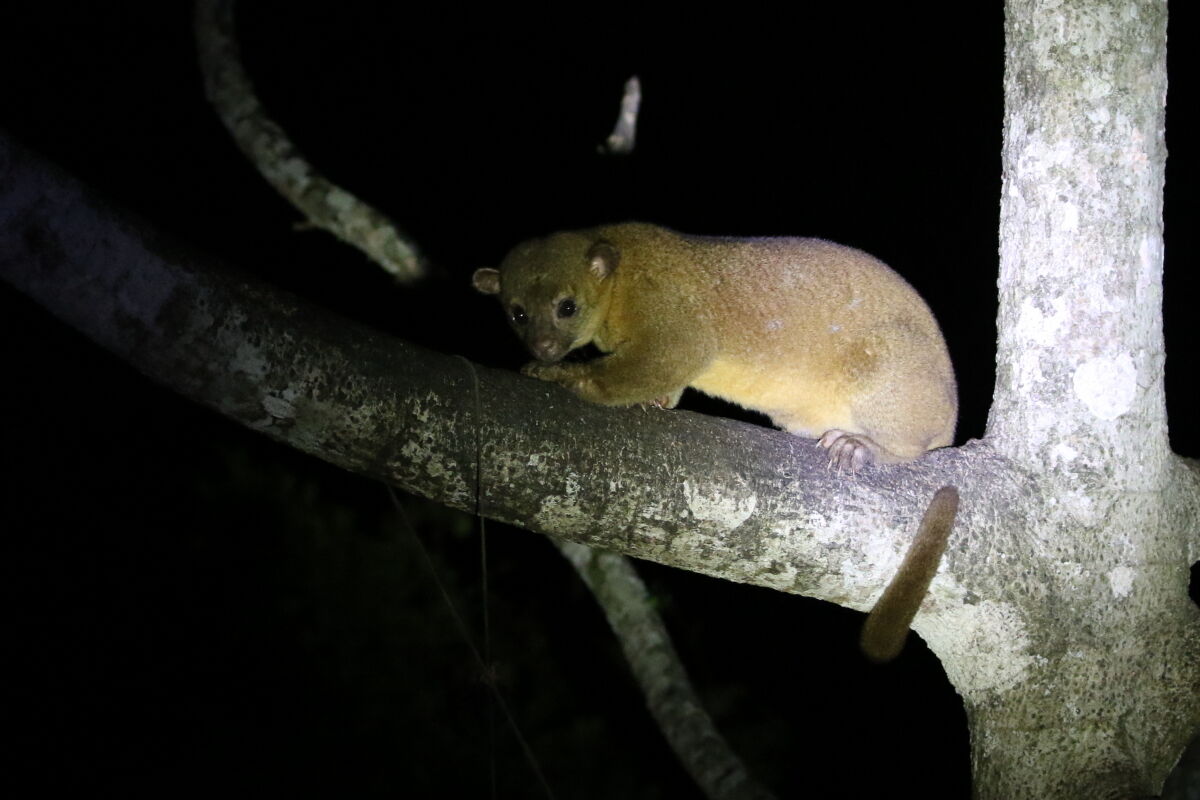
Kinkajous are nocturnal, tree-dwelling relatives of raccoons that eat mostly fruit. They can live 20–40 years in captivity.
Care guide
Housing
- Strictly arboreal: tall enclosures with branches and resting spots; fully prehensile tail and reversible hind feet.
Sources animaldiversity.org
Diet
- Mostly fruit, especially figs, plus insects, flowers and nectar.
Sources animaldiversity.org
Understanding the animal
In the wild
In the wild
Researched for this exact species, not its family. Wild conditions are context, not enclosure settings.1
| Where it lives | Forest canopies from southern Mexico through Central America into tropical South America, including rainforest, secondary forest and tropical dry forest. Sleeps in tree holes or branch crotches. |
| Ground it lives on | Arboreal; rarely on the ground. |
| Climate | Tropical; the provided source text does not give specific temperatures, humidity levels, or seasonal climate values. |
| Active | Nocturnal; daytime rest in tree dens. |
| Social life | Small territorial social units can share dens and groom together; individuals usually forage separately. |
| Wild diet | Mostly ripe fruit, especially figs; supplements with flowers, nectar and insects, including ants, according to season and locality. |
| Behavior to plan for | Travels along branches using a prehensile tail and returns to familiar fruiting trees. Scent marking maintains territorial boundaries. |
Native climate (measured)
Native climate (measured)
| Warm-season highs | about 88°F (up to 92°F in the hottest sampled areas) |
| Cool-season lows | about 64°F (down to 54°F in the coldest sampled areas) |
| Average temperature | 65–79°F across sampled records |
| Relative humidity | 80–85% on average (driest month about 78%) |
| Rainfall | about 2426 mm a year |
Measured at 107 wild occurrence records sampled against WorldClim 2.1 climate data (1970–2000 averages). Air conditions in the range are ecological context, not enclosure settings: microhabitats such as burrows, leaf litter or basking rocks can be cooler, warmer or more humid.
Profile
Profile
Researched for this exact species. Sources are listed under In the wild above.
History
Kinkajous were once placed in the order Primates as Lemur flavus because of their distinctive arboreal features. They are now classified within the carnivoran family Procyonidae.
Data and studies
Researched care notes
Researched care notes
Findings checked against veterinary, zoo, welfare, keeper and peer-reviewed sources. Air, basking-surface and water temperatures are kept separate, and where sources disagree both are shown. “Study” notes report what a paper measured, not a universal rule.
Kinkajou (species)
- The manual describes tropical procyonids requiring protected warm accommodation during prolonged cold. A cold-protection threshold is not a routine optimum.1
- Strong frugivorous feeding tendencies are described, but fruit alone is not established as a balanced ration. A separately analysed complete diet is needed.1
Kinkajou
- Provide strong, connected elevated branches and other climbing structures that accommodate movement between levels.1
- Time important feeding and foraging opportunities for the animal's nocturnal activity period.1
- The name 'honey bear' does not justify routine honey or sweets; the manual warns against overindulgence in sugary foods.1
The numbers
The numbers
Each bar is what one source reports. Where several sources weigh in, the dashed gold band marks their average.
Lifespan in care
Maximum recorded lifespan
Longest recorded lifespan reported by each database; typical lifespans are usually shorter. The AnAge record comes from an animal in human care.
Typical adult weight
Average adult body mass in each database (FishBase gives the maximum recorded weight).
Litter size
Average per litter or clutch.
Gestation
Female maturity
Veterinary & husbandry research
Veterinary & husbandry research
- Raccoon roundworms in pet kinkajous--three states, 1999 and 2010 Centers for Disease Control and Prevention (CDC) et al., MMWR. Morbidity and mortality weekly report 2011
- Prevalence of Baylisascaris Roundworm in Captive Kinkajous in Japan Tokiwa T et al., The Journal of parasitology 2016
- Binturong (Arctictis binturong) and Kinkajou (Potos flavus) digestive strategy: implications for interpreting frugivory in Carnivora and primates Lambert JE et al., PloS one 2014
- Baylisascaris potosis n. sp., a new ascarid nematode isolated from captive kinkajou, Potos flavus, from the Cooperative Republic of Guyana Tokiwa T et al., Parasitology international 2014
Peer-reviewed papers that mention this species alongside captivity, zoos, veterinary care or aquaculture. Some cover several species or mention it only in passing, so check the abstract. See all 9 on PubMed → PubMed
Sources for this sheet
- Animal Diversity Web (University of Michigan): Potos flavus (CC BY-NC-SA 3.0) Zoo, university or veterinaryUniversity-hosted species account, mostly wild biology.
- AnAge: The Animal Ageing and Longevity Database (Human Ageing Genomic Resources) (CC BY 3.0) Peer-reviewed researchCurated, referenced longevity and life-history records for thousands of species; maximum lifespans are often from zoo animals.
- Myhrvold et al. (2015). An amniote life-history database. Ecology 96: 3109 Peer-reviewed researchPeer-reviewed compilation of life-history data for over 21,000 birds, mammals and reptiles.
- Species+ (UNEP-WCMC and the CITES Secretariat) Zoo, university or veterinaryThe official database of species listed under CITES. UNEP (2026). The Species+ Website. Nairobi, Kenya. Compiled by UNEP-WCMC, Cambridge, UK. Available at: www.speciesplus.net. [Accessed 04/10/2026].
- USFWS International Affairs: CITES Zoo, university or veterinaryFederal agency that issues CITES permits.
- 9 CFR 2.1: Animal Welfare Act licensing (USDA) Zoo, university or veterinaryWho needs a USDA license to breed, sell or exhibit animals.
- GBIF Backbone Taxonomy (Global Biodiversity Information Facility) (CC BY 4.0) Peer-reviewed researchInternational scientific taxonomy used here for classification. GBIF Secretariat (2023). GBIF Backbone Taxonomy. Checklist dataset https://doi.org/10.15468/39omei, accessed via GBIF.org.
- Wikipedia (species article) (CC BY-SA 4.0) Community referenceFree encyclopedia; useful overviews with their own citations. Short excerpts are quoted under CC BY-SA 4.0, each credited with a link to its article.
- PubMed (U.S. National Library of Medicine) Peer-reviewed researchIndex of peer-reviewed veterinary, zoo and husbandry research.
- iNaturalist (captive observations) Community referenceCommunity observation platform run by the California Academy of Sciences and National Geographic; observations marked captive show animals living in homes, zoos and aquariums.