Home / Mammals / Hedgehogs / Long-eared hedgehog
No federal permit to keepLong-eared hedgehog
Hemiechinus auritus
Mammals › Hedgehogs (Erinaceomorpha) › Erinaceidae (Hedgehogs)
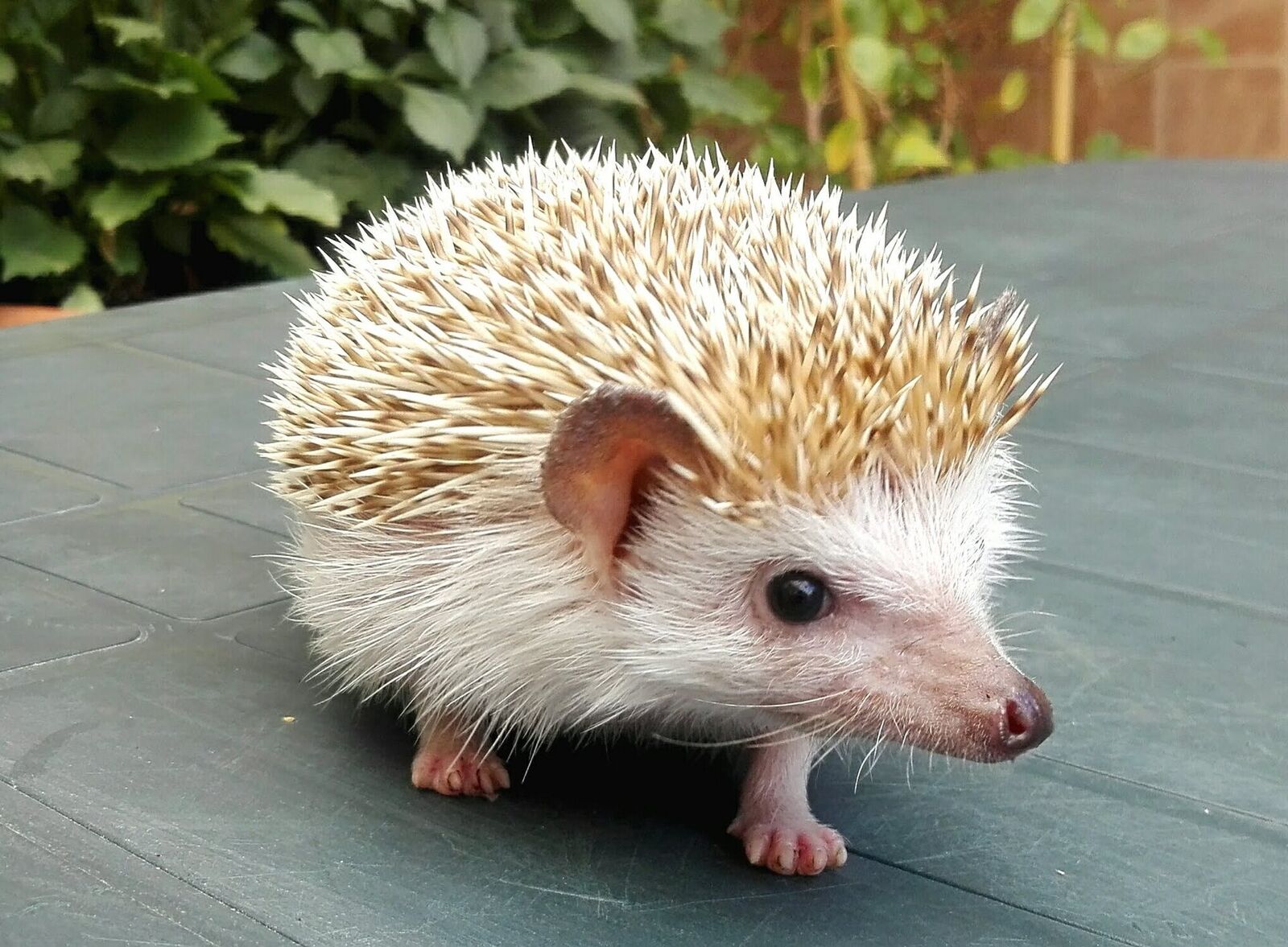
The long-eared hedgehog (Hemiechinus auritus) is a species of hedgehog native to Central Asian countries and some countries of the Middle East.
From Wikipedia: Long-eared hedgehog, CC BY-SA 4.0 (excerpt)

Care at a glance
Species-specific values
Values researched for this exact species. Air, surface and water temperatures are listed separately, and each source is kept as published rather than averaged.
| Feeding frequency | Hand-rear hoglets roughly every 2 hours. Source: pawsteps.co.uk | |
| Social housing | Keep solitary except for mating or raising young; some related females may co-house if there is enough space. Source: pawsteps.co.uk | |
| Substrate | Provide burrowable shredded paper or soil; avoid dusty sawdust and sand. Source: pawsteps.co.uk |
Understanding the animal
About this animal
About this animal
The long-eared hedgehog lives in burrows that it either makes or finds and is distinguished by its long ears. It is considered one of the smallest Middle Eastern hedgehogs.
From Wikipedia: Long-eared hedgehog, CC BY-SA 4.0 (excerpt)
In the wild
In the wild
| Overview | The long-eared hedgehog (Hemiechinus auritus) is a species of hedgehog native to Central Asian countries and some countries of the Middle East. The long-eared hedgehog lives in burrows that it either makes or finds and is distinguished by its long ears. It is considered one of the smallest Middle Eastern hedgehogs. This hedgehog is insectivorous but may also feed on small vertebrates and plants. — From Wikipedia: Long-eared hedgehog, CC BY-SA 4.0 (excerpt) |
Read about this species in the wild at Animal Diversity Web.
Native climate (measured)
Native climate (measured)
| Warm-season highs | about 89°F (up to 97°F in the hottest sampled areas) |
| Cool-season lows | about 38°F (down to 10°F in the coldest sampled areas) |
| Average temperature | 47–68°F across sampled records |
| Relative humidity | 57–65% on average (driest month about 50%) |
| Rainfall | about 387 mm a year, with strong wet and dry seasons |
| Winters | Cool to cold winters (lows around 38°F) in much of its native range. Seasonal slowdown may be relevant, but species-specific biology determines whether brumation or hibernation occurs. |
Measured at 119 wild occurrence records sampled against WorldClim 2.1 climate data (1970–2000 averages). Air conditions in the range are ecological context, not enclosure settings: microhabitats such as burrows, leaf litter or basking rocks can be cooler, warmer or more humid.
Data and studies
Researched care notes
Researched care notes
Findings checked against veterinary, zoo, welfare, keeper and peer-reviewed sources. Air, basking-surface and water temperatures are kept separate, and where sources disagree both are shown. “Study” notes report what a paper measured, not a universal rule.
Insectivorous Small Mammals (feeding group)
Researched for this whole family or group; check species differences before applying.
- The reference discusses suitable complete insectivore feeds and invertebrates; match the ration to the actual taxon. Hedgehogs, armadillos, and aardvarks do not share one interchangeable recipe.1
The numbers
The numbers
Each bar is what one source reports. Where several sources weigh in, the dashed gold band marks their average.
Maximum recorded lifespan
Longest recorded lifespan reported by each database; typical lifespans are usually shorter. The AnAge record comes from an animal in human care.
Typical adult weight
Average adult body mass in each database (FishBase gives the maximum recorded weight).
Litter size
Average per litter or clutch.
Gestation
Female maturity
Veterinary & husbandry research
Veterinary & husbandry research
- A survey on parasites of long-eared hedgehog (Hemiechinus auritus) in northeast of Iran Moshaverinia A et al., Journal of parasitic diseases: official organ of the Indian Society for Parasitology 2016
- Identification of Anaplasma marginale in long-eared hedgehogs (Hemiechinus auritus) and their Rhipicephalus turanicus ticks in Iran Khodadadi N et al., Ticks and tick-borne diseases 2021
- First report of Enterocytozoon bieneusi in Erinaceus europaeus and Hemiechinus auritus hedgehogs from recovery centers of Portugal Gomes-Gonçalves S et al., Medical mycology 2024
Peer-reviewed papers that mention this species alongside captivity, zoos, veterinary care or aquaculture. Some cover several species or mention it only in passing, so check the abstract. See all 4 on PubMed → PubMed
Sources for this sheet
- AnAge: The Animal Ageing and Longevity Database (Human Ageing Genomic Resources) (CC BY 3.0) Peer-reviewed researchCurated, referenced longevity and life-history records for thousands of species; maximum lifespans are often from zoo animals.
- Myhrvold et al. (2015). An amniote life-history database. Ecology 96: 3109 Peer-reviewed researchPeer-reviewed compilation of life-history data for over 21,000 birds, mammals and reptiles.
- 9 CFR 2.1: Animal Welfare Act licensing (USDA) Zoo, university or veterinaryWho needs a USDA license to breed, sell or exhibit animals.
- GBIF Backbone Taxonomy (Global Biodiversity Information Facility) (CC BY 4.0) Peer-reviewed researchInternational scientific taxonomy used here for classification. GBIF Secretariat (2023). GBIF Backbone Taxonomy. Checklist dataset https://doi.org/10.15468/39omei, accessed via GBIF.org.
- Wikipedia (species article) (CC BY-SA 4.0) Community referenceFree encyclopedia; useful overviews with their own citations. Short excerpts are quoted under CC BY-SA 4.0, each credited with a link to its article.
- PubMed (U.S. National Library of Medicine) Peer-reviewed researchIndex of peer-reviewed veterinary, zoo and husbandry research.
- iNaturalist (captive observations) Community referenceCommunity observation platform run by the California Academy of Sciences and National Geographic; observations marked captive show animals living in homes, zoos and aquariums.