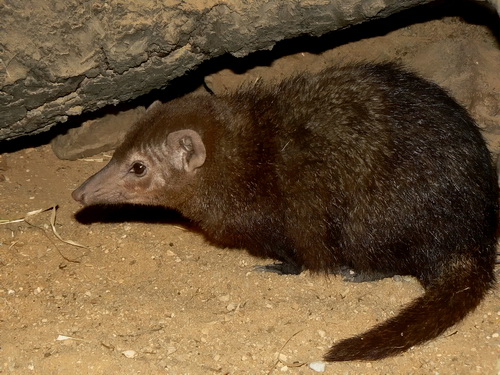
Home / Mammals / Cats, dogs and other carnivores / Meerkat
Federal restrictions apply In-depth sheetMeerkat
Suricata suricatta
Mammals › Cats, dogs and other carnivores (Carnivora) › Herpestidae (Mongooses and meerkats)
Meerkats are highly social mongooses that live in colonies of up to 40. They must be kept in pairs or groups, with warm indoor areas.
Warnings
Care guide
Housing
- Both indoor and outdoor areas, with deep digging substrate.
Sources 48
Social needs
- Never keep alone; colonies have a dominant breeding pair and their offspring.
Sources 48
Show the group care guide for mongooses and meerkats
Mongooses and meerkats
Applies to most species in this group. Habitat: Savanna and forest. Individual species can differ, so compare with the species numbers above and the linked sources.
Housing & setup
- Secure enclosures with deep digging substrate, heat lamps and dens.
Diet
- Insectivore and carnivore diets with insects.
Health watch
- Most mongoose genera, including meerkats, are federally injurious wildlife.
Understanding the animal
In the wild
In the wild
Researched for this exact species, not its family. Good care copies these conditions.1
| Where it lives | Arid southern African plains and scrub, including Kalahari thornveld and Karoo habitats. Multi-entrance burrows shelter it from heat and predators. |
| Ground it lives on | diggable firm earth or desert sand under sparse grass and scrub |
| Climate | Arid to semi-arid conditions with seasonal rainfall; burrows buffer daytime heat. Reliable occupied-microhabitat temperature and relative-humidity ranges were not established. |
| Active | Diurnal. |
| Social life | Territorial cooperative groups with dominance hierarchies, shared vigilance and care of young. |
| Wild diet | Mainly insects, including beetles and moths, plus spiders, scorpions, centipedes and occasional small vertebrates. |
| Behavior to plan for | Digs prey from soil while group sentinels watch from elevated positions. Retreats rapidly to nearby burrow entrances. |
What this means for care
- Provide digging areas and multiple tunnel-like shelters.
- Keep compatible established groups with options to separate aggressors.
- Include insect-search enrichment and elevated lookout positions.
Native climate (measured)
Native climate (measured)
| Warm-season highs | about 87°F (up to 96°F in the hottest sampled areas) |
| Cool-season lows | about 37°F (down to 31°F in the coldest sampled areas) |
| Average temperature | 58–69°F across sampled records |
| Relative humidity | 41–61% on average (driest month about 46%) |
| Rainfall | about 320 mm a year |
| Winters | Cool to cold winters (lows around 37°F) in much of its native range. Seasonal slowdown may be relevant, but species-specific biology determines whether brumation or hibernation occurs. |
Measured at 107 wild occurrence records sampled against WorldClim 2.1 climate data (1970–2000 averages). Air conditions in the range are ecological context, not enclosure settings: microhabitats such as burrows, leaf litter or basking rocks can be cooler, warmer or more humid.
Profile
Profile
Researched for this exact species. Sources are listed under In the wild above.
History
The provided source describes observations across southern Africa, particularly the Kalahari, and cites a 1980 study documenting multi-level burrow systems.
Keeper tips
- Use a substrate deep and workable enough to permit digging.
- Include several shelter or burrow access points rather than relying on one hide.
- Combine open ground with scrub, grasses, or similarly sparse structural cover.
Behaviors reported
- Constructs its own burrows.
- Uses abandoned burrows made by other small mammals.
- May displace other species from burrows that are already occupied.
Unique adaptations
- Uses complex underground dens in arid and semi-arid environments.
- Occupies both firm soils and sandy desert soils suitable for burrowing.
Remarkable facts
- The species occurs from southwestern Angola through Namibia and Botswana into South Africa.
- It is frequently observed in the southern Kalahari Desert.
- Many occupied habitats average less than 600 mm of rainfall annually.
- Burrow entrances are surrounded by mounds of excavated soil.
- Burrow entrances are dug at approximately 40-degree angles.
- A 1980 study reported burrow systems containing two to three tunnel levels.
From the sources
From the sources
Quoted from the matching sections of reputable sources for this exact species. Specialist databases are used first; Wikipedia (community-edited, CC BY-SA 4.0) only fills gaps. Other sources are short credited quotes.
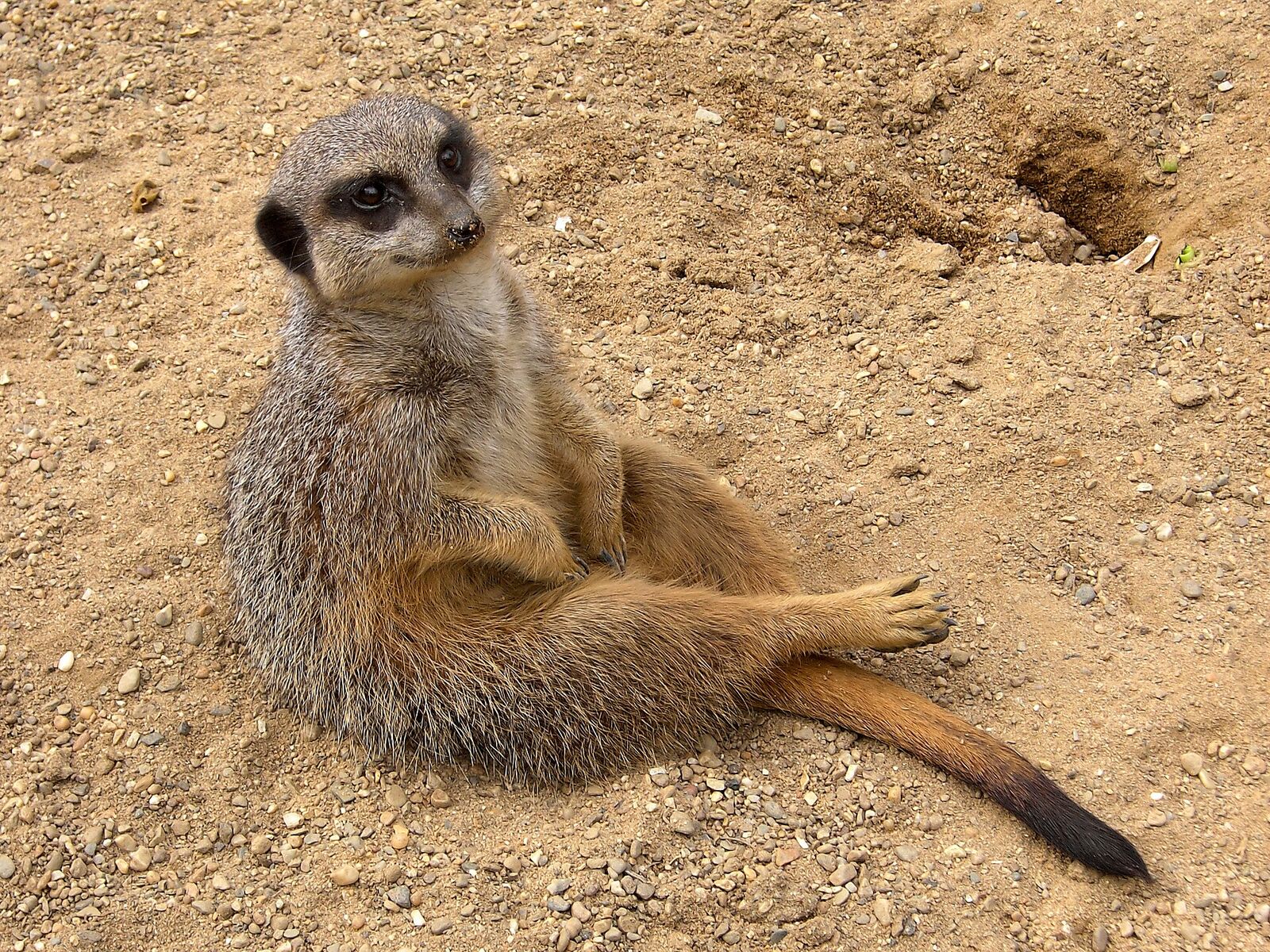
| Overview | The meerkat (Suricata suricatta) or suricate is a small mongoose found in southern Africa. It is characterised by a broad head, large eyes, a pointed snout, long legs, a thin tapering tail, and a brindled coat pattern. The head-and-body length is around 24–35 cm, and the weight is typically between 0.62 and 0.97 kg. The coat is light grey to yellowish-brown with alternate, poorly defined light and dark bands on the back. — Wikipedia (community-edited) |
| Where it lives | Meerkats live in a range of habitats, including arid or semi-arid open plains and rocky crevices near rivers. — Animal Diversity Web |
| Behavior | The meerkat is a social mammal, forming packs of two to 30 individuals each comprising nearly equal numbers of either sex and multiple family units of pairs and their offspring. Members of a pack take turns at jobs such as looking after pups and keeping a lookout for predators. Meerkats are a cooperatively breeding species—typically the dominant 'breeders' in a pack produce offspring. — Wikipedia (community-edited) |
| Reproduction | Meerkats breed seasonally, commonly corresponding with greater amounts of rainfall. — Animal Diversity Web |
| Appearance and size | Meerkats are one of the smallest species of mongooses in the family Herpestidae. — Animal Diversity Web |
| History and naming | In 1776, Johann Christian Daniel von Schreber described a meerkat from the Cape of Good Hope, giving it the scientific name Viverra suricatta. The generic name Suricata was proposed by Anselme Gaëtan Desmarest in 1804, who also described a zoological specimen from the Cape of Good Hope. — Wikipedia (community-edited) |
Data and studies
Researched care notes
Researched care notes
Findings checked against veterinary, zoo, welfare, keeper and peer-reviewed sources. Air, basking-surface and water temperatures are kept separate, and where sources disagree both are shown. “Study” notes report what a paper measured, not a universal rule.
Meerkat (species)
- Compatible social housing is recommended, but hierarchy changes can produce serious aggression.1
- Natural foods include invertebrate prey, some small vertebrates, eggs, and plant foods. Feeding ecology does not specify a complete captive ration.1
- Monitor stress between adjacent groups; mixed exhibits require separate retreat and feeding resources. Confidence: LOW.1
Meerkat
- Provide digging opportunities and accessible, collapse-resistant tunnels; inaccessible or unstable burrows complicate care and can injure animals.1
- Containment should resist excavation and climbing; buried barriers and nonclimbable upper boundaries address different escape mechanisms.1
- Use scatter feeding, foraging pans or appropriate puzzle feeders to extend food-search behavior; the manual documents these specifically for meerkats.1
The numbers
The numbers
Each bar is what one source reports. Where several sources weigh in, the dashed gold band marks their average.
Indoor temperature
Indoor areas kept above about 68°F (20°C).
Maximum recorded lifespan
Longest recorded lifespan reported by each database; typical lifespans are usually shorter. The AnAge record comes from an animal in human care.
Typical adult weight
Average adult body mass in each database (FishBase gives the maximum recorded weight).
Veterinary & husbandry research
Veterinary & husbandry research
- Oral and Dental Examination Findings in a Family of Zoo Suricates ( Suricata Suricatta) Kvapil P et al., Journal of veterinary dentistry 2018
- Right atrioventricular valve dysplasia in a meerkat Cham TC et al., Journal of veterinary diagnostic investigation: official publication of the American Association of Veterinary Laboratory Diagnosticians, Inc 2022
- Epizootic disseminated toxoplasmosis in captive slender-tailed meerkats (Suricata suricatta) Juan-Sallés C et al., Veterinary pathology 1997
- A Comparison of Zoo Animal Behavior in the Presence of Familiar and Unfamiliar People Martin RA et al., Journal of applied animal welfare science: JAAWS 2016
Peer-reviewed papers that mention this species alongside captivity, zoos, veterinary care or aquaculture. Some cover several species or mention it only in passing, so check the abstract. See all 37 on PubMed → 170
Sources for this sheet
- Royal Veterinary College Exotics Service: Meerkat care Zoo, university or veterinaryVet-school exotics hospital factsheet, reviewed 2021–2024.
- AnAge: The Animal Ageing and Longevity Database (Human Ageing Genomic Resources) Peer-reviewed researchCurated, referenced longevity and life-history records for thousands of species; maximum lifespans are often from zoo animals.
- Myhrvold et al. (2015). An amniote life-history database. Ecology 96: 3109 Peer-reviewed researchPeer-reviewed compilation of life-history data for over 21,000 birds, mammals and reptiles.
- 50 CFR Part 16: Injurious wildlife (Lacey Act) Zoo, university or veterinaryCurrent federal regulation, read from eCFR.
- U.S. Association of Reptile Keepers v. Zinke (D.C. Cir. 2017) Zoo, university or veterinaryAppeals ruling that the Lacey Act's shipping ban does not cover moves between the continental states.
- 9 CFR 2.1: Animal Welfare Act licensing (USDA) Zoo, university or veterinaryWho needs a USDA license to breed, sell or exhibit animals.
- GBIF Backbone Taxonomy (Global Biodiversity Information Facility) Peer-reviewed researchInternational scientific taxonomy used here for classification.
- Wikipedia (species article) Community referenceFree encyclopedia; useful overviews with their own citations. Intro text is quoted under CC BY-SA 4.0.
- PubMed (U.S. National Library of Medicine) Peer-reviewed researchIndex of peer-reviewed veterinary, zoo and husbandry research.
- iNaturalist (captive observations) Community referenceCommunity observation platform run by the California Academy of Sciences and National Geographic; observations marked captive show animals living in homes, zoos and aquariums.