
Home / Birds / Ducks, geese and swans / Muscovy duck
Federal restrictions applyMuscovy duck
Cairina moschata
Birds › Ducks, geese and swans (Anseriformes) › Anatidae (Ducks, geese and swans)
The Muscovy duck (Cairina moschata) is a species of duck native to the Americas, from the Lower Rio Grande Valley of Texas and Mexico south to Argentina and Uruguay.

Care at a glance
Species-specific values
Values researched for this exact species. Air, surface and water temperatures are listed separately, and each source is kept as published rather than averaged.
| Enclosure layout | Provide elevated structures as well as solid littered floors, drainage and bathing or head-dipping water. Domestic Muscovy ducks; not a universal duck perch requirement. | efsa.europa.eu |
| Minimum enclosure | Average of 15 square feet per bird. Source: thetinylife.com | |
| Diet | Muscovies can forage on bugs and plants; ducklings need high-protein waterfowl feed until 12 to 16 weeks, then daily foragers can get a small amount once per day. Source: thetinylife.com | |
| Feeding frequency | For daily foragers older than 12 to 16 weeks, provide a small amount of feed once per day. Source: thetinylife.com |
Warnings
Understanding the animal
About this animal
About this animal
The species has been domesticated, and feral Muscovy ducks can be found locally in New Zealand, Australia, the United States, and in Central and Eastern Europe.
From Wikipedia: Muscovy duck, CC BY-SA 4.0 (excerpt)
In the wild
In the wild
Researched for this exact species, not its family. Wild conditions are context, not enclosure settings.123
| Where it lives | Wild Muscovy ducks inhabit wooded wetlands from Mexico through Central and South America. They feed beside lakes, rivers and swamps, but use trees for night roosts and cavity nests. |
| Ground it lives on | Vegetated wetland banks and forest ground; tree branches and cavities |
| Water it lives in | Freshwater lakes, ponds, rivers and swamps; still and flowing habitats. Species-specific pH, hardness and water-temperature ranges are not established. |
| Active | Diurnal; generally resident |
| Social life | Social, with dominance hierarchies; dominant males defend breeding territories. |
| Wild diet | Aquatic and terrestrial roots, stems, leaves and seeds, insects, termites, millipedes, crustaceans and small fish or reptiles. |
| Behavior to plan for | It swims and dabbles, but also grazes on land and flies to tree roosts. Tree-cavity nesting matters when providing breeding sites. |
Native climate (measured)
Native climate (measured)
| Warm-season highs | about 77°F (up to 92°F in the hottest sampled areas) |
| Cool-season lows | about 35°F (down to 30°F in the coldest sampled areas) |
| Average temperature | 49–75°F across sampled records |
| Relative humidity | 71–79% on average (driest month about 69%) |
| Rainfall | about 798 mm a year, spread fairly evenly |
| Winters | Cool to cold winters (lows around 35°F) in much of its native range. Seasonal slowdown may be relevant, but species-specific biology determines whether brumation or hibernation occurs. |
Measured at 122 wild occurrence records sampled against WorldClim 2.1 climate data (1970–2000 averages). Air conditions in the range are ecological context, not enclosure settings: microhabitats such as burrows, leaf litter or basking rocks can be cooler, warmer or more humid.
Profile
Profile
Researched for this exact species. Sources are listed under In the wild above.
History
The Muscovy duck is native to the Americas but has been domesticated and transported widely. Feral populations now occur in several regions outside its native distribution.
Data and studies
Researched care notes
Researched care notes
Findings checked against veterinary, zoo, welfare, keeper and peer-reviewed sources. Air, basking-surface and water temperatures are kept separate, and where sources disagree both are shown. “Study” notes report what a paper measured, not a universal rule.
Domestic Duck
- Provide open water deep enough for adults to wash the head and body, with an exit they can use easily.1
- Provide drinking water separately from bathing water, which rapidly becomes contaminated.1
- Clean and refill small bathing pools or troughs at least daily, and manage drainage to prevent persistent muddy ground.1
- Give young ducklings shallow water facilities; RSPCA advises against access to deep swimming water before sufficient feather waterproofing develops.1
- Feed a ration suited to duck species, age and breed rather than assuming that any poultry feed meets all life-stage requirements.2
- Keep a compatible group; RSPCA recommends at least three birds and cautions against bullying when markedly different body sizes are mixed.2
The numbers
The numbers
Each bar is what one source reports. Where several sources weigh in, the dashed gold band marks their average.
Typical adult weight
Average adult body mass in each database (FishBase gives the maximum recorded weight).
Incubation
Sources for this sheet
- Myhrvold et al. (2015). An amniote life-history database. Ecology 96: 3109 Peer-reviewed researchPeer-reviewed compilation of life-history data for over 21,000 birds, mammals and reptiles.
- 50 CFR 21.48: Permit exceptions for captive-bred migratory waterfowl Zoo, university or veterinaryCurrent federal rule letting people keep marked, captive-bred waterfowl without a permit.
- 50 CFR 10.13: List of migratory birds Zoo, university or veterinaryCurrent federal regulation listing birds protected by the Migratory Bird Treaty Act.
- GBIF Backbone Taxonomy (Global Biodiversity Information Facility) (CC BY 4.0) Peer-reviewed researchInternational scientific taxonomy used here for classification. GBIF Secretariat (2023). GBIF Backbone Taxonomy. Checklist dataset https://doi.org/10.15468/39omei, accessed via GBIF.org.
- Species+ (UNEP-WCMC and the CITES Secretariat) Zoo, university or veterinaryThe official database of species listed under CITES. UNEP (2026). The Species+ Website. Nairobi, Kenya. Compiled by UNEP-WCMC, Cambridge, UK. Available at: www.speciesplus.net. [Accessed 04/10/2026].
- Wikipedia (species article) (CC BY-SA 4.0) Community referenceFree encyclopedia; useful overviews with their own citations. Short excerpts are quoted under CC BY-SA 4.0, each credited with a link to its article.
- iNaturalist (captive observations) Community referenceCommunity observation platform run by the California Academy of Sciences and National Geographic; observations marked captive show animals living in homes, zoos and aquariums.
More ducks, geese and swans
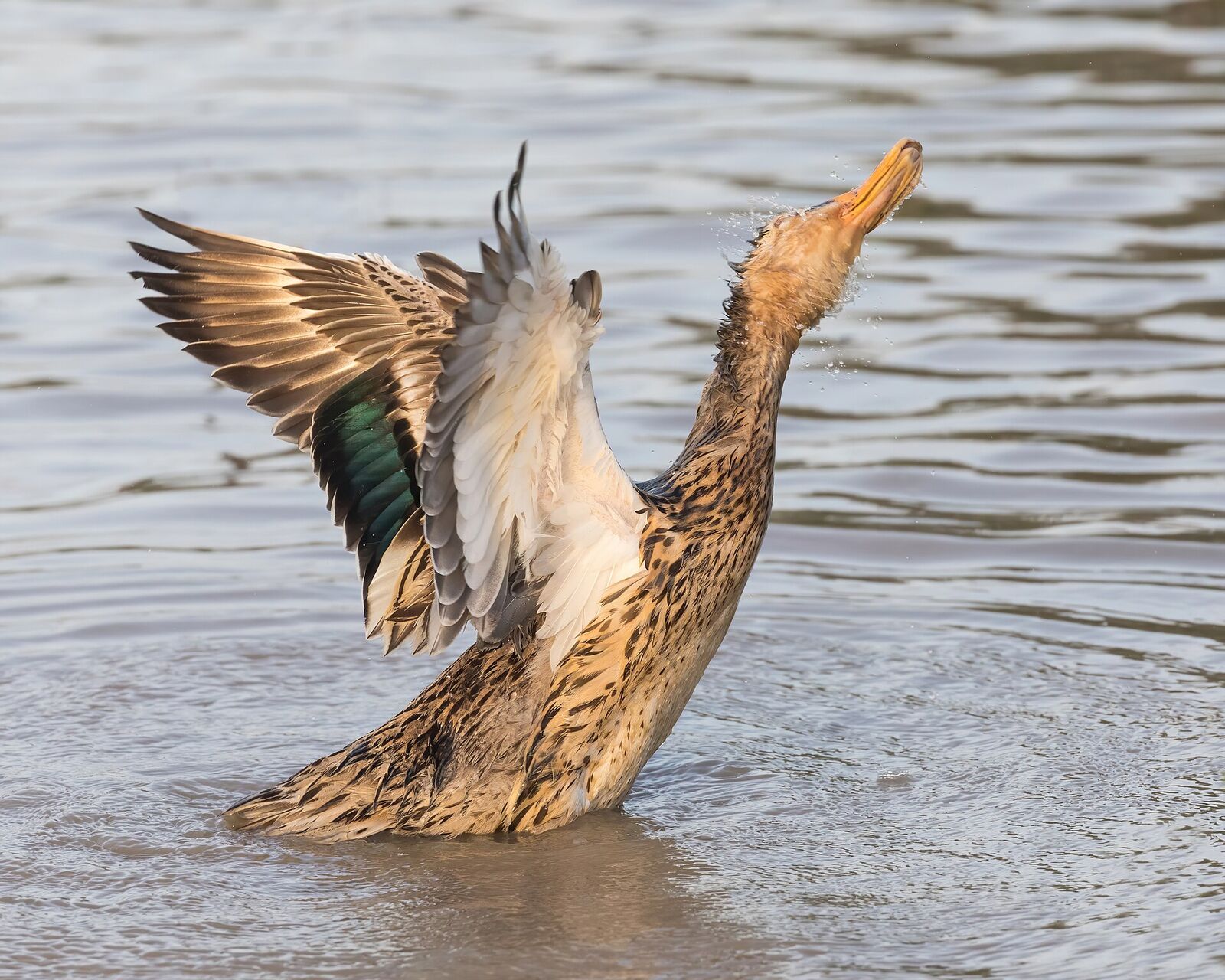
Domestic duck (mallard)
Anas platyrhynchos
Messy, hardy and happiest near water.
Farm & ranch

Baer's pochard
Aythya baeri
Aviary

Bernier's teal
Anas bernieri
Aviary

Black scoter
Melanitta americana
Aviary

Brazilian teal
Amazonetta brasiliensis
Aviary

Comb duck
Sarkidiornis sylvicola
Aviary