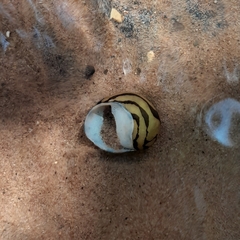
Home / Invertebrates / Nerite snails / Baby's tooth
No federal permit to keepBaby's tooth
Nerita tessellata
Invertebrates › Nerite snails (Cycloneritida) › Neritidae (Nerite snails)
Nerita tessellata, sometimes known as the checkered nerite, is a species of tropical sea snail with a gill and an operculum, a nerite, a marine gastropod mollusk in the family Neritidae, the nerites.
From Wikipedia: Nerita tessellata, CC BY-SA 4.0 (excerpt)
Experience: Easy
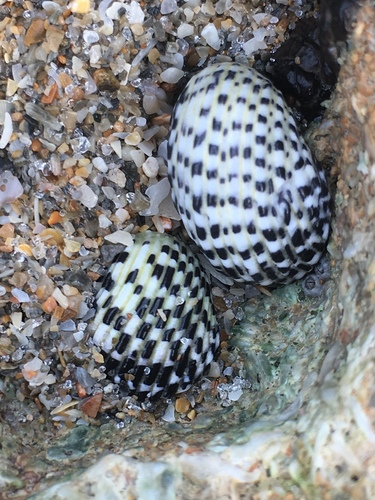
FamilyNerite snails
Adult lengthup to 1 in
WaterSaltwater
HabitatReef-associated
Care at a glance
Species-specific values
Values researched for this exact species. Air, surface and water temperatures are listed separately, and each source is kept as published rather than averaged.
| Minimum enclosure | Recommended minimum volume is 20 liters (5.3 gallons). Source: reeflings.com | |
| Water temperature | 75–82 °F (24–28 °C) Source: reeflings.com | |
| Diet | Primarily grazes on algae; supplement with algae wafers or blanched zucchini or spinach if algae is insufficient. Source: reeflings.com | |
| Feeding frequency | Feed sparingly; natural grazing means they are almost always foraging. Source: reeflings.com | |
| Social housing | Solitary, but can be kept in groups without issues. Source: reeflings.com |
Understanding the animal
In the wild
In the wild
| Overview | Nerita tessellata, sometimes known as the checkered nerite, is a species of tropical sea snail with a gill and an operculum, a nerite, a marine gastropod mollusk in the family Neritidae, the nerites. — From Wikipedia: Nerita tessellata, CC BY-SA 4.0 (excerpt) |
Read about this species in the wild at SeaLifeBase.
Data and studies
The numbers
The numbers
Each bar is what one source reports. Where several sources weigh in, the dashed gold band marks their average.
Sources for this sheet
- SeaLifeBase (Palomares & Pauly, eds.), version 24.07 (CC BY-NC 4.0) Peer-reviewed researchFishBase's sister database for non-fish marine and freshwater life; values are referenced.
- GBIF Backbone Taxonomy (Global Biodiversity Information Facility) (CC BY 4.0) Peer-reviewed researchInternational scientific taxonomy used here for classification. GBIF Secretariat (2023). GBIF Backbone Taxonomy. Checklist dataset https://doi.org/10.15468/39omei, accessed via GBIF.org.
- Wikipedia (species article) (CC BY-SA 4.0) Community referenceFree encyclopedia; useful overviews with their own citations. Short excerpts are quoted under CC BY-SA 4.0, each credited with a link to its article.
- iNaturalist (captive observations) Community referenceCommunity observation platform run by the California Academy of Sciences and National Geographic; observations marked captive show animals living in homes, zoos and aquariums.