Home / Mammals / Hedgehogs / North African hedgehog
No federal permit to keepNorth African hedgehog
Atelerix algirus
Mammals › Hedgehogs (Erinaceomorpha) › Erinaceidae (Hedgehogs)
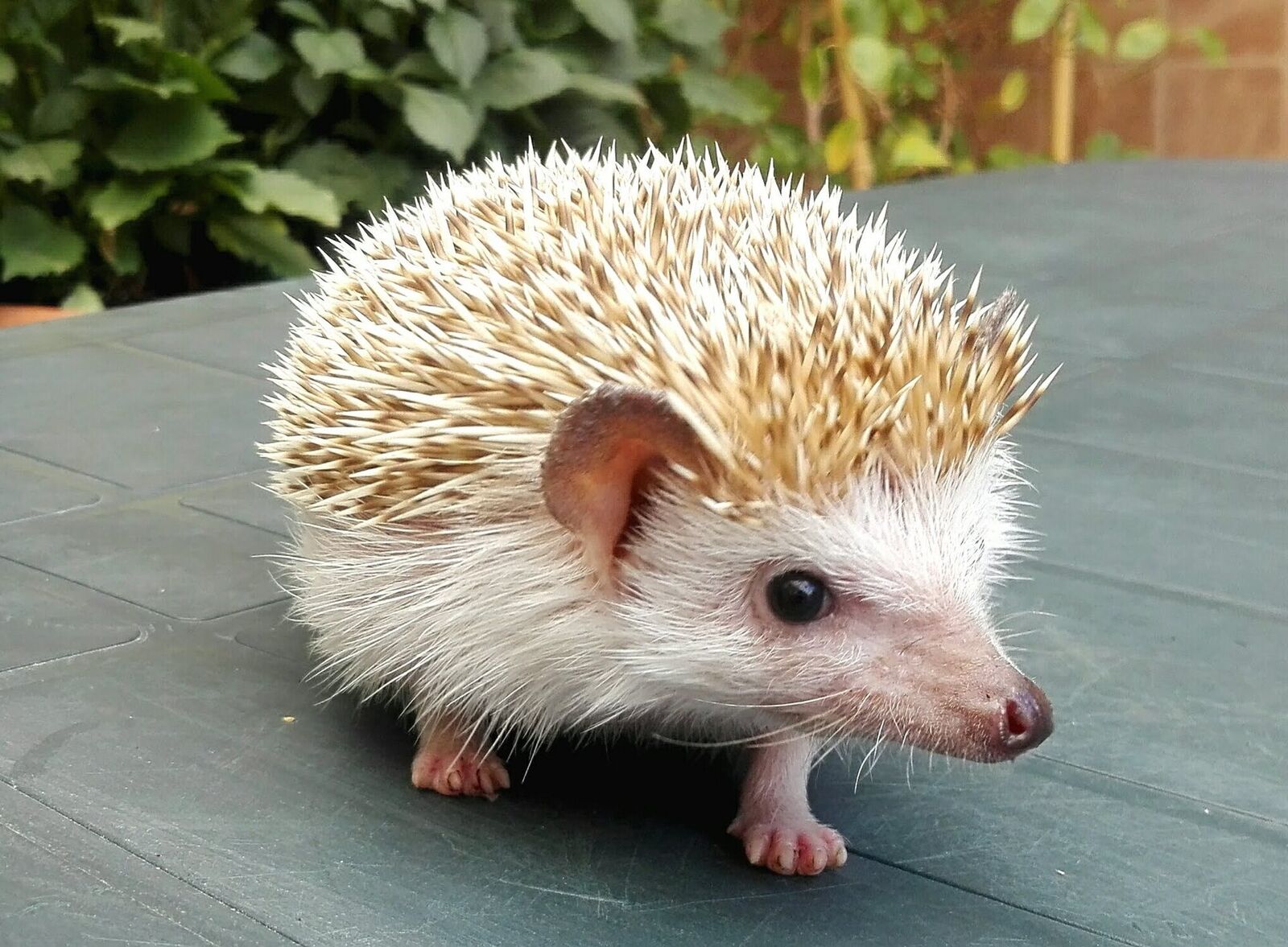
The North African hedgehog (Atelerix algirus) or Algerian hedgehog, is a mammal species in the family Erinaceidae native to Morocco, Algeria, Tunisia, Libya, Spain, Malta, and France.
From Wikipedia: North African hedgehog, CC BY-SA 4.0 (excerpt)

Care at a glance
Species-specific values
Values researched for this exact species. Air, surface and water temperatures are listed separately, and each source is kept as published rather than averaged.
| Minimum enclosure | Practical minimum adult floor area is 100 × 50 cm. Source: academy.herpeton.net | |
| Uvb lighting | UVB lighting is not required for routine indoor care. Source: academy.herpeton.net | |
| Warm side air temperature | 72–81 °F (22–27 °C) Source: academy.herpeton.net | |
| Cool side air temperature | 72–81 °F (22–27 °C) Source: academy.herpeton.net | |
| Humidity | 40–60 % Source: academy.herpeton.net | |
| Diet | Use complete commercial hedgehog or insectivore food as the measured staple; offer varied suitable invertebrates and small amounts of vegetables. Source: academy.herpeton.net | |
| Feeding frequency | Offer a measured portion of complete food in the evening. Source: academy.herpeton.net | |
| Social housing | Keep singly; routine cohabitation risks competition and injury. Source: academy.herpeton.net | |
| Substrate | Put 8–10 cm of aspen or dust-free paper bedding in digging zones. Source: academy.herpeton.net | |
| Seasonal cooling | Deliberate winter cooling is not a generic pet-care step; do not cool vulnerable animals without a species-specific veterinary plan. Source: academy.herpeton.net |
Understanding the animal
About this animal
About this animal
The most common breed of domesticated hedgehogs is a result of crossing a four-toed hedgehog with a North African hedgehog.
From Wikipedia: North African hedgehog, CC BY-SA 4.0 (excerpt)
In the wild
In the wild
| Overview | The North African hedgehog (Atelerix algirus) or Algerian hedgehog, is a mammal species in the family Erinaceidae native to Morocco, Algeria, Tunisia, Libya, Spain, Malta, and France. The most common breed of domesticated hedgehogs is a result of crossing a four-toed hedgehog with a North African hedgehog. — From Wikipedia: North African hedgehog, CC BY-SA 4.0 (excerpt) |
Read about this species in the wild at Animal Diversity Web.
Native climate (measured)
Native climate (measured)
| Warm-season highs | about 84°F (up to 89°F in the hottest sampled areas) |
| Cool-season lows | about 54°F (down to 40°F in the coldest sampled areas) |
| Average temperature | 61–69°F across sampled records |
| Relative humidity | 67–71% on average (driest month about 64%) |
| Rainfall | about 181 mm a year, with strong wet and dry seasons |
Measured at 137 wild occurrence records sampled against WorldClim 2.1 climate data (1970–2000 averages). Air conditions in the range are ecological context, not enclosure settings: microhabitats such as burrows, leaf litter or basking rocks can be cooler, warmer or more humid.
Data and studies
Researched care notes
Researched care notes
Findings checked against veterinary, zoo, welfare, keeper and peer-reviewed sources. Air, basking-surface and water temperatures are kept separate, and where sources disagree both are shown. “Study” notes report what a paper measured, not a universal rule.
Insectivorous Small Mammals (feeding group)
Researched for this whole family or group; check species differences before applying.
- The reference discusses suitable complete insectivore feeds and invertebrates; match the ration to the actual taxon. Hedgehogs, armadillos, and aardvarks do not share one interchangeable recipe.1
The numbers
The numbers
Each bar is what one source reports. Where several sources weigh in, the dashed gold band marks their average.
Maximum recorded lifespan
Longest recorded lifespan reported by each database; typical lifespans are usually shorter.
Typical adult weight
Average adult body mass in each database (FishBase gives the maximum recorded weight).
Litter size
Average per litter or clutch.
Gestation
Veterinary & husbandry research
Veterinary & husbandry research
- Study of Zoonotic Enteric Pathogens of Atelerix algirus in Tenerife, Canary Islands, Spain Izquierdo-Rodriguez E et al., Frontiers in veterinary science 2020
- Rickettsiae in arthropods collected from the North African Hedgehog (Atelerix algirus) and the desert hedgehog (Paraechinus aethiopicus) in Algeria Khaldi M et al., Comparative immunology, microbiology and infectious diseases 2012
- Hedgehogs and Angiostrongylus cantonensis: Uncovering the Role of Atelerix albiventris in the Parasite Life Cycle Šipková A et al., Integrative zoology 2026
Peer-reviewed papers that mention this species alongside captivity, zoos, veterinary care or aquaculture. Some cover several species or mention it only in passing, so check the abstract. PubMed
Sources for this sheet
- Myhrvold et al. (2015). An amniote life-history database. Ecology 96: 3109 Peer-reviewed researchPeer-reviewed compilation of life-history data for over 21,000 birds, mammals and reptiles.
- AnAge: The Animal Ageing and Longevity Database (Human Ageing Genomic Resources) (CC BY 3.0) Peer-reviewed researchCurated, referenced longevity and life-history records for thousands of species; maximum lifespans are often from zoo animals.
- 9 CFR 2.1: Animal Welfare Act licensing (USDA) Zoo, university or veterinaryWho needs a USDA license to breed, sell or exhibit animals.
- GBIF Backbone Taxonomy (Global Biodiversity Information Facility) (CC BY 4.0) Peer-reviewed researchInternational scientific taxonomy used here for classification. GBIF Secretariat (2023). GBIF Backbone Taxonomy. Checklist dataset https://doi.org/10.15468/39omei, accessed via GBIF.org.
- Species+ (UNEP-WCMC and the CITES Secretariat) Zoo, university or veterinaryThe official database of species listed under CITES. UNEP (2026). The Species+ Website. Nairobi, Kenya. Compiled by UNEP-WCMC, Cambridge, UK. Available at: www.speciesplus.net. [Accessed 04/10/2026].
- Wikipedia (species article) (CC BY-SA 4.0) Community referenceFree encyclopedia; useful overviews with their own citations. Short excerpts are quoted under CC BY-SA 4.0, each credited with a link to its article.
- PubMed (U.S. National Library of Medicine) Peer-reviewed researchIndex of peer-reviewed veterinary, zoo and husbandry research.
- iNaturalist (captive observations) Community referenceCommunity observation platform run by the California Academy of Sciences and National Geographic; observations marked captive show animals living in homes, zoos and aquariums.