
Home / Reptiles / Turtles and tortoises / Ouachita map turtle
Some federal rules applyOuachita map turtle
Graptemys ouachitensis
Reptiles › Turtles and tortoises (Testudines) › Emydidae (Pond turtles and box turtles)
The Ouachita map turtle (Graptemys ouachitensis) is a species of turtle belonging to the family Emydidae.
From Wikipedia: Ouachita map turtle, CC BY-SA 4.0 (excerpt)

Care at a glance
Species-specific values
Values researched for this exact species. Air, surface and water temperatures are listed separately, and each source is kept as published rather than averaged.
| Basking surface temperature | Basking temperature is in the high 80s to low 90s °F. Source: austinsturtlepage.com | |
| Warm side air temperature | Air temperature is in the low to mid 80s °F. Source: austinsturtlepage.com | |
| Water temperature | Water temperature is in the low to mid 70s °F. Source: austinsturtlepage.com | |
| Uvb lighting | UVB lighting is needed. Source: austinsturtlepage.com | |
| Substrate | Use sand to fine-to-medium-size gravel. Source: austinsturtlepage.com | |
| Minimum enclosure | Minimum aquarium size: 40 gallons for males and 90 gallons for large females. Source: austinsturtlepage.com | |
| Diet | Captive foods include Mazuri, ReptoMin, other listed pellets and sticks, plants, fish, vegetables, snails, crickets, worms, and insects. Source: austinsturtlepage.com | |
| Social housing | Suitable community tankmates listed include Mud, Musk, Slider, Cooter, other Map, and Painted Turtles. Source: austinsturtlepage.com |
Understanding the animal
In the wild
In the wild
Read about this species in the wild at Animal Diversity Web · The Reptile Database.
Native climate (measured)
Native climate (measured)
| Warm-season highs | about 94°F (up to 94°F in the hottest sampled areas) |
| Cool-season lows | about 25°F (down to 9°F in the coldest sampled areas) |
| Average temperature | 47–63°F across sampled records |
| Relative humidity | 62–70% on average (driest month about 62%) |
| Rainfall | about 926 mm a year, spread fairly evenly |
| Winters | Cool to cold winters (lows around 25°F) in much of its native range. Seasonal slowdown may be relevant, but species-specific biology determines whether brumation or hibernation occurs. |
Measured at 54 wild occurrence records sampled against WorldClim 2.1 climate data (1970–2000 averages). Air conditions in the range are ecological context, not enclosure settings: microhabitats such as burrows, leaf litter or basking rocks can be cooler, warmer or more humid.
Profile
Profile
Researched for this exact species. Sources are listed under In the wild above.
History
Named after the type locality.
Data and studies
The numbers
The numbers
Each bar is what one source reports. Where several sources weigh in, the dashed gold band marks their average.
Maximum recorded lifespan
Longest recorded lifespan reported by each database; typical lifespans are usually shorter.
Typical adult weight
Average adult body mass in each database (FishBase gives the maximum recorded weight).
Incubation
Female maturity
Sources for this sheet
- Myhrvold et al. (2015). An amniote life-history database. Ecology 96: 3109 Peer-reviewed researchPeer-reviewed compilation of life-history data for over 21,000 birds, mammals and reptiles.
- Species+ (UNEP-WCMC and the CITES Secretariat) Zoo, university or veterinaryThe official database of species listed under CITES. UNEP (2026). The Species+ Website. Nairobi, Kenya. Compiled by UNEP-WCMC, Cambridge, UK. Available at: www.speciesplus.net. [Accessed 04/10/2026].
- USFWS International Affairs: CITES Zoo, university or veterinaryFederal agency that issues CITES permits.
- 21 CFR 1240.62: Turtles under 4 inches (FDA) Zoo, university or veterinaryFederal ban on selling small turtles.
- The Reptile Database Peer-reviewed researchScientist-curated catalog of every reptile species, with taxonomy and literature.
- GBIF Backbone Taxonomy (Global Biodiversity Information Facility) (CC BY 4.0) Peer-reviewed researchInternational scientific taxonomy used here for classification. GBIF Secretariat (2023). GBIF Backbone Taxonomy. Checklist dataset https://doi.org/10.15468/39omei, accessed via GBIF.org.
- Wikipedia (species article) (CC BY-SA 4.0) Community referenceFree encyclopedia; useful overviews with their own citations. Short excerpts are quoted under CC BY-SA 4.0, each credited with a link to its article.
- iNaturalist (captive observations) Community referenceCommunity observation platform run by the California Academy of Sciences and National Geographic; observations marked captive show animals living in homes, zoos and aquariums.
More pond turtles and box turtles
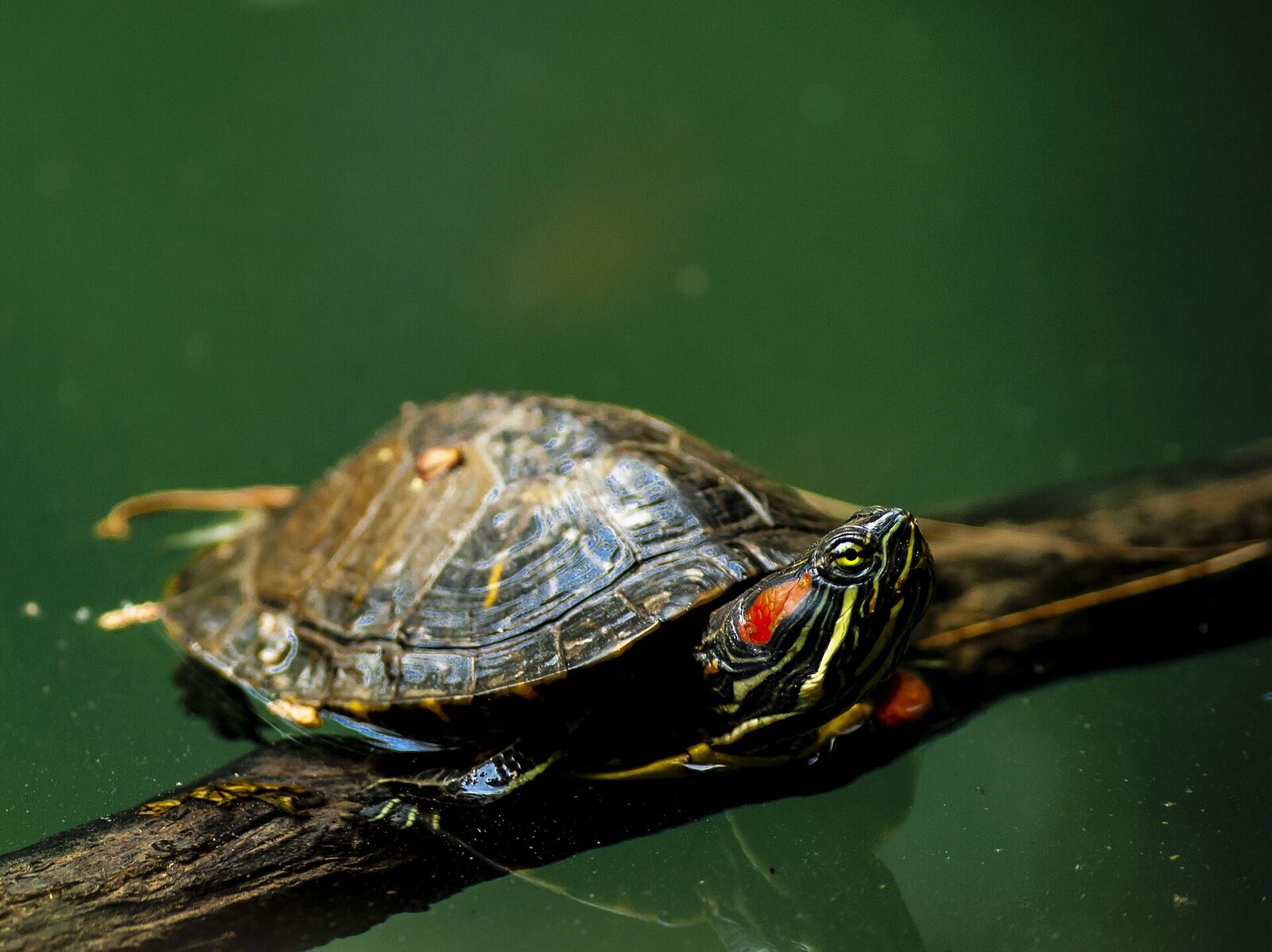
Red-eared slider
Trachemys scripta elegans
America's classic pet turtle, built to last decades.
Pet trade

Alabama map turtle
Graptemys pulchra
Zoos & aquariums

Baja California slider
Trachemys nebulosa
Pet trade

Barbour's map turtle
Graptemys barbouri
Zoos & aquariums

Black-knobbed map turtle
Graptemys nigrinoda
Pet trade

Blanding's turtle
Emydoidea blandingii
Pet trade