Home / Mammals / Cats, dogs and other carnivores / Raccoon
No federal permit to keep In-depth sheetRaccoon
Procyon lotor
Mammals › Cats, dogs and other carnivores (Carnivora) › Procyonidae (Raccoons, coatis and kinkajous)
Raccoons are nocturnal, highly intelligent omnivores with famously sensitive, almost human-like forepaws. Hand-raised raccoons can bond closely with their people, but they stay strong-willed, mischievous and wild at heart, and they need a lot of space, enrichment and patience.
Care guide
Housing
- Common setups: a raccoon-proofed home, a dedicated raccoon room, a large indoor enclosure, or an outdoor enclosure. Many owners combine an enclosure with supervised free-roam time.
- Outdoor enclosures must be both predator-proof and escape-proof, with a solid roof. Covered chicken pens with fence panels can work with modifications.
- Floor space matters more than extra levels for young kits; adults want lots of climbing, a bed area and room to play.
Sources 1
Diet
- Adults: quality dog kibble with real ingredients as a base, plus vegetables (more) and fruit (less), extra proteins like eggs, meat, organ meat and seafood, and small treats like seeds and nuts.
- Raccoons have a sweet tooth and can get picky. Offer lots of variety while they're young, and monitor weight, since obesity is easy.
- Kits may still need bottle-feeding when they go home. Follow the breeder's formula and schedule exactly, and weigh kits on a kitchen scale.
Behavior & enrichment
- Raccoons explore with their hands: foraging boxes, puzzle feeders, shallow water play and safe objects to manipulate keep them busy.
- They are mainly nocturnal and can sleep long stretches in severe winter weather without truly hibernating.
Sources 3
Health & vet care
- Line up an exotic-friendly vet before bringing a kit home. There are no raccoon-specific vaccines, so vets generally protect them against canine distemper, parvovirus and feline distemper, and discuss rabies.
- Spay or neuter on time. Unaltered raccoons often turn hormonal and aggressive in winter and spring.
- Raccoons can carry diseases and parasites transmissible to people and pets, including raccoon roundworm. Good hygiene and regular deworming plans with your vet matter.
- Medication doses should always come from your veterinarian.
Handling
- Keep kits' nails trimmed weekly; they're sharp.
- Expect testing behavior as they mature. Patience and consistency beat punishment.
Sources 1
Show the group care guide for raccoons, coatis and kinkajous
Raccoons, coatis and kinkajous
Applies to most species in this group. Habitat: Forests and suburbs. Individual species can differ, so compare with the species numbers above and the linked sources.
Housing & setup
- Large, climb-proof enclosures with lots of enrichment; very dexterous and destructive.
Diet
- Balanced omnivore diets with fruits, vegetables and protein; kinkajous are mostly fruit-eaters.
Health watch
- Raccoon roundworm (zoonotic) and rabies-vector rules for raccoons.
Understanding the animal
In the wild
In the wild
Researched for this exact species, not its family. Good care copies these conditions.1
| Where it lives | Woodlands and wetland edges across much of North America, also farmland and urban areas. It dens in tree cavities, existing burrows, rocky shelters or buildings, usually with nearby water. |
| Ground it lives on | Woodland soil and litter, wetland banks, fields and urban surfaces; also frequently climbs trees. |
| Climate | Occupies both cold temperate and warm regions. Northern animals build autumn fat reserves and spend prolonged snowy periods in dens; a single wild temperature or humidity range would not represent the species. |
| Active | Mostly nocturnal; winter denning and reduced activity occur, without true hibernation. |
| Social life | Often forages alone; mothers live with dependent young. The source does not establish a universal territorial system. |
| Wild diet | Fruits, nuts and grains, especially berries, acorns and corn; also invertebrates, aquatic prey, eggs and small vertebrates. |
| Behavior to plan for | An agile climber and capable swimmer with dexterous forepaws. It investigates and manipulates objects while searching for food. |
What this means for care
- Provide strong climbing structures and enclosed sleeping dens.
- Use manipulation-based food puzzles and varied foraging tasks.
- Make latches resistant to dexterous paws.
- Adjust enrichment timing to evening activity and monitor seasonal body-condition changes.
Native climate (measured)
Native climate (measured)
| Warm-season highs | about 89°F (up to 92°F in the hottest sampled areas) |
| Cool-season lows | about 30°F (down to 15°F in the coldest sampled areas) |
| Average temperature | 48–76°F across sampled records |
| Relative humidity | 67–73% on average (driest month about 65%) |
| Rainfall | about 1170 mm a year, spread fairly evenly |
| Winters | Cool to cold winters (lows around 30°F) in much of its native range. Seasonal slowdown may be relevant, but species-specific biology determines whether brumation or hibernation occurs. |
Measured at 62 wild occurrence records sampled against WorldClim 2.1 climate data (1970–2000 averages). Air conditions in the range are ecological context, not enclosure settings: microhabitats such as burrows, leaf litter or basking rocks can be cooler, warmer or more humid.
Profile
Profile
Researched for this exact species. Sources are listed under In the wild above.
History
the raccoon is native across much of North America and into northern South America, with introduced populations now widely distributed in parts of Europe and Asia.
Keeper tips
- Provide ready access to water.
- Provide secure denning or hiding opportunities.
- Use secure containment that accounts for the raccoon's unusually dexterous forepaws.
- Plan for a highly adaptable animal that can interact readily with complex surroundings.
Behaviors reported
- Readily lives near humans.
- Uses both natural cavities and human structures as dens.
- Can manipulate objects with unusually dexterous forepaws.
Unique adaptations
- Slender, hand-like forepaws with five toes provide unusual dexterity.
- A stocky body and substantial capacity for seasonal fat storage occur, especially in northern populations.
- Broad habitat tolerance allows the species to occupy tropical through cold temperate environments.
Remarkable facts
- Raccoons occur from southern Canada through most of the United States into northern South America and have also been introduced to parts of Europe and Asia.
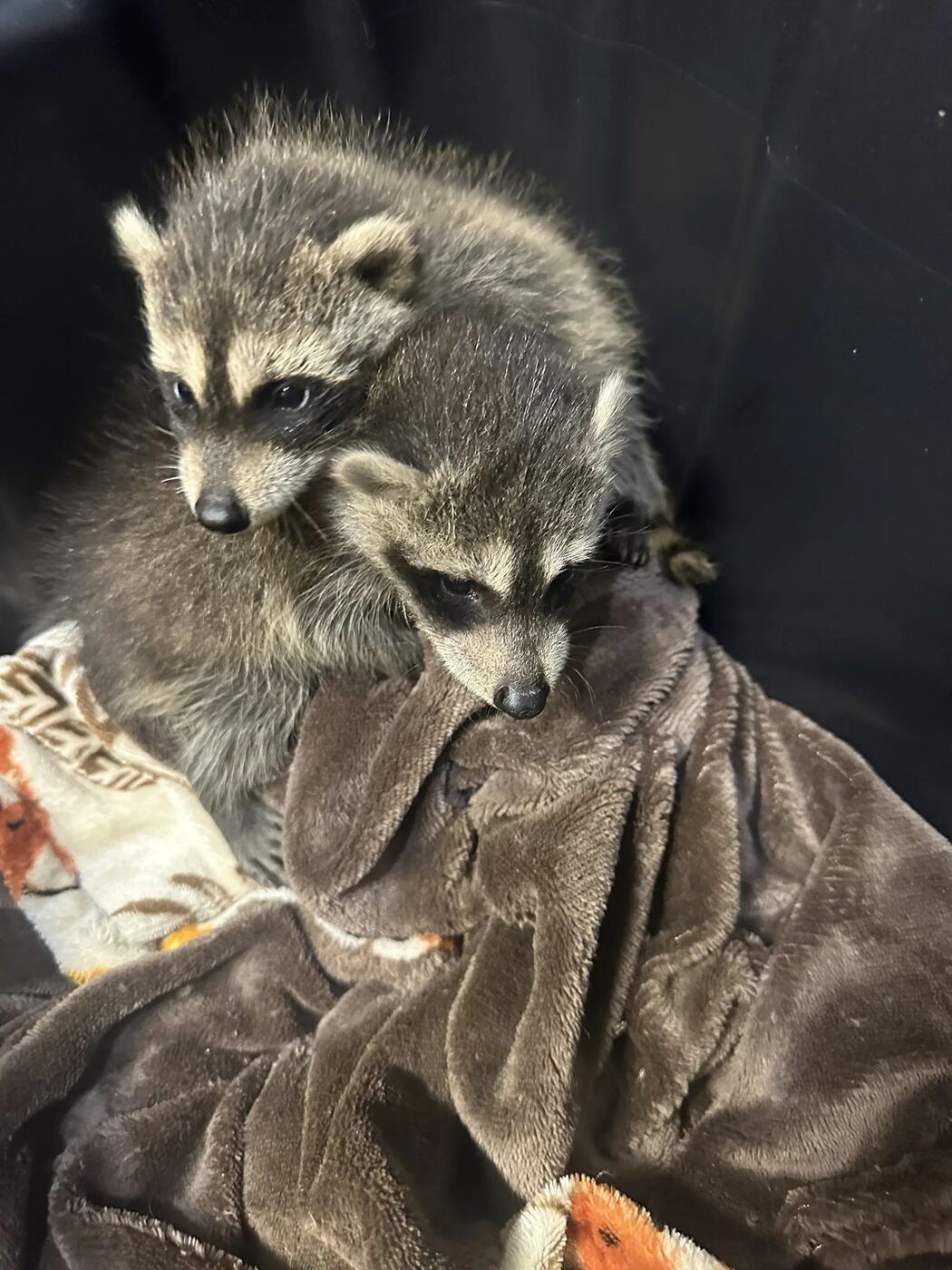
- The species has a black facial mask and a bushy tail with four to ten black rings.
- Body weight is generally around 6 to 7 kg but has been reported from 1.8 to 10.4 kg.
- Males are usually 10 to 30 percent heavier than females.
- Northern raccoons can reach body masses composed of as much as 50 percent body fat.
From the sources
From the sources
Quoted from the matching sections of reputable sources for this exact species. Specialist databases are used first; Wikipedia (community-edited, CC BY-SA 4.0) only fills gaps. Other sources are short credited quotes.
| Overview | The raccoon ( or, Procyon lotor), sometimes called the North American, northern or common raccoon (also spelled racoon) to distinguish it from other species of raccoon, is a mammal native to North America. It is the largest of the procyonid family, having a body length of 40 to 70 cm, and a body weight of 5 to 26 kg. Its grayish coat mostly consists of dense underfur, which insulates it against cold weather. — Wikipedia (community-edited) |
| Where it lives | Raccoons are extremely adaptable, being found in many kinds of habitats and easily living near humans. — Animal Diversity Web |
| Social life and communication | Raccoons have a highly developed tactile sense. — Animal Diversity Web |
| Wild diet | Procyon lotor is omnivorous and opportunistic. — Animal Diversity Web |
| Behavior | Raccoons are nocturnal and seldom active in the daytime. — Animal Diversity Web |
| Reproduction | During the mating season, raccoon males frequently expand their home ranges, presumably to include the home ranges of more females as potential mates. — Animal Diversity Web |
| Lifespan | Raccoons may live up to 16 years in the wild, but most don't make it past their second year. — Animal Diversity Web |
| Appearance and size | The most distinguishable characteristics of the raccoon are its black mask across the eyes and bushy tail with anywhere from four to ten black rings. — Animal Diversity Web |
| History and naming | In the first decades after its discovery by the members of the expedition of Christopher Columbus, who were the first Europeans to leave a written record about the species, taxonomists thought the raccoon was related to many different species, including dogs, cats, badgers and particularly bears. — Wikipedia (community-edited) |
Data and studies
Researched care notes
Researched care notes
Findings checked against veterinary, zoo, welfare, keeper and peer-reviewed sources. Air, basking-surface and water temperatures are kept separate, and where sources disagree both are shown. “Study” notes report what a paper measured, not a universal rule.
Raccoon (species)
- A balanced omnivorous ration needs a formulated basis and suitable varied foods; unrestricted calorie-dense food risks obesity. Professional managed-care guidance.1
- Design for complex movement, escape resistance, and den accommodation. Zoo-manual guidance.2
- Group tolerance varies with breeding, crowding, and individual histories. Confidence: LOW.2
- Raccoon-roundworm exposure can occur through ingestion of eggs from contaminated faeces or environments. Public-health guidance.3
The numbers
The numbers
Each bar is what one source reports. Where several sources weigh in, the dashed gold band marks their average.
Lifespan in care
Wild raccoons average about 5 years; captive records reach 21.
Outdoor enclosure size
Minimum 5×10 ft; 8×8 to 10×10 ft preferred. Bigger is always better.
Maximum recorded lifespan
Longest recorded lifespan reported by each database; typical lifespans are usually shorter. The AnAge record comes from an animal in human care.
Typical adult weight
Average adult body mass in each database (FishBase gives the maximum recorded weight).
Veterinary & husbandry research
Veterinary & husbandry research
- Behavioral flexibility of a generalist carnivore Daniels SE et al., Animal cognition 2019
- Trypanosoma cruzi Transmission Among Captive Nonhuman Primates, Wildlife, and Vectors Hodo CL et al., EcoHealth 2018
- Immunogenicity and efficacy of two rabies vaccines in wild-caught, captive raccoons Brown LJ et al., Journal of wildlife diseases 2011
- Efficacy of Ontario Rabies Vaccine Baits (ONRAB) against rabies infection in raccoons Gilbert A et al., Vaccine 2018
Peer-reviewed papers that mention this species alongside captivity, zoos, veterinary care or aquaculture. Some cover several species or mention it only in passing, so check the abstract. See all 107 on PubMed → 170
Sources for this sheet
- Just Wright Exotics at Beacon Fire Farm: Raccoon care Experienced keeper or breederHands-on breeder in Monclova, Ohio, written with guidance from their veterinarians for their own adopters.
- Animal Diversity Web (University of Michigan): Procyon lotor Zoo, university or veterinaryUniversity-hosted species account, mostly wild biology.
- AnAge: The Animal Ageing and Longevity Database (Human Ageing Genomic Resources) Peer-reviewed researchCurated, referenced longevity and life-history records for thousands of species; maximum lifespans are often from zoo animals.
- Myhrvold et al. (2015). An amniote life-history database. Ecology 96: 3109 Peer-reviewed researchPeer-reviewed compilation of life-history data for over 21,000 birds, mammals and reptiles.
- 9 CFR 2.1: Animal Welfare Act licensing (USDA) Zoo, university or veterinaryWho needs a USDA license to breed, sell or exhibit animals.
- Smithsonian's National Zoo: White-nosed coati Zoo, university or veterinaryZoo with scientific staff and long experience keeping coatis.
- Animal Diversity Web (University of Michigan): Potos flavus Zoo, university or veterinaryUniversity-hosted species account, mostly wild biology.
- Clint's Reptiles (YouTube): Raccoon, The Best Pet Mammal? Expert educator & keeperClint Laidlaw, PhD in Biology Education and MS in Evolutionary Ecology; owner of Clint's Reptile Room and a longtime keeper. His "Best Pet?" series reviews each species' care in depth.
- GBIF Backbone Taxonomy (Global Biodiversity Information Facility) Peer-reviewed researchInternational scientific taxonomy used here for classification.
- Wikipedia (species article) Community referenceFree encyclopedia; useful overviews with their own citations. Intro text is quoted under CC BY-SA 4.0.
- PubMed (U.S. National Library of Medicine) Peer-reviewed researchIndex of peer-reviewed veterinary, zoo and husbandry research.
- iNaturalist (captive observations) Community referenceCommunity observation platform run by the California Academy of Sciences and National Geographic; observations marked captive show animals living in homes, zoos and aquariums.