Home / Mammals / Rodents / Fancy rat
No federal permit to keep In-depth sheetFancy rat
Rattus norvegicus
Mammals › Rodents (Rodentia) › Muridae (Rats, mice and gerbils)
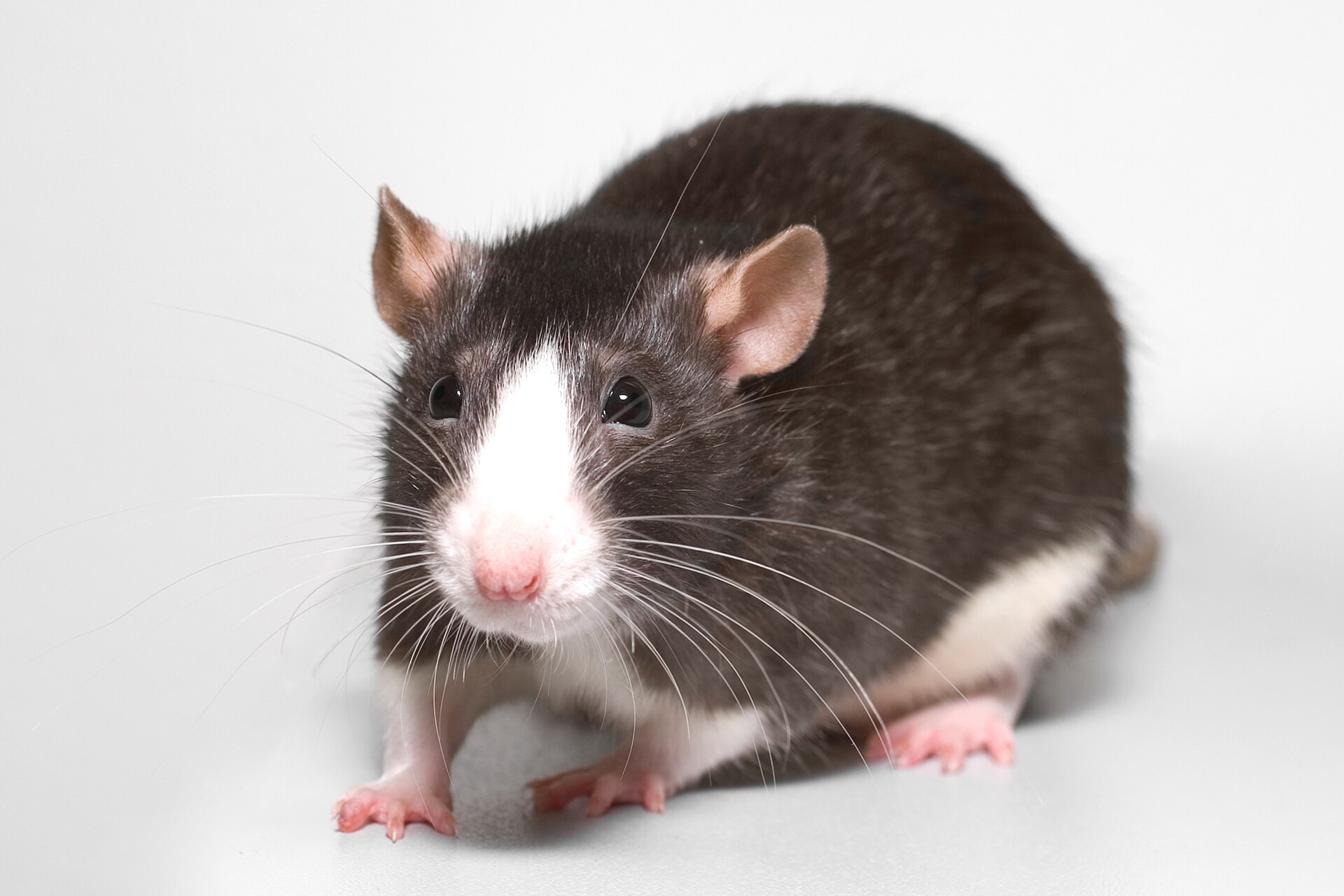
Pet rats are intelligent, social and trainable. They're happiest in same-sex groups with lots to climb and explore.
Care at a glance
Species-specific values
Values researched for this exact species. Where they differ from the group guide below, follow these. Air, surface and water temperatures are listed separately, and each source is kept as published rather than averaged.
| Lifespan typical captive | 2–3 years Pet-rodent table; not maximum longevity | 291 |
| Adult body mass male | 300–500 g | 291 |
| Adult body mass female | 200–325 g | 291 |
| Social | Keep compatible same-species companions; introductions require care. | 128 |
Care guide
Diet
- About one tablespoon of rat pellets per rat per day, scattered in the cage, plus a handful of vegetables and some fruit. Don't overfeed; obesity is common.
Sources 52
Health
- Respiratory disease is the most common problem; dusty bedding and ammonia make it worse.
Sources 52
Show the group care guide for rats and mice
Rats and mice
Applies to most species in this group. Habitat: Varies. Individual species can differ, so compare with the species numbers above and the linked sources.
Housing & setup
- A large wire or bin cage with deep, dust-free bedding, multiple levels and hides.
- Compatible rats and female mice may share; adult male mice often require separate housing.
Diet
- Use a balanced pet-rodent diet with portion control; unlimited laboratory pellets can promote obesity.
Social life
- Rats need compatible companions; female mice commonly share, while male-mouse aggression needs separate management.
Health watch
- Respiratory infection (rats), tumors and fast breeding.
Understanding the animal
In the wild
In the wild
Researched for this exact species, not its family. Good care copies these conditions.12
| Where it lives | Originally an Asian terrestrial rodent, now widespread in human-associated habitats worldwide. Wild brown rats use banks, fields, buildings and sewers, constructing branching burrows with nesting and food-storage chambers. |
| Ground it lives on | Diggable soil, bank earth and debris-lined burrows; also floors and sewer passages. |
| Climate | Lives across temperate and tropical regions, frequently buffered from weather by burrows or buildings. No single species-wide temperature or humidity range was established. |
| Active | Mostly nocturnal and crepuscular. |
| Social life | Lives in colonies with dominance hierarchies and defended group territories. |
| Wild diet | Seeds and grains, fruit, roots, invertebrates, eggs, fish, small vertebrates, carrion and discarded human food; caches food. |
| Behavior to plan for | Digs complex tunnels and follows learned foraging routes. It is an adept swimmer and navigates dark passages using smell, whiskers and touch. |
What this means for care
- Keep compatible social companions with multiple resting and feeding sites.
- Provide digging material, nesting material and interconnected tunnels.
- Use scatter feeding and changing food-search puzzles.
- Distinguish a fancy rat's domestic history from the wild ecology of this same species.
Native climate (measured)
Native climate (measured)
| Warm-season highs | about 73°F (up to 74°F in the hottest sampled areas) |
| Cool-season lows | about 33°F (down to 23°F in the coldest sampled areas) |
| Average temperature | 45–51°F across sampled records |
| Relative humidity | 78–82% on average (driest month about 71%) |
| Rainfall | about 780 mm a year, spread fairly evenly |
| Winters | Cool to cold winters (lows around 33°F) in much of its native range. Seasonal slowdown may be relevant, but species-specific biology determines whether brumation or hibernation occurs. |
Measured at 122 wild occurrence records sampled against WorldClim 2.1 climate data (1970–2000 averages). Air conditions in the range are ecological context, not enclosure settings: microhabitats such as burrows, leaf litter or basking rocks can be cooler, warmer or more humid.
Profile
Profile
Researched for this exact species. Sources are listed under In the wild above.
History
Brown rats spread from Asia into Europe, reaching every European country by about 1800, and records place them in the New World by the 1770s as ship stowaways. Selective breeding later produced the domesticated fancy rat and laboratory rat.
Keeper tips
- Use dedicated fancy-rat husbandry sources for captive-care requirements because those details are not included in the supplied material.
- Do not treat descriptions of wild sewer, urban or woodland habitat as direct captive-housing instructions.
- Recognize that the fancy rat is a selectively bred domesticated form of Rattus norvegicus.
Behaviors reported
- Readily colonizes environments associated with humans.
- Occupies a very broad range of habitats when food and shelter are available.
- Reproduces rapidly.
Unique adaptations
- An omnivorous diet permits exploitation of many food sources.
- Exceptional ecological flexibility allows the species to live in environments ranging from forests and wetlands to cities and sewers.
- Rapid reproduction assists population expansion.
Remarkable facts
- Selective breeding of brown rats produced both fancy rats and laboratory rats.
- Fancy and laboratory rats are domesticated Rattus norvegicus.
- The species is thought to have originated in northern China and neighboring areas.
- It now occurs on every continent except Antarctica.
- The supplied sources give a weight range of about 140-500 g.
- The name 'Norway rat' is a historical misnomer because the species did not originate in Norway.
From the sources
From the sources
Quoted from the matching sections of reputable sources for this exact species. Specialist databases are used first; Wikipedia (community-edited, CC BY-SA 4.0) only fills gaps. Other sources are short credited quotes.
| Overview | The brown rat (Rattus norvegicus), also known as the common rat, street rat, sewer rat, wharf rat, Hanover rat, Norway rat and Norwegian rat, is a widespread, common species of rat. One of the largest muroids, it is a brown or grey rodent with a body length of up to 28 cm long, and a tail slightly shorter than that. It weighs between 140 and 500 g. Thought to have originated in northern China and neighbouring areas, it has now spread to all continents except Antarctica, and is the dominant rat in Europe and much of North America, having become naturalised across the world. — Wikipedia (community-edited) |
| Where it lives | In Asia, R. norvegicus was native to forests and brushy areas. — Animal Diversity Web |
| Social life and communication | Like most mammals, Norway rats use a variety of communication avenues. — Animal Diversity Web |
| Wild diet | Norway rats are excellent foragers. — Animal Diversity Web |
| Behavior | Mostly nocturnal or active at dusk, Norway rats go about digging burrows, foraging for food, and preparing nests during these hours. — Animal Diversity Web |
| Reproduction | The mating system of R. norvegicus is best described as polygynandrous. — Animal Diversity Web |
| Lifespan | The maximum lifespan of R. norvegicus is 4 years (in captivity). — Animal Diversity Web |
| Appearance and size | Rattus norvegicus is a rather large member of the mouse family. — Animal Diversity Web |
| Biology | The brown rat is nocturnal and is a good swimmer, both on the surface and underwater, and has been observed climbing slim round metal poles several feet in order to reach garden bird feeders. Brown rats dig well, and often excavate extensive burrow systems. — Wikipedia (community-edited) |
| History and naming | The brown rat was originally called the "Hanover rat" by people wishing to link problems in 18th-century England with the House of Hanover. It is not known for certain why the brown rat is named Rattus norvegicus (Norwegian rat), as it did not originate from Norway. — Wikipedia (community-edited) |
Data and studies
Researched care notes
Researched care notes
Findings checked against veterinary, zoo, welfare, keeper and peer-reviewed sources. Air, basking-surface and water temperatures are kept separate, and where sources disagree both are shown. “Study” notes report what a paper measured, not a universal rule.
Fancy Rat
- Keep compatible rats in pairs or small same-sex groups; mixed-sex groups require prevention of reproduction.1
- RSPCA gives 19–23°C for enclosure air temperature; this is a room-air guideline, not a heated-surface target.2
- Provide a solid floor, climbing opportunities and several shelters; shelters should have exits that prevent one rat trapping another.2
- Use a rat-specific balanced pellet as the dietary base; small varied additions belong within the daily allowance to avoid excess calories.3
- Provide more than one drinking-water access point and check bottle flow morning and evening, so a blocked bottle does not deprive the group.3
The numbers
The numbers
Each bar is what one source reports. Where several sources weigh in, the dashed gold band marks their average.
Lifespan
Maximum recorded lifespan
Longest recorded lifespan reported by each database; typical lifespans are usually shorter. The AnAge record comes from an animal in human care.
Typical adult weight
Average adult body mass in each database (FishBase gives the maximum recorded weight).
Litter size
Average per litter or clutch.
Veterinary & husbandry research
Veterinary & husbandry research
- Alternative Animal Models of Aging Research Holtze S et al., Frontiers in molecular biosciences 2021
- Wild Rats, Laboratory Rats, Pet Rats: Global Seoul Hantavirus Disease Revisited Clement J et al., Viruses 2019
- The ancient rat Haines VL et al., The veterinary clinics of North America. Exotic animal practice 2010
- Intraperitoneal Alfaxalone and Alfaxalone-Dexmedetomidine Anesthesia in Sprague-Dawley Rats (Rattus norvegicus) West SE et al., Journal of the American Association for Laboratory Animal Science: JAALAS 2020
Peer-reviewed papers that mention this species alongside captivity, zoos, veterinary care or aquaculture. Some cover several species or mention it only in passing, so check the abstract. See all 114 on PubMed → 170
Sources for this sheet
- Royal Veterinary College Exotics Service: Rat care Zoo, university or veterinaryVet-school exotics hospital factsheet, reviewed 2021–2024.
- AnAge: The Animal Ageing and Longevity Database (Human Ageing Genomic Resources) Peer-reviewed researchCurated, referenced longevity and life-history records for thousands of species; maximum lifespans are often from zoo animals.
- Myhrvold et al. (2015). An amniote life-history database. Ecology 96: 3109 Peer-reviewed researchPeer-reviewed compilation of life-history data for over 21,000 birds, mammals and reptiles.
- Merck Veterinary Manual: Mice and rats as pets Zoo, university or veterinaryThe Merck Veterinary Manual: a standard veterinary reference written and reviewed by veterinary specialists.
- Royal Veterinary College Exotics Service: Mouse care Zoo, university or veterinaryVet-school exotics hospital factsheet, reviewed 2021–2024.
- Clint's Reptiles (YouTube): Rat, The Best Pet Mammal? Expert educator & keeperClint Laidlaw, PhD in Biology Education and MS in Evolutionary Ecology; owner of Clint's Reptile Room and a longtime keeper. His "Best Pet?" series reviews each species' care in depth.
- GBIF Backbone Taxonomy (Global Biodiversity Information Facility) Peer-reviewed researchInternational scientific taxonomy used here for classification.
- Wikipedia (species article) Community referenceFree encyclopedia; useful overviews with their own citations. Intro text is quoted under CC BY-SA 4.0.
- PubMed (U.S. National Library of Medicine) Peer-reviewed researchIndex of peer-reviewed veterinary, zoo and husbandry research.
- iNaturalist (captive observations) Community referenceCommunity observation platform run by the California Academy of Sciences and National Geographic; observations marked captive show animals living in homes, zoos and aquariums.