
Home / Reptiles / Turtles and tortoises / River cooter
No federal permit to keepRiver cooter
Pseudemys concinna
Reptiles › Turtles and tortoises (Testudines) › Emydidae (Pond turtles and box turtles)
The river cooter is a species of freshwater turtle in the family Emydidae.
Care at a glance
Setup
One answer per setting. Where sources differ, the smaller figure is the minimum and the larger is what we recommend.
| Adult enclosure | At least 20 Preferably 30 Aquarium size suitable for a 3- to 4-inch juvenile cooter. | reptilesmagazine.com |
| Hot spot | 85°F Required temperature for the basking platform. | reptilesmagazine.com |
| Water | At least 1 ft Preferably 2 ft Water depth for adult cooters in large tanks. | reptilesmagazine.com |
| Housing | 300 Adult river cooters of either sex need large tanks or outdoor ponds. | reptilesmagazine.com |
Care guide
By age
| Juvenile | Enclosure: 20- or 30-gallon aquarium, filled two-thirds to the top for a 3- to 4-inch juvenile. Feeding: Omnivorous diet including ReptoMin, Mazuri Turtle Chow, insects, snails, crayfish, earthworms, and tadpoles. | reptilesmagazine.com |
Understanding the animal
About this animal
About this animal
The species is native to the central and eastern United States, but has been introduced into parts of California, Washington, and British Columbia.
From Wikipedia: River cooter, CC BY-SA 4.0 (excerpt)
Localities
Localities
Keepers buy these by where the bloodline comes from. Care is basically the same; size, color and temperament can differ. “Breeder-reported” details still need a published source.
| eastern river cooter | Recognized as a subspecies, P. concinna concinna. | Published dwr.virginia.gov |
| hieroglyphic river cooter | Recognized as a subspecies, P. concinna hieroglyphica. | Published dwr.virginia.gov |
In the wild
In the wild
Researched for this exact species, not its family. Wild conditions are context, not enclosure settings.12
| Where it lives | River cooters inhabit large rivers with clear-flowing water, gravel bottoms, and rooted aquatic plants, as well as lakes and ponds. |
| Active | They are diurnal animals that wake with the warming sun to bask and forage, and sleep hidden under vegetation in the water. |
| Social life | River cooters frequently bask in groups on logs or rocks, sometimes piled on top of each other, and quickly slip into water. |
| Wild diet | They are omnivorous, feeding on aquatic plants, grasses, algae, small fish, aquatic invertebrates, crustaceans, insects, snails, and carrion. |
| Behavior to plan for | They are avid baskers with surprising speed, can overwinter dormant in mud underwater, and may wander between bodies of fresh water. |
Profile
Profile
Researched for this exact species. Sources are listed under In the wild above.
Keeper tips
- They are shy and quick to slip into the water when disturbed, though avid and prominent baskers.
- Turtles can be associated with public health impacts like Salmonella.
Data and studies
Veterinary & husbandry research
Veterinary & husbandry research
- Complete mitochondrial genome of the river cooter (Pseudemys concinna, Testudines: Emydidae) in Korea. et al., Mitochondrial DNA. Part B, Resources 2022
- Magnetic resonance imaging measurements of organs within the coelomic cavity of red-eared sliders (Trachemys scripta elegans), yellow-bellied sliders (Trachemys scripta scripta), Coastal plain cooters (Pseudemys concinna floridana), and hieroglyphic river cooters (Pseudemys concinna hieroglyphica). et al., American journal of veterinary research 2017
- What is your diagnosis? Coelomic fluid in an Eastern River Cooter (Pseudemys concinna concinna). et al., Veterinary clinical pathology 2023
- Turtle Girdles: Comparing the Relationships Between Environment and Behavior on Forelimb Function in Loggerhead Sea Turtles (Caretta caretta) and River Cooters (Pseudemys concinna). et al., Journal of morphology 2024
Peer-reviewed papers that mention this species alongside captivity, zoos, veterinary care or aquaculture. Some cover several species or mention it only in passing, so check the abstract. PubMed
Sources for this sheet
- Cooter turtles (reptilesmagazine.com) Experienced keeper or breederKeeper care guide.
- Eastern river cooter (dwr.virginia.gov) Expert educator & keeperZoo, government or conservation body.
- Wikipedia: Pseudemys concinna (CC BY-SA 4.0) Community referenceEncyclopedia article.
- The Reptile Database: Pseudemys concinna Zoo, university or veterinaryTaxonomy, distribution and literature for every reptile species.
- The Reptile Database Peer-reviewed researchScientist-curated catalog of every reptile species, with taxonomy and literature.
- GBIF Backbone Taxonomy (Global Biodiversity Information Facility) (CC BY 4.0) Peer-reviewed researchInternational scientific taxonomy used here for classification. GBIF Secretariat (2023). GBIF Backbone Taxonomy. Checklist dataset https://doi.org/10.15468/39omei, accessed via GBIF.org.
- Wikipedia (species article) (CC BY-SA 4.0) Community referenceFree encyclopedia; useful overviews with their own citations. Short excerpts are quoted under CC BY-SA 4.0, each credited with a link to its article.
- PubMed (U.S. National Library of Medicine) Peer-reviewed researchIndex of peer-reviewed veterinary, zoo and husbandry research.
More pond turtles and box turtles
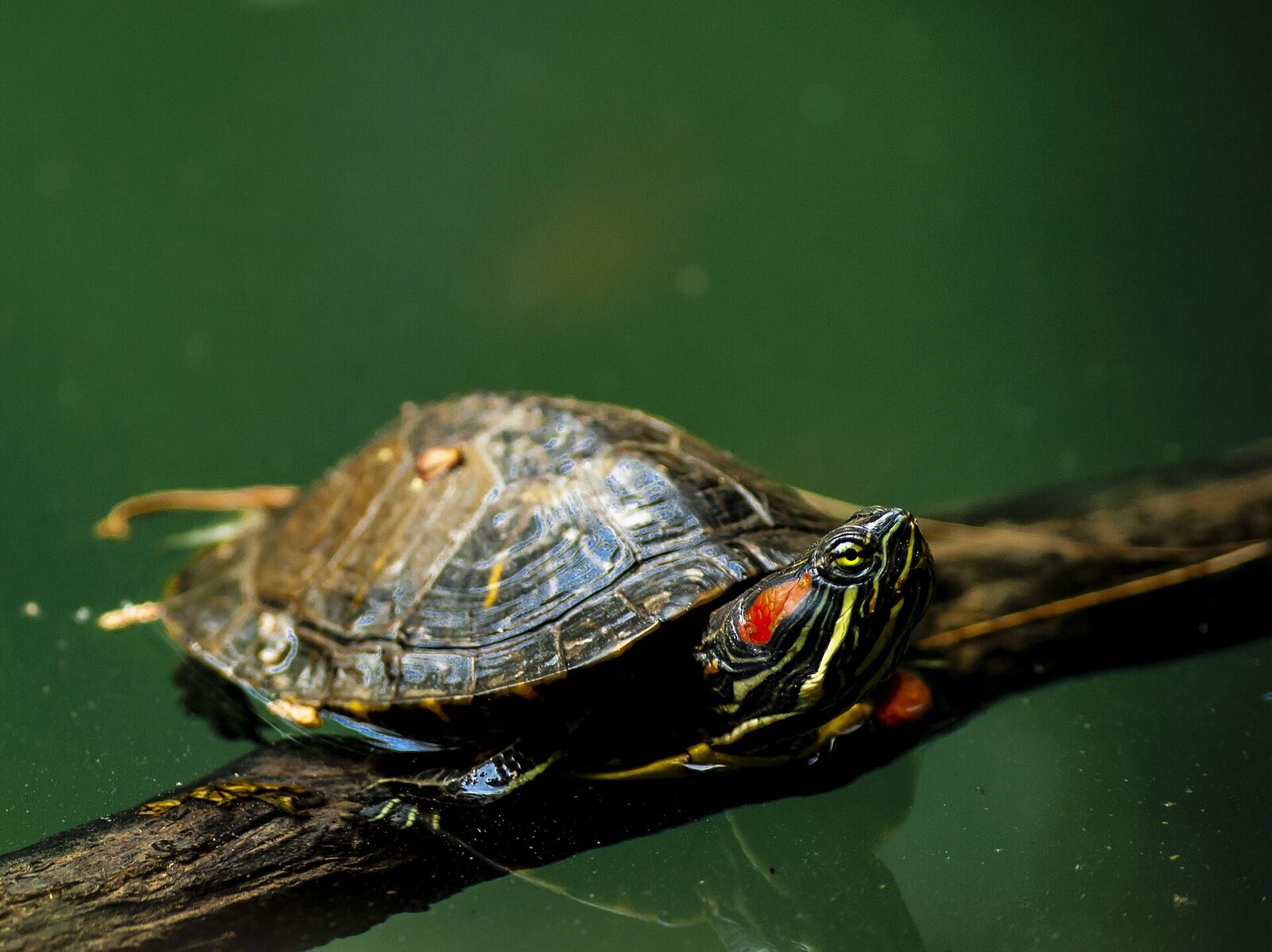
Red-eared slider
Trachemys scripta elegans
America's classic pet turtle, built to last decades.
Pet trade

Alabama map turtle
Graptemys pulchra
Zoos & aquariums

Baja California slider
Trachemys nebulosa
Pet trade

Barbour's map turtle
Graptemys barbouri
Zoos & aquariums

Black-knobbed map turtle
Graptemys nigrinoda
Pet trade

Blanding's turtle
Emydoidea blandingii
Pet trade