
Home / Reptiles / Lizards / Agamidae / Secret toad-headed agama
No federal permit to keepSecret toad-headed agama
Phrynocephalus mystaceus
Reptiles › Lizards (Lacertilia) › Agamidae (Agamas and dragons)
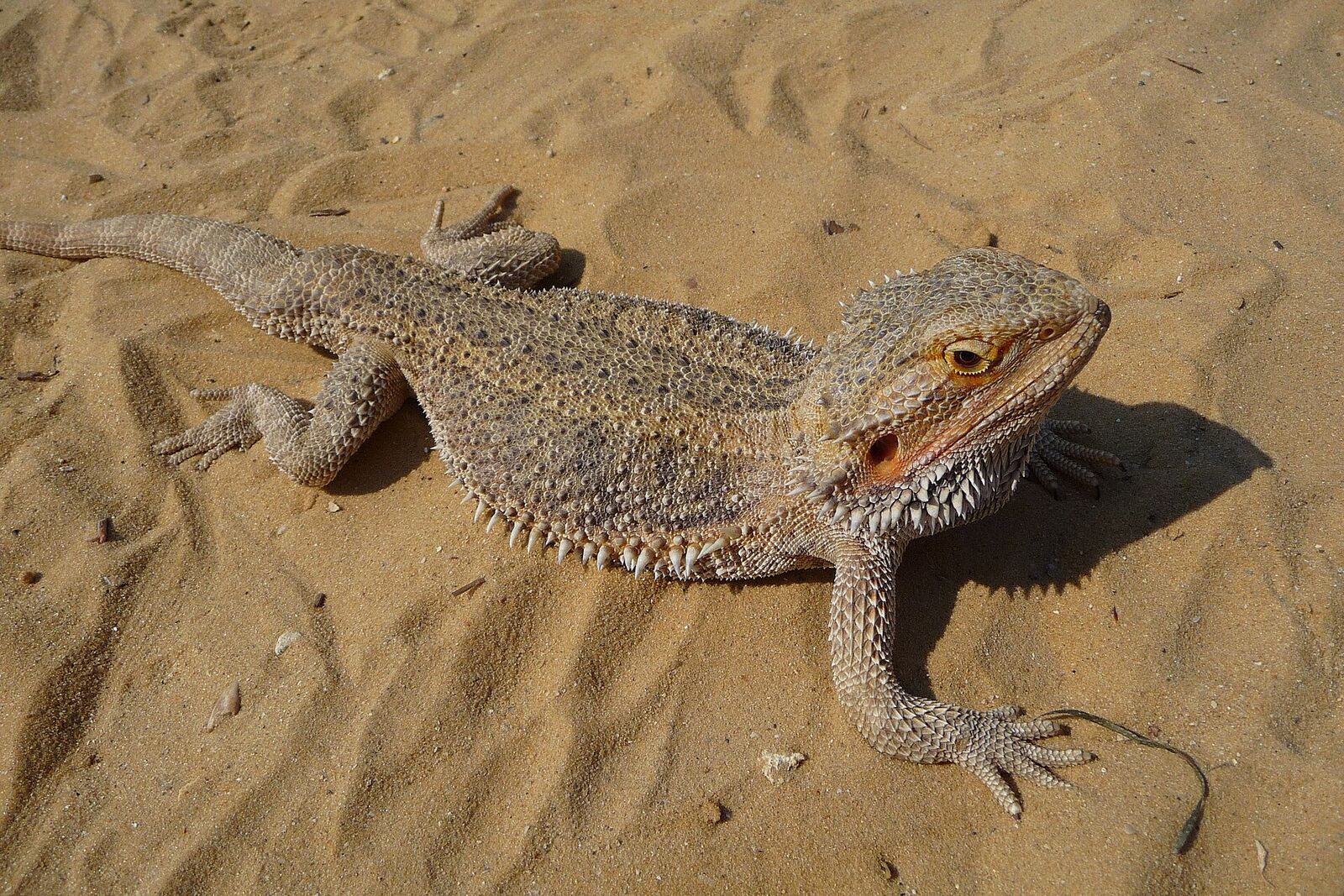
Phrynocephalus mystaceus, also known as the secret toadhead agama and toad-headed agama, is a species of agamid lizard.

Care at a glance
Species-specific values
Values researched for this exact species. Air, surface and water temperatures are listed separately, and each source is kept as published rather than averaged.
| Minimum enclosure | Use a 4 x 2 x 2 enclosure for 3 or 4 agamas. Source: mystaceus.weebly.com | |
| Basking surface temperature | The hottest point under the basking light should be nearing 45c. Source: mystaceus.weebly.com | |
| Cool side air temperature | 81–86 °F (27–30 °C) Source: mystaceus.weebly.com | |
| Humidity | Provide a humidity spike in the morning with a spray or misting. Source: mystaceus.weebly.com | |
| Uvb lighting | The article suggests an Arcadia UV +D3 flood bulb. Source: mystaceus.weebly.com | |
| Diet | Offer insects and two helpings of vegetation per week; dust with calcium, vitamin D3 weekly, and verm x monthly. Source: mystaceus.weebly.com | |
| Social housing | They prefer groups; a suggested ratio is 1 male to 3 females, with dominant males possibly housed separately. Source: mystaceus.weebly.com | |
| Substrate | Use loose sand, with at least 6 inches in the enclosure. Source: mystaceus.weebly.com |
Understanding the animal
About this animal
About this animal
It is found in southern Russia, Kazakhstan, and northwestern China (Xinjiang) and southward to northern Iran, Afghanistan, Turkmenistan, Tajikistan, Kyrgyzstan, and Uzbekistan.The most exciting feature of the toad-headed agamas is their defense mechanism. When threatened, they flatten their bodies and open their mouths wide, such that their bright-colored flaps open.
From Wikipedia: Phrynocephalus mystaceus, CC BY-SA 4.0 (excerpt)
In the wild
In the wild
Researched for this exact species, not its family. Wild conditions are context, not enclosure settings.1234
| Where it lives | Inhabits open sandy deserts and dunes from the Caspian region through Central Asia, with populations in northeastern Iran. Uses loose and partly stabilized dunes with sparse grasses, Haloxylon or Tamarix shrubs, and extensive open sand. |
| Ground it lives on | deep loose dune sand with sparse vegetation |
| Climate | Strongly seasonal arid climate. Iranian localities in the taxonomic study have January monthly means around 41-44°F (4.8-6.6°C) and July means around 85-89°F (29.2-31.9°C); these are locality air means, not basking targets. Humidity ranges were not established. |
| Active | Primarily diurnal; additional late crepuscular activity has been documented at Sarykum, Dagestan. |
| Behavior to plan for | Digs short tunnels and chambers and can rapidly sink into sand with lateral body movements. Its conspicuous fringed mouth folds form part of the threat display. |
Native climate (measured)
Native climate (measured)
| Warm-season highs | about 92°F (up to 102°F in the hottest sampled areas) |
| Cool-season lows | about 22°F (down to 12°F in the coldest sampled areas) |
| Average temperature | 50–60°F across sampled records |
| Relative humidity | 47–73% on average (driest month about 37%) |
| Rainfall | about 220 mm a year, spread fairly evenly |
| Winters | Cool to cold winters (lows around 22°F) in much of its native range. Seasonal slowdown may be relevant, but species-specific biology determines whether brumation or hibernation occurs. |
Measured at 85 wild occurrence records sampled against WorldClim 2.1 climate data (1970–2000 averages). Air conditions in the range are ecological context, not enclosure settings: microhabitats such as burrows, leaf litter or basking rocks can be cooler, warmer or more humid.
Profile
Profile
Researched for this exact species. Sources are listed under In the wild above.
History
The supplied Reptile Database material notes differing historical treatments of some named forms, including galli, which has been considered a synonym of P. mystaceus by some authors.
Data and studies
The numbers
The numbers
Each bar is what one source reports. Where several sources weigh in, the dashed gold band marks their average.
Typical adult weight
Average adult body mass in each database (FishBase gives the maximum recorded weight).
Adult snout-to-vent length
Body length without the tail.
Incubation
Sources for this sheet
- Myhrvold et al. (2015). An amniote life-history database. Ecology 96: 3109 Peer-reviewed researchPeer-reviewed compilation of life-history data for over 21,000 birds, mammals and reptiles.
- Clint's Reptiles (YouTube): Toad headed Agama, The Best Pet Lizard? Expert educator & keeperClint Laidlaw, PhD in Biology Education and MS in Evolutionary Ecology; owner of Clint's Reptile Room and a longtime keeper. His "Best Pet?" series reviews each species' care in depth.
- The Reptile Database Peer-reviewed researchScientist-curated catalog of every reptile species, with taxonomy and literature.
- GBIF Backbone Taxonomy (Global Biodiversity Information Facility) (CC BY 4.0) Peer-reviewed researchInternational scientific taxonomy used here for classification. GBIF Secretariat (2023). GBIF Backbone Taxonomy. Checklist dataset https://doi.org/10.15468/39omei, accessed via GBIF.org.
- Wikipedia (species article) (CC BY-SA 4.0) Community referenceFree encyclopedia; useful overviews with their own citations. Short excerpts are quoted under CC BY-SA 4.0, each credited with a link to its article.
- iNaturalist (captive observations) Community referenceCommunity observation platform run by the California Academy of Sciences and National Geographic; observations marked captive show animals living in homes, zoos and aquariums.
More agamas and dragons
Bearded dragon
Pogona vitticeps
Sun-loving, friendly and endlessly popular.
Pet trade

(Sulawesi) Sailfin Lizard
Hydrosaurus celebensis
Pet trade

(Sulawesi) Sailfin Lizard (Hydrosaurus microlophus)
Hydrosaurus microlophus
Pet trade

Australian water dragon
Intellagama lesueurii
Pet trade

Bent's Mastigure
Uromastyx benti
Pet trade

Black-necked agama
Acanthocercus atricollis
Zoos & aquariums