
Home / Reptiles / Lizards / Agamidae / Shield-tailed agama
No federal permit to keepShield-tailed agama
Xenagama taylori
Reptiles › Lizards (Lacertilia) › Agamidae (Agamas and dragons)
The shield-tailed agama (Xenagama taylori), also known commonly as the dwarf shield-tailed agama, Taylor's strange agama, and the turnip-tailed agama, is a species of lizard in the family Agamidae.
From Wikipedia: Shield-tailed agama, CC BY-SA 4.0 (excerpt)

Care at a glance
Species-specific values
Values researched for this exact species. Air, surface and water temperatures are listed separately, and each source is kept as published rather than averaged.
| Minimum enclosure | One adult needs 90 x 45 x 45 cm of space minimum. Source: academy.herpeton.net | |
| Basking surface temperature | 104–113 °F (40–45 °C) Source: academy.herpeton.net | |
| Warm side air temperature | 77–86 °F (25–30 °C) Source: academy.herpeton.net | |
| Cool side air temperature | 73–81 °F (23–27 °C) Source: academy.herpeton.net | |
| Humidity | 40–60 % Source: academy.herpeton.net | |
| Uvb lighting | Use linear UVB and target UVI around 3-4.5 at basking height. Source: academy.herpeton.net | |
| Diet | Feed small insects and offer safe greens, flowers, and grated vegetables. Source: academy.herpeton.net | |
| Feeding frequency | Juveniles eat small insects daily or nearly daily; adults eat insects every other day and plant food most days. Source: academy.herpeton.net | |
| Social housing | Compatible pairs or small groups may be kept by experienced keepers, with separation if aggression appears. Source: academy.herpeton.net | |
| Substrate | Use 10-15 cm of compactable sandy soil with clay or topsoil. Source: academy.herpeton.net | |
| Substrate | Use garden soil 3–5 inches deep for tunneling. Source: kingsnake.com | |
| Basking surface temperature | 90–110 °F Source: kingsnake.com | |
| Cool side air temperature | The cool end is approximately 20 degrees cooler than the basking site. Source: kingsnake.com | |
| Uvb lighting | They offer little or no extra lighting; some direct sunlight exposure is suggested. Source: kingsnake.com | |
| Diet | Small to medium crickets, mealworms, occasional super worms, and varied leafy greens and vegetables. Source: kingsnake.com | |
| Feeding frequency | Crickets or mealworms are offered daily; greens and vegetables twice weekly. Source: kingsnake.com | |
| Social housing | The authors kept them communally in larger enclosures, with one male and four or five females for breeding. Source: kingsnake.com | |
| Seasonal cooling | 65–80 °F Source: kingsnake.com |
Understanding the animal
About this animal
About this animal
The species is endemic to the Horn of Africa.
From Wikipedia: Shield-tailed agama, CC BY-SA 4.0 (excerpt)
In the wild
In the wild
| Overview | The shield-tailed agama (Xenagama taylori), also known commonly as the dwarf shield-tailed agama, Taylor's strange agama, and the turnip-tailed agama, is a species of lizard in the family Agamidae. The species is endemic to the Horn of Africa. — From Wikipedia: Shield-tailed agama, CC BY-SA 4.0 (excerpt) |
| Where it lives | X. taylori lives on arid, flat land, sometimes on hilly landscapes, sandy but also hard ground, where it digs deep galleries. It survives at 45 to 50 °C maximum temperature, but average ranges between 25 and 35 °C in very dry environments, with the exception of strong spring storms and high humidity. — From Wikipedia: Shield-tailed agama, CC BY-SA 4.0 (excerpt) |
| Wild diet | Being a small lizard, X. taylori is essentially insectivorous, but has been seen to eat grasses, fruits, and berries. — From Wikipedia: Shield-tailed agama, CC BY-SA 4.0 (excerpt) |
| Behavior | Like most other Xenagama species, X. taylori will shelter within self-made burrows and use the whorl-like, heavily built tail to close the burrow to evade predators. — From Wikipedia: Shield-tailed agama, CC BY-SA 4.0 (excerpt) |
Read about this species in the wild at The Reptile Database.
Profile
Profile
Researched for this exact species. Sources are listed under In the wild above.
Data and studies
The numbers
The numbers
Each bar is what one source reports. Where several sources weigh in, the dashed gold band marks their average.
Incubation
Sources for this sheet
- Myhrvold et al. (2015). An amniote life-history database. Ecology 96: 3109 Peer-reviewed researchPeer-reviewed compilation of life-history data for over 21,000 birds, mammals and reptiles.
- The Reptile Database Peer-reviewed researchScientist-curated catalog of every reptile species, with taxonomy and literature.
- GBIF Backbone Taxonomy (Global Biodiversity Information Facility) (CC BY 4.0) Peer-reviewed researchInternational scientific taxonomy used here for classification. GBIF Secretariat (2023). GBIF Backbone Taxonomy. Checklist dataset https://doi.org/10.15468/39omei, accessed via GBIF.org.
- Wikipedia (species article) (CC BY-SA 4.0) Community referenceFree encyclopedia; useful overviews with their own citations. Short excerpts are quoted under CC BY-SA 4.0, each credited with a link to its article.
- iNaturalist (captive observations) Community referenceCommunity observation platform run by the California Academy of Sciences and National Geographic; observations marked captive show animals living in homes, zoos and aquariums.
More agamas and dragons
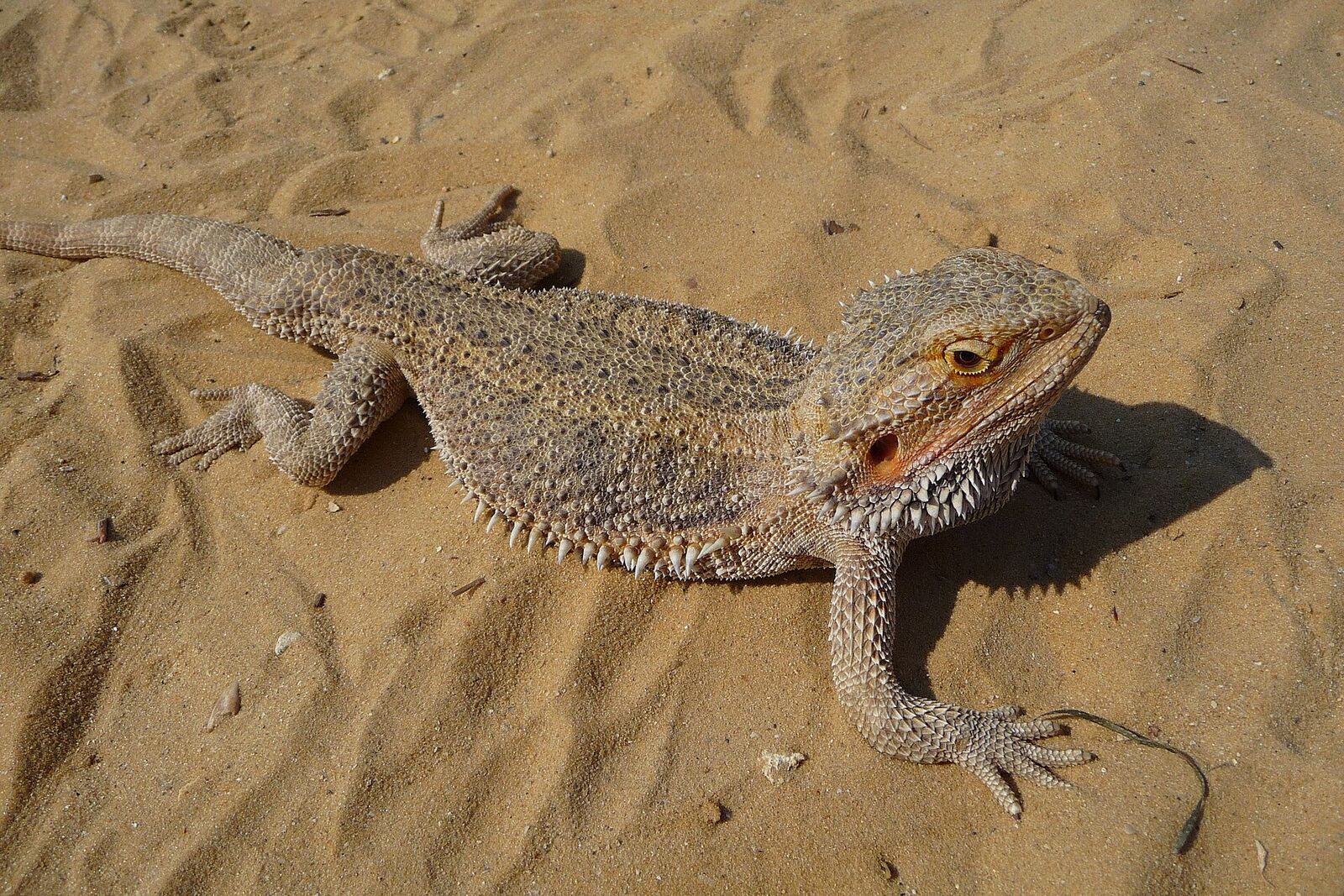
Bearded dragon
Pogona vitticeps
Sun-loving, friendly and endlessly popular.
Pet trade

(Sulawesi) Sailfin Lizard
Hydrosaurus celebensis
Pet trade

(Sulawesi) Sailfin Lizard (Hydrosaurus microlophus)
Hydrosaurus microlophus
Pet trade

Australian water dragon
Intellagama lesueurii
Pet trade

Bent's Mastigure
Uromastyx benti
Pet trade

Black-necked agama
Acanthocercus atricollis
Zoos & aquariums