
Home / Reptiles / Turtles and tortoises / Spotted turtle
Some federal rules applySpotted turtle
Clemmys guttata
Reptiles › Turtles and tortoises (Testudines) › Emydidae (Pond turtles and box turtles)
The spotted turtle (Clemmys guttata), the only species of the genus Clemmys, is a small, semi-aquatic turtle.

Care at a glance
Species-specific values
Values researched for this exact species. Air, surface and water temperatures are listed separately, and each source is kept as published rather than averaged.
| Minimum enclosure | 36″L x 18″W x 12″H or larger Source: reptifiles.com | |
| Basking surface temperature | 86–90 °F Source: reptifiles.com | |
| Water temperature | 70–84 °F Source: reptifiles.com | |
| Uvb lighting | Supply UVB aiming for a 3.0 to 4.0 UVI range within the basking zone. Source: reptifiles.com | |
| Social housing | House one turtle per enclosure; loneliness is not a concern for this species. Source: reptifiles.com |
Understanding the animal
About this animal
About this animal
Their broad, smooth, low upper shell, or carapace, reaches 8–12 cm (3.1–4.7 in) upon adulthood, and ranges in its exact colour from black to a bluish black with a number of tiny yellow round spots. The spotting patterning extends from the head, to the neck and out onto the limbs.
From Wikipedia: Spotted turtle, CC BY-SA 4.0 (excerpt)
In the wild
In the wild
Researched for this exact species, not its family. Wild conditions are context, not enclosure settings.123
| Where it lives | Eastern North American sedge marshes, boggy ponds, fens, wooded swamps and slow muddy streams. Uses shallow vegetated water and adjacent woodland or marsh-edge land refuges. |
| Ground it lives on | Soft wetland mud; leaf litter and moist soil in terrestrial refuges. |
| Climate | Strong seasonal cooling and winter dormancy. Wild courtship is recorded in water at 36–47°F; feeding begins around 59°F, while water above about 86°F often accompanies summer inactivity. Humidity ranges were not established. |
| Active | Usually described as diurnal, with documented nighttime movement; winter brumation and sometimes prolonged summer aestivation. |
| Social life | Local aggregations share wetlands; males can fight over females and courtship includes biting. |
| Wild diet | Worms, mollusks, crustaceans, aquatic insects, amphibian eggs and larvae, carrion, algae and soft aquatic plants. |
| Behavior to plan for | Travels on land and may bury in leaf litter for summer dormancy. Startled basking turtles dive and hide in bottom mud. |
Data and studies
The numbers
The numbers
Each bar is what one source reports. Where several sources weigh in, the dashed gold band marks their average.
Maximum recorded lifespan
Longest recorded lifespan reported by each database; typical lifespans are usually shorter.
Typical adult weight
Average adult body mass in each database (FishBase gives the maximum recorded weight).
Clutch size
Average per litter or clutch.
Incubation
Female maturity
Basking spot
Species-specific values from keeper care sheets. Basking figures are often surface readings taken with an infrared thermometer, which run hotter than air.
Care articles for this species
Care articles for this species
- Spotted Turtle Care Sheet (ReptiFiles)
- Captive Breeding Program For The Spotted Turtle Launched In Ohio (Reptiles Magazine)
- Spotted Turtle Care Info (Reptiles Magazine)
- Spotted Turtle Care And Breeding Information (Reptiles Magazine)
Written by keepers, breeders and vets Reptiles MagazineReptiFiles
Veterinary & husbandry research
Veterinary & husbandry research
- PARTIAL HEMATOLOGY, BIOCHEMISTRY, AND PROTEIN ELECTROPHORESIS REFERENCE INTERVALS FOR CAPTIVE SPOTTED TURTLES (CLEMMYS GUTTATA) Buscaglia NA et al., Journal of zoo and wildlife medicine: official publication of the American Association of Zoo Veterinarians 2021
Peer-reviewed papers that mention this species alongside captivity, zoos, veterinary care or aquaculture. Some cover several species or mention it only in passing, so check the abstract. See all 2 on PubMed → PubMed
Sources for this sheet
- AnAge: The Animal Ageing and Longevity Database (Human Ageing Genomic Resources) (CC BY 3.0) Peer-reviewed researchCurated, referenced longevity and life-history records for thousands of species; maximum lifespans are often from zoo animals.
- Myhrvold et al. (2015). An amniote life-history database. Ecology 96: 3109 Peer-reviewed researchPeer-reviewed compilation of life-history data for over 21,000 birds, mammals and reptiles.
- ReptiFiles (care guides) Experienced keeper or breederWell-researched reptile care guides that cite herpetological literature and experienced keepers.
- Species+ (UNEP-WCMC and the CITES Secretariat) Zoo, university or veterinaryThe official database of species listed under CITES. UNEP (2026). The Species+ Website. Nairobi, Kenya. Compiled by UNEP-WCMC, Cambridge, UK. Available at: www.speciesplus.net. [Accessed 04/10/2026].
- USFWS International Affairs: CITES Zoo, university or veterinaryFederal agency that issues CITES permits.
- 21 CFR 1240.62: Turtles under 4 inches (FDA) Zoo, university or veterinaryFederal ban on selling small turtles.
- The Reptile Database Peer-reviewed researchScientist-curated catalog of every reptile species, with taxonomy and literature.
- GBIF Backbone Taxonomy (Global Biodiversity Information Facility) (CC BY 4.0) Peer-reviewed researchInternational scientific taxonomy used here for classification. GBIF Secretariat (2023). GBIF Backbone Taxonomy. Checklist dataset https://doi.org/10.15468/39omei, accessed via GBIF.org.
- Wikipedia (species article) (CC BY-SA 4.0) Community referenceFree encyclopedia; useful overviews with their own citations. Short excerpts are quoted under CC BY-SA 4.0, each credited with a link to its article.
- PubMed (U.S. National Library of Medicine) Peer-reviewed researchIndex of peer-reviewed veterinary, zoo and husbandry research.
- iNaturalist (captive observations) Community referenceCommunity observation platform run by the California Academy of Sciences and National Geographic; observations marked captive show animals living in homes, zoos and aquariums.
- Reptiles Magazine (care articles) Experienced keeper or breederEstablished reptile and amphibian hobby magazine; care articles are written by breeders, keepers and veterinarians.
More pond turtles and box turtles
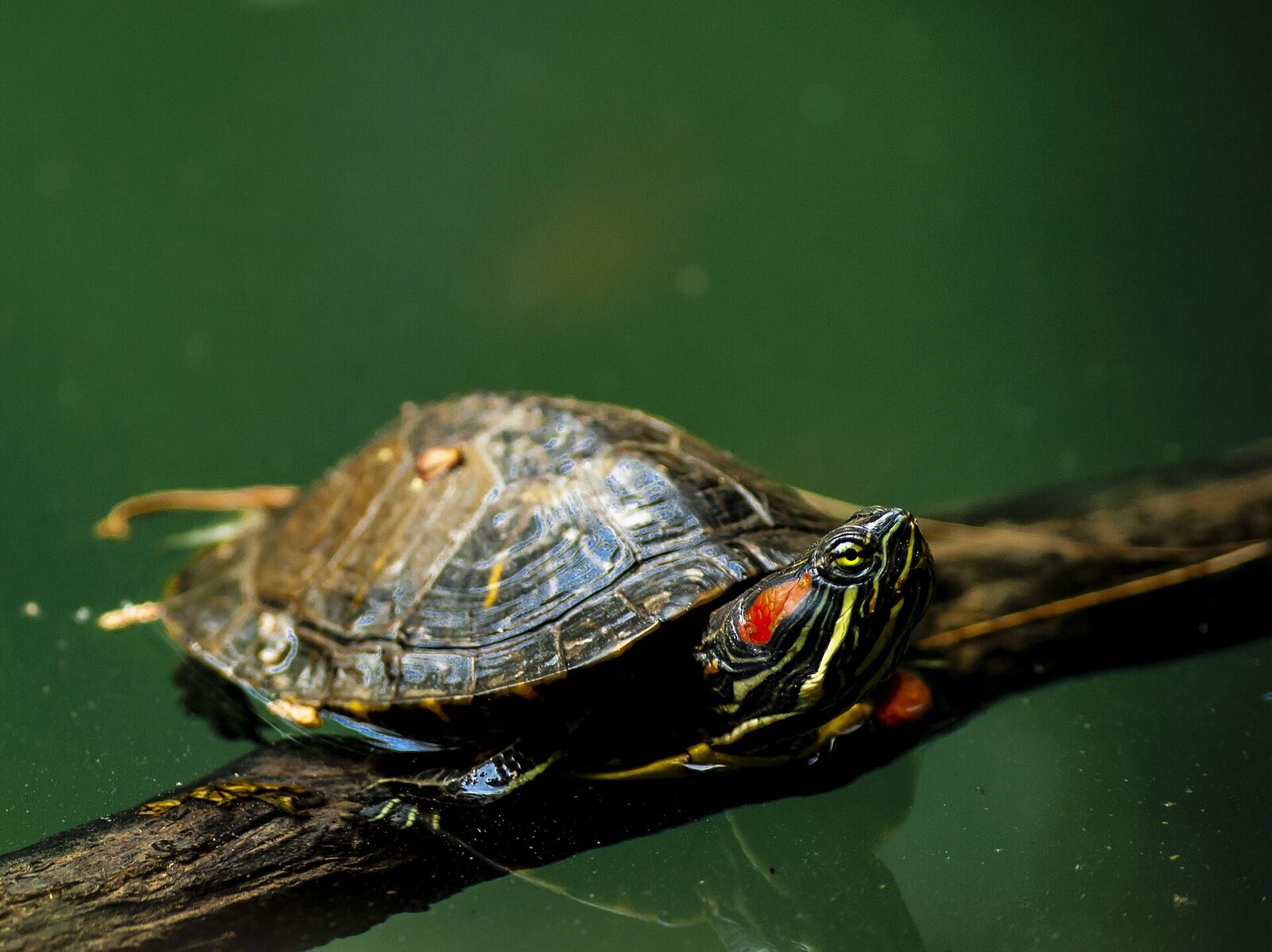
Red-eared slider
Trachemys scripta elegans
America's classic pet turtle, built to last decades.
Pet trade

Alabama map turtle
Graptemys pulchra
Zoos & aquariums

Baja California slider
Trachemys nebulosa
Pet trade

Barbour's map turtle
Graptemys barbouri
Zoos & aquariums

Black-knobbed map turtle
Graptemys nigrinoda
Pet trade

Blanding's turtle
Emydoidea blandingii
Pet trade