Home / Reptiles / Turtles and tortoises / Sulcata (African spurred) tortoise
Some federal rules apply In-depth sheetSulcata (African spurred) tortoise
Centrochelys sulcata
Reptiles › Turtles and tortoises (Testudines) › Testudinidae (Tortoises)
Sulcatas grow into very large, powerful tortoises that need outdoor space. Clint's Reptiles recommends rescuing one, scoring them 3.4/5.
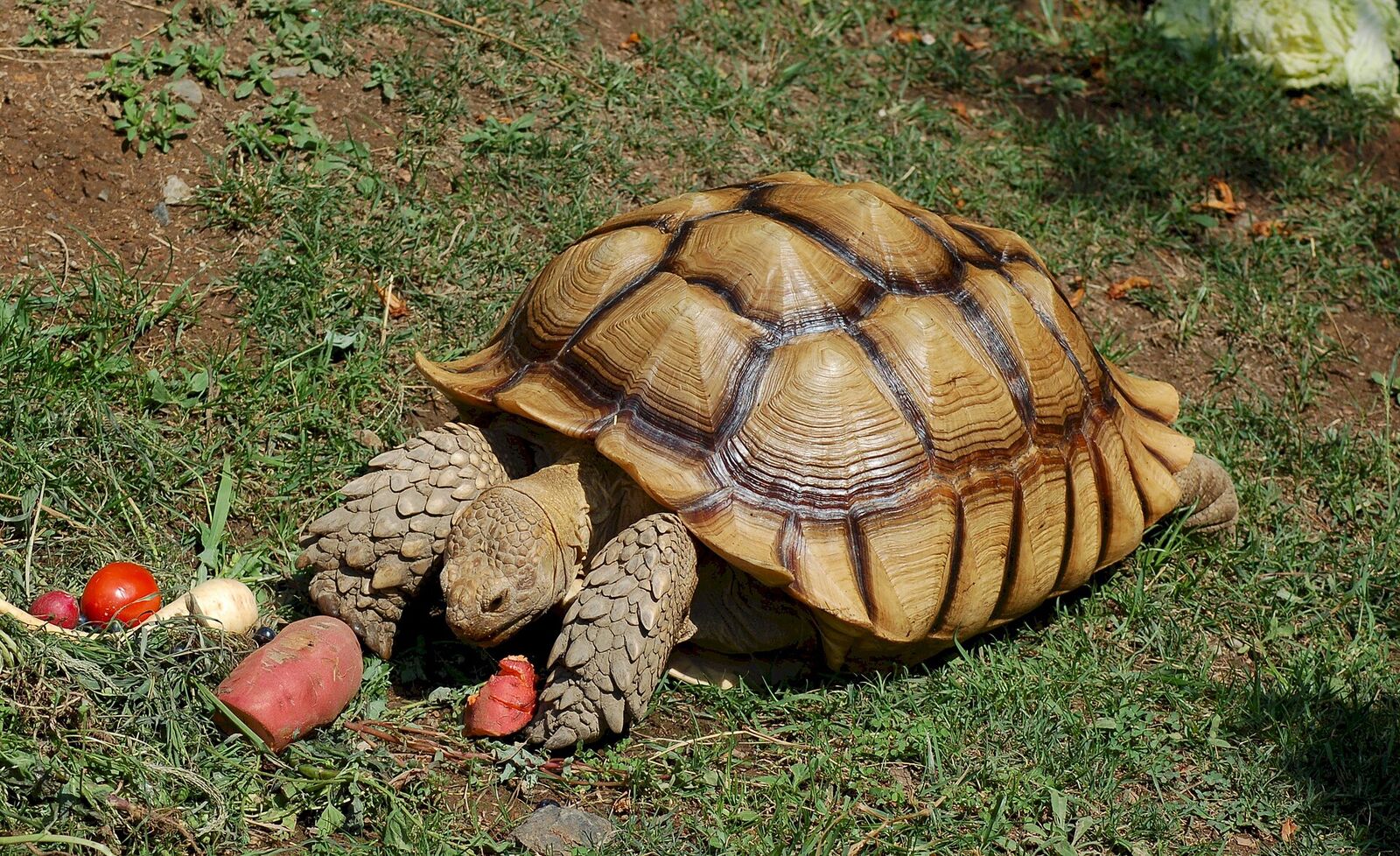
Care guide
Care
- Extremely hardy but grow huge; plan for outdoor enclosures and heated shelter.
Sources 98
Show the group care guide for grassland and giant tortoises
Grassland and giant tortoises
Applies to most species in this group. Habitat: Savanna, dry grassland and islands. Individual species can differ, so compare with the species numbers above and the linked sources.
Housing & setup
- Sulcatas, leopards and giants grow huge: plan for a large outdoor yard with a heated shed.
- They dig, so fences need to go deep or have a buried footing.
Climate & lighting
| Basking spot | 95–105°F |
| Warm side / daytime | 80–90°F |
| Cool side | 70–78°F |
| Humidity | 40–60% |
- UVB: Required (strong).
Diet
- Grasses and hay as a staple, plus weeds and leafy greens; no fruit for grassland species.
Health watch
- Bladder stones and dehydration from dry diets; give soaking water.
Understanding the animal
In the wild
In the wild
Researched for this exact species, not its family. Good care copies these conditions.123
| Where it lives | Inhabits Sahelian savannas along the southern Sahara, including Senegal, Mali, Burkina Faso and Niger. It favors seasonal drainage corridors, vegetated stabilized dunes and shrublands with grasses, using deep burrows. |
| Ground it lives on | Light sandy soil suitable for digging long burrows, beneath savanna grasses and shrubs. |
| Climate | Strong wet/dry seasonality; Mali habitats can exceed 104°F (40°C) by day and fall below 59°F (15°C) at night. Burrows buffer surface extremes; a quantitative wild relative-humidity range was not established. |
| Active | Diurnal with early-morning and smaller evening peaks; wet-season surface activity peaks around August in Burkina Faso. Prolonged dry-season burrow retreat includes aestivation. |
| Social life | Dispersed individuals; males are highly territorial and fight. Burrows are occasionally shared. |
| Wild diet | Grasses, herbs, succulents and withered vegetation, including crowfoot grass, fingergrass, purslane and Leptadenia hastata; occasional mushrooms and carrion. |
| Behavior to plan for | Excavates burrows reported up to 49 feet (15 m) long. Male combat and mating involve forceful physical interactions. |
What this means for care
- Provide deep diggable soil and secure boundaries against tunneling.
- Offer a buffered retreat rather than exposing it continuously to surface heat or cold.
- Base feeding on fibrous grasses and weeds.
- Plan separate housing for territorial males.
Native climate (measured)
Native climate (measured)
| Warm-season highs | about 91°F (up to 96°F in the hottest sampled areas) |
| Cool-season lows | about 38°F (down to 24°F in the coldest sampled areas) |
| Average temperature | 57–73°F across sampled records |
| Relative humidity | 65–72% on average (driest month about 66%) |
| Rainfall | about 1216 mm a year, spread fairly evenly |
| Winters | Cool to cold winters (lows around 38°F) in much of its native range. Seasonal slowdown may be relevant, but species-specific biology determines whether brumation or hibernation occurs. |
Measured at 42 wild occurrence records sampled against WorldClim 2.1 climate data (1970–2000 averages). Air conditions in the range are ecological context, not enclosure settings: microhabitats such as burrows, leaf litter or basking rocks can be cooler, warmer or more humid.
Profile
Profile
Researched for this exact species. Sources are listed under In the wild above.
History
John Frederick Miller illustrated and formally named the species Testudo sulcata in 1779. The name sulcata derives from the Latin sulcus, meaning 'furrow,' referring to furrows on the tortoise's scales.
Keeper tips
- Account for strong natural digging and burrowing behavior.
- Provide a way for the animal to retreat from intense heat rather than assuming constant exposure to hot, dry conditions is natural.
- Do not interpret the species' desert and Sahel distribution as meaning it never uses more humid microhabitats; wild tortoises specifically burrow toward higher moisture.
Behaviors reported
- Excavates deep and extensive burrows.
- Spends the hottest part of the day underground.
- Uses burrows to reach areas with higher moisture.
Unique adaptations
- Deep burrowing allows access to more favorable moisture conditions in an arid environment.
- Retreating underground during extreme daytime heat reduces exposure to harsh surface conditions.
- The species persists across semiarid grasslands, savannas, thorn shrublands, dunes, and other dry habitats.
Remarkable facts
- Centrochelys sulcata is the largest mainland tortoise species in Africa.
- It is described as the third-largest tortoise species in the world.
- It is the only living species in the genus Centrochelys.
- There are no recognized subspecies.
- The species is oviparous and has temperature-dependent sex determination.
From the sources
From the sources
Quoted from the matching sections of reputable sources for this exact species. Specialist databases are used first; Wikipedia (community-edited, CC BY-SA 4.0) only fills gaps. Other sources are short credited quotes.
| Overview | The African spurred tortoise (Centrochelys sulcata), also called the sulcata tortoise, is an endangered species of tortoise inhabiting the southern edge of the Sahara Desert and the Sahel. It is the largest mainland species of tortoise in Africa, and the third-largest in the world, after the Galapagos tortoise and Aldabra giant tortoise. It is the only living species in its genus, Centrochelys. — Wikipedia (community-edited) |
| Where it lives | The African spurred tortoise is native to the Sahara Desert and the Sahel, a transitional ecoregion of semiarid grasslands, savannas, and thorn shrublands found in the countries of Burkina Faso, the Central African Republic, Chad, Eritrea, Ethiopia, Mali, Mauritania, Nigeria, Senegal, Sudan and possibly in Somalia, Algeria, Benin, and Cameroon. It is possibly extirpated from Djibouti and Togo. — Wikipedia (community-edited) |
| Wild diet | Sulcata tortoises are mostly herbivores. Primarily, their diets consist of many types of grasses, plants (especially succulent plants), and hay. Flowers and other plants, including cactus pads, can be consumed. — Wikipedia (community-edited) |
| Reproduction | Temperature‐dependent sex determination (TSD) fide Nemesházi & Bókony 2023. — The Reptile Database |
| Lifespan | C.The species is the largest of the mainland tortoises. — Wikipedia (community-edited) |
| History and naming | Probably named after Latin sulcus (= groove) in reference to the grooved carapace, which has a deep cleavage above the neck. — The Reptile Database |
Data and studies
Researched care notes
Researched care notes
Findings checked against veterinary, zoo, welfare, keeper and peer-reviewed sources. Air, basking-surface and water temperatures are kept separate, and where sources disagree both are shown. “Study” notes report what a paper measured, not a universal rule.
Sulcata Tortoise (species; focused juvenile evidence)
- The rearing study links drier conditions with greater pyramidal shell growth. Growing sulcatas need a distinct microclimate review; this does not establish a universal adult humidity target. Research interpretation.1
The numbers
The numbers
Each bar is what one source reports. Where several sources weigh in, the dashed gold band marks their average.
Maximum recorded lifespan
Longest recorded lifespan reported by each database; typical lifespans are usually shorter. The AnAge record comes from an animal in human care.
Typical adult weight
Average adult body mass in each database (FishBase gives the maximum recorded weight).
Veterinary & husbandry research
Veterinary & husbandry research
- Investigations on the prevalence of tortoise picorna-virus in captive tortoises in Germany Paries S et al., Tierarztliche Praxis. Ausgabe K, Kleintiere/Heimtiere 2018
- Survey of tortoises with urolithiasis in Japan Takami Y et al., The Journal of veterinary medical science 2021
- SELECTED PLASMA BIOCHEMISTRY ANALYTES OF HEALTHY CAPTIVE SULCATA (AFRICAN SPURRED) TORTOISES (CENTROCHELYS SULCATA) Eshar D et al., Journal of zoo and wildlife medicine: official publication of the American Association of Zoo Veterinarians 2016
- Hematochezia in an African spurred tortoise (Centrochelys sulcata) Raiti P et al., Journal of zoo and wildlife medicine: official publication of the American Association of Zoo Veterinarians 2011
Peer-reviewed papers that mention this species alongside captivity, zoos, veterinary care or aquaculture. Some cover several species or mention it only in passing, so check the abstract. See all 9 on PubMed → 170
Sources for this sheet
- Clint's Reptiles (YouTube): Sulcata Tortoise, The Best Pet Turtle? Expert educator & keeperClint Laidlaw, PhD in Biology Education and MS in Evolutionary Ecology; owner of Clint's Reptile Room and a longtime keeper. Rates each species on handleability, care, hardiness, availability and upfront cost.
- AnAge: The Animal Ageing and Longevity Database (Human Ageing Genomic Resources) Peer-reviewed researchCurated, referenced longevity and life-history records for thousands of species; maximum lifespans are often from zoo animals.
- Species+ (UNEP-WCMC and the CITES Secretariat) Zoo, university or veterinaryThe official database of species listed under CITES.
- USFWS International Affairs: CITES Zoo, university or veterinaryFederal agency that issues CITES permits.
- 21 CFR 1240.62: Turtles under 4 inches (FDA) Zoo, university or veterinaryFederal ban on selling small turtles.
- Merck Veterinary Manual: Management and husbandry of reptiles Zoo, university or veterinaryThe Merck Veterinary Manual: a standard veterinary reference written and reviewed by veterinary specialists.
- Merck Veterinary Manual: Nutritional, metabolic and endocrine diseases of reptiles Zoo, university or veterinaryThe Merck Veterinary Manual: a standard veterinary reference written and reviewed by veterinary specialists.
- Royal Veterinary College Exotics Service: Leopard tortoise care Zoo, university or veterinaryVet-school exotics hospital factsheet, reviewed 2021–2024.
- Clint's Reptiles (YouTube): Sulcata Tortoise, The Best Pet Turtle? Expert educator & keeperClint Laidlaw, PhD in Biology Education and MS in Evolutionary Ecology; owner of Clint's Reptile Room and a longtime keeper. His "Best Pet?" series reviews each species' care in depth.
- The Reptile Database Peer-reviewed researchScientist-curated catalog of every reptile species, with taxonomy and literature.
- GBIF Backbone Taxonomy (Global Biodiversity Information Facility) Peer-reviewed researchInternational scientific taxonomy used here for classification.
- Wikipedia (species article) Community referenceFree encyclopedia; useful overviews with their own citations. Intro text is quoted under CC BY-SA 4.0.
- PubMed (U.S. National Library of Medicine) Peer-reviewed researchIndex of peer-reviewed veterinary, zoo and husbandry research.
- iNaturalist (captive observations) Community referenceCommunity observation platform run by the California Academy of Sciences and National Geographic; observations marked captive show animals living in homes, zoos and aquariums.
More tortoises
 In-depth
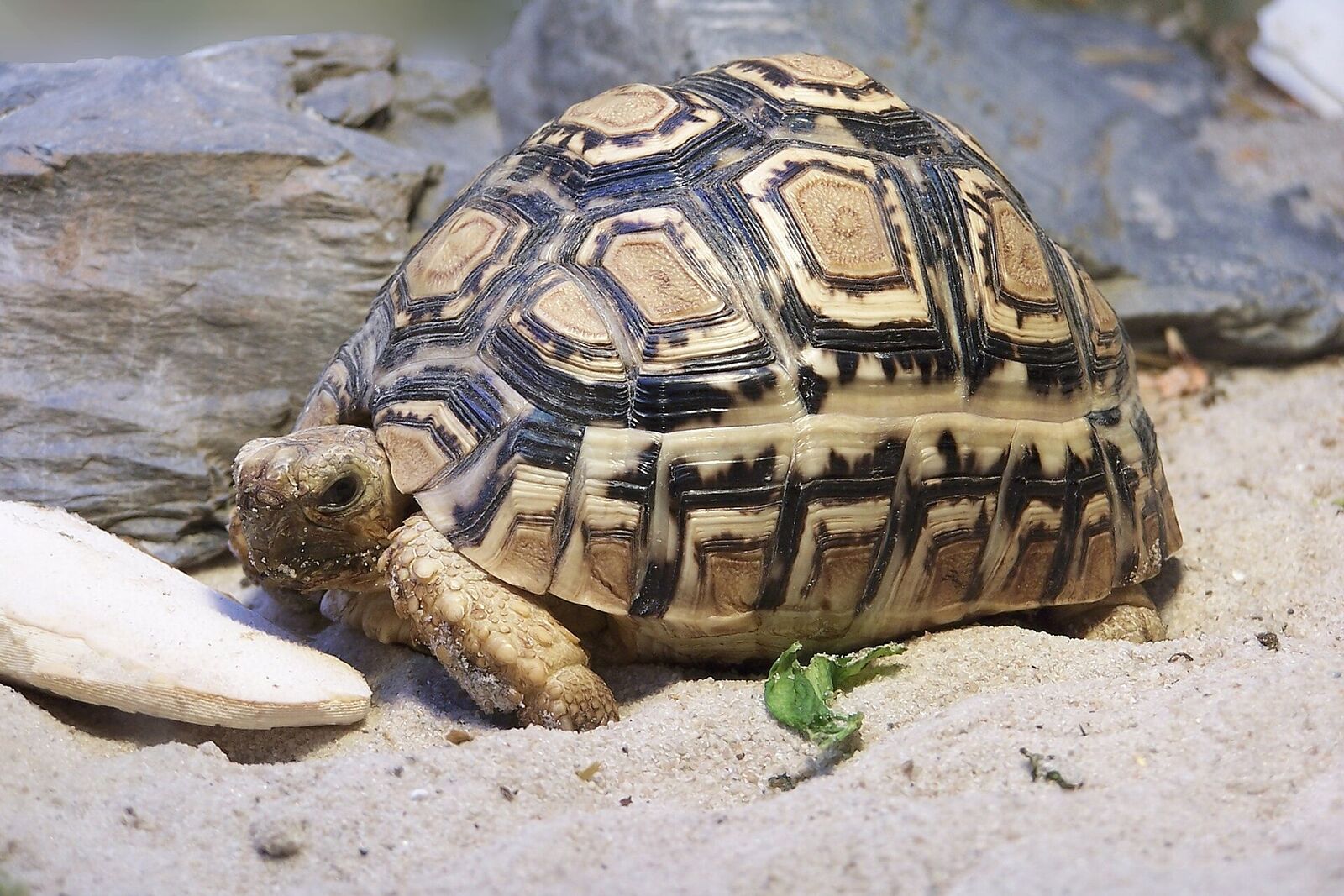
Leopard tortoise
Stigmochelys pardalis
A spotted savanna grazer.
Pet trade
 In-depth
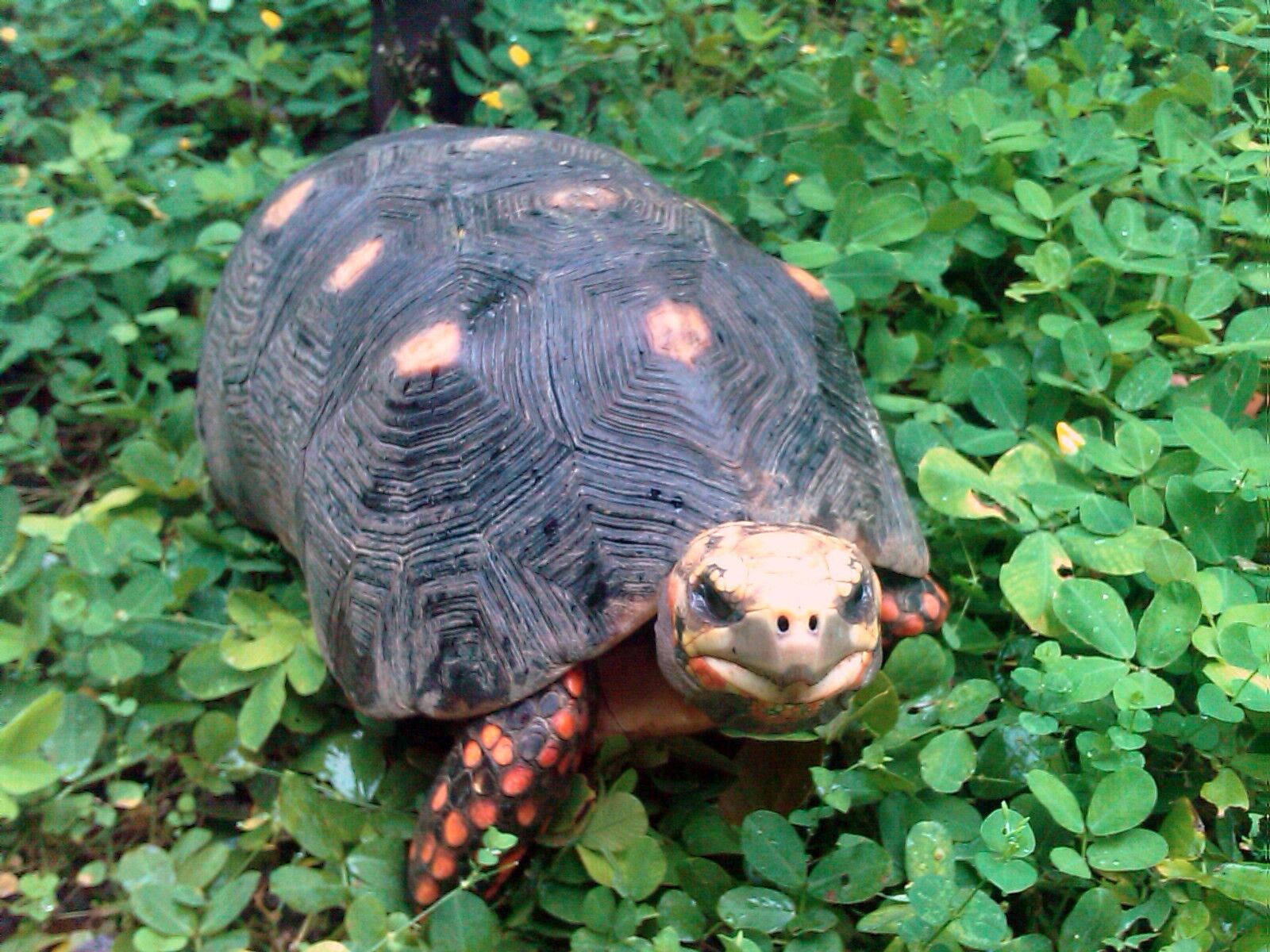
Red-footed tortoise
Chelonoidis carbonarius
A humid-forest tortoise that eats fruit.
Pet trade
 In-depth
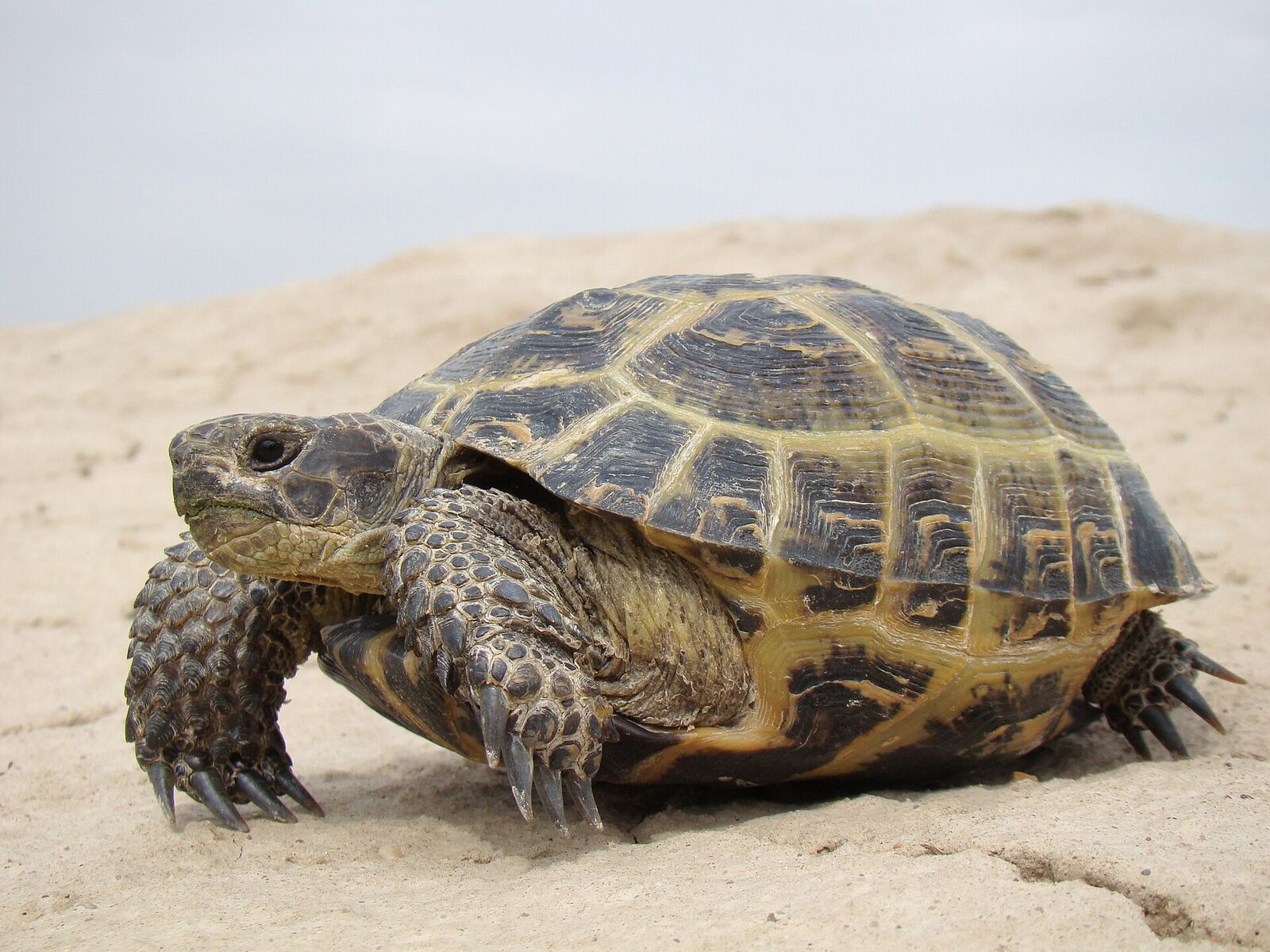
Russian tortoise
Testudo horsfieldii
Small, tough and a great first tortoise.
Pet trade

Egyptian tortoise
Testudo kleinmanni
Pet trade