
Home / Reptiles / Turtles and tortoises / Mexican box turtle
Some federal rules applyMexican box turtle
Terrapene mexicana
Reptiles › Turtles and tortoises (Testudines) › Emydidae (Pond turtles and box turtles)
The Mexican box turtle (Terrapene mexicana) is a species of box turtle belonging to the family Emydidae.
From Wikipedia: Mexican box turtle, CC BY-SA 4.0 (excerpt)

Care at a glance
Species-specific values
Values researched for this exact species. Air, surface and water temperatures are listed separately, and each source is kept as published rather than averaged.
| Minimum enclosure | An 8 sqft pen is big enough for the turtle. Source: allturtles.com | |
| Basking surface temperature | at least 90 °F Source: allturtles.com | |
| Warm side air temperature | The warm end of the enclosure should have temperatures of 90 degrees and above. Source: allturtles.com | |
| Cool side air temperature | 75 °F Source: allturtles.com | |
| Night temperature | at least 70 °F Source: allturtles.com | |
| Uvb lighting | Provide adequate UVA/UVB light; outdoor sunlight may be the only light needed. Source: allturtles.com | |
| Diet | Offer animal foods, lettuces, fruits, and mushrooms. Source: allturtles.com | |
| Feeding frequency | Feed juveniles daily and adults once every two days. Source: allturtles.com | |
| Social housing | Females mate with several males. Source: allturtles.com | |
| Substrate | Use substrate that increases humidity; play sand mixed with topsoil is suggested. Source: allturtles.com | |
| Night temperature | 65 °F Source: boxturtles.com | |
| Humidity | 70–80 % Source: boxturtles.com | |
| Basking surface temperature | 90–95 °F (32–35 °C) Source: boxturtles.com | |
| Warm side air temperature | 75–82 °F (24–28 °C) Source: boxturtles.com | |
| Diet | Provide a standard Terrapene diet with slightly more fruit and fungi. Source: boxturtles.com | |
| Seasonal cooling | Captive brumation is generally not recommended; keep warm and feed year-round. Source: boxturtles.com |
Understanding the animal
About this animal
About this animal
It is sometimes treated as a subspecies of Terrapene carolina (Terrapene carolina mexicana).
From Wikipedia: Mexican box turtle, CC BY-SA 4.0 (excerpt)
In the wild
In the wild
| Overview | The Mexican box turtle (Terrapene mexicana) is a species of box turtle belonging to the family Emydidae. It is sometimes treated as a subspecies of Terrapene carolina (Terrapene carolina mexicana). — From Wikipedia: Mexican box turtle, CC BY-SA 4.0 (excerpt) |
| Where it lives | It lives in areas with tropical climates within humid forests at shallow rainwater puddles. — From Wikipedia: Mexican box turtle, CC BY-SA 4.0 (excerpt) |
| Appearance and size | Terrapene mexicana can reach a length of about 18–20 cm. The carapace is long and dome-shaped, with rather variable color and markings. The adult males show gray-blue nuances on the head and red or orange nuances on the front legs. — From Wikipedia: Mexican box turtle, CC BY-SA 4.0 (excerpt) |
| Biology | The Mexican box turtle does not have much information on them because very few of them are domesticated (kept as pets). However, we do know that they have a lifespan of 100 years. Usually these turtles have water nearby homes and a bush to hide. — From Wikipedia: Mexican box turtle, CC BY-SA 4.0 (excerpt) |
Read about this species in the wild at The Reptile Database.
Native climate (measured)
Native climate (measured)
| Warm-season highs | about 93°F (up to 97°F in the hottest sampled areas) |
| Cool-season lows | about 54°F (down to 46°F in the coldest sampled areas) |
| Average temperature | 70–77°F across sampled records |
| Relative humidity | 69–77% on average (driest month about 67%) |
| Rainfall | about 974 mm a year |
Measured at 42 wild occurrence records sampled against WorldClim 2.1 climate data (1970–2000 averages). Air conditions in the range are ecological context, not enclosure settings: microhabitats such as burrows, leaf litter or basking rocks can be cooler, warmer or more humid.
Profile
Profile
Researched for this exact species. Sources are listed under In the wild above.
History
Named after the type locality.
Data and studies
The numbers
The numbers
Each bar is what one source reports. Where several sources weigh in, the dashed gold band marks their average.
Maximum recorded lifespan
Longest recorded lifespan reported by each database; typical lifespans are usually shorter.
Typical adult weight
Average adult body mass in each database (FishBase gives the maximum recorded weight).
Incubation
Female maturity
Sources for this sheet
- Myhrvold et al. (2015). An amniote life-history database. Ecology 96: 3109 Peer-reviewed researchPeer-reviewed compilation of life-history data for over 21,000 birds, mammals and reptiles.
- Species+ (UNEP-WCMC and the CITES Secretariat) Zoo, university or veterinaryThe official database of species listed under CITES. UNEP (2026). The Species+ Website. Nairobi, Kenya. Compiled by UNEP-WCMC, Cambridge, UK. Available at: www.speciesplus.net. [Accessed 04/10/2026].
- USFWS International Affairs: CITES Zoo, university or veterinaryFederal agency that issues CITES permits.
- 21 CFR 1240.62: Turtles under 4 inches (FDA) Zoo, university or veterinaryFederal ban on selling small turtles.
- The Reptile Database Peer-reviewed researchScientist-curated catalog of every reptile species, with taxonomy and literature.
- GBIF Backbone Taxonomy (Global Biodiversity Information Facility) (CC BY 4.0) Peer-reviewed researchInternational scientific taxonomy used here for classification. GBIF Secretariat (2023). GBIF Backbone Taxonomy. Checklist dataset https://doi.org/10.15468/39omei, accessed via GBIF.org.
- Wikipedia (species article) (CC BY-SA 4.0) Community referenceFree encyclopedia; useful overviews with their own citations. Short excerpts are quoted under CC BY-SA 4.0, each credited with a link to its article.
- iNaturalist (captive observations) Community referenceCommunity observation platform run by the California Academy of Sciences and National Geographic; observations marked captive show animals living in homes, zoos and aquariums.
More pond turtles and box turtles
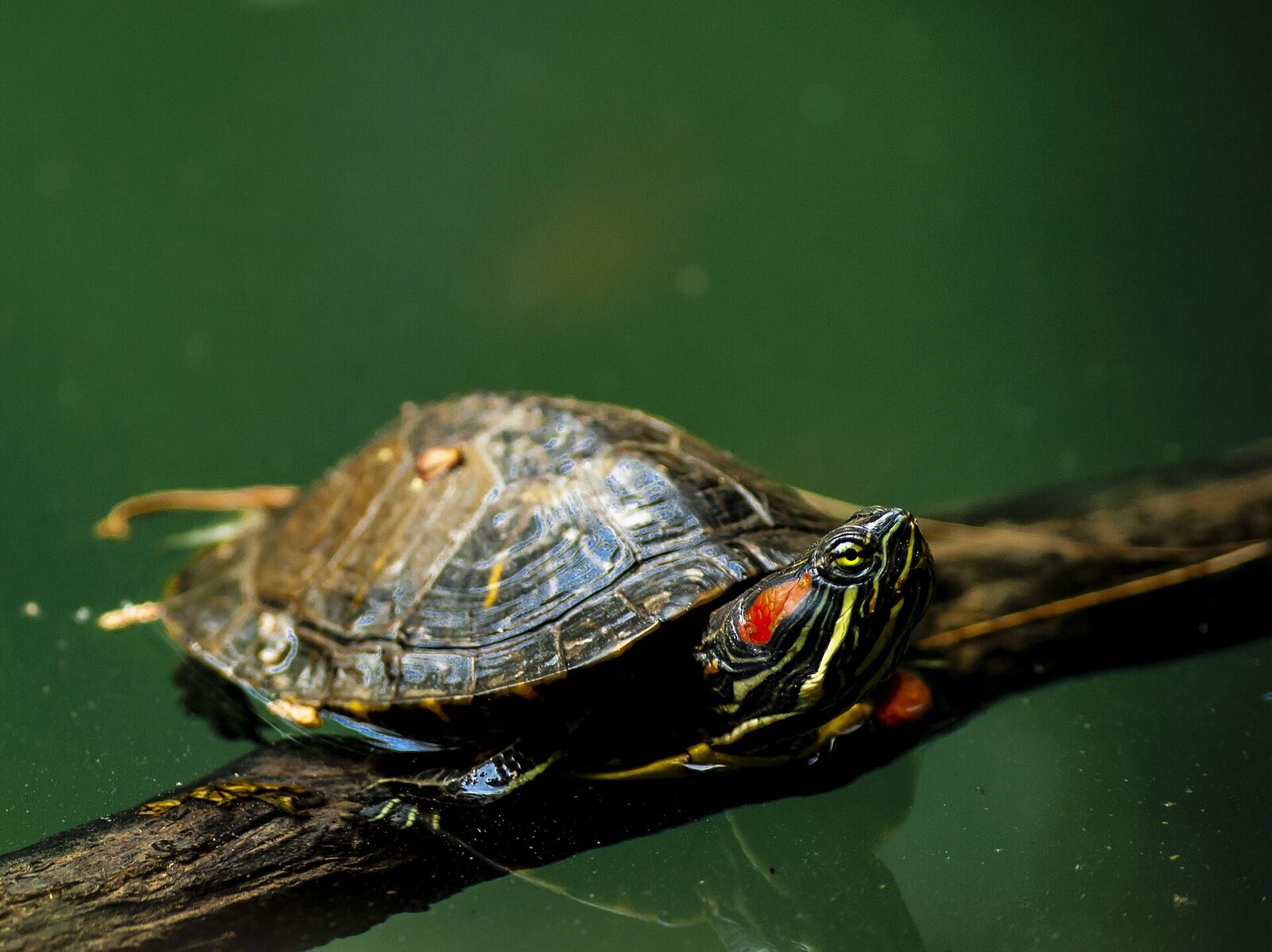
Red-eared slider
Trachemys scripta elegans
America's classic pet turtle, built to last decades.
Pet trade

Alabama map turtle
Graptemys pulchra
Zoos & aquariums

Baja California slider
Trachemys nebulosa
Pet trade

Barbour's map turtle
Graptemys barbouri
Zoos & aquariums

Black-knobbed map turtle
Graptemys nigrinoda
Pet trade

Blanding's turtle
Emydoidea blandingii
Pet trade