Home / Reptiles / Snakes / Western hognose snake
No federal permit to keep In-depth sheetWestern hognose snake
Heterodon nasicus
Reptiles › Snakes (Serpentes) › Colubridae (Colubrid snakes)
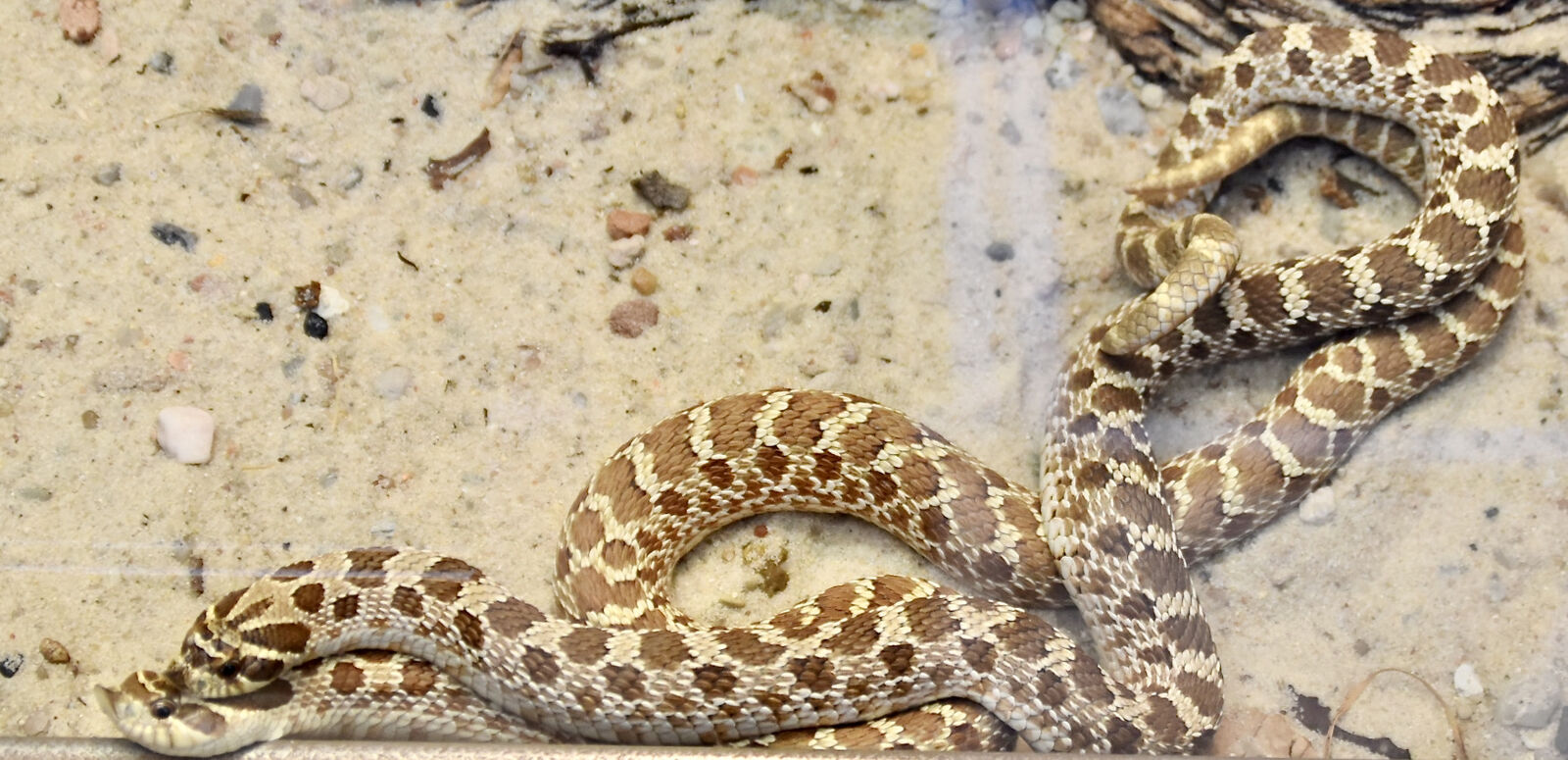
Hognose snakes are small, dramatic snakes known for hissing, flattening and playing dead. Clint's Reptiles gives the western hognose 4.2/5.
Care at a glance
Species-specific values
Values researched for this exact species. Where they differ from the group guide below, follow these. Air, surface and water temperatures are listed separately, and each source is kept as published rather than averaged.
| Basking zone temperature | 90–95 °F Source says basking zone; probe is placed on basking spot | 211 |
| Humidity | 30–50 % RH | 211 |
Care guide
Enclosure
- Minimum 36×18×18 in; females are larger than males.
Sources 44
Feeding
- About one mouse a week for a 500 g snake.
Sources 44
Show the group care guide for hognose snakes
Hognose snakes
Applies to most species in this group. Habitat: Sandy grasslands and scrub. Individual species can differ, so compare with the species numbers above and the linked sources.
Housing & setup
- Deep, loose substrate for burrowing and a few hides; they rarely climb.
- Compact enclosures suit western hognose snakes.
Climate & lighting
Starting point only: Western versus eastern/southern Heterodon require different humidity and basking targets; these values also cover unrelated genera. Check the species-specific values for this animal where shown.
| Warm side / daytime | 88–92°F |
| Cool side | 72–78°F |
| Humidity | 30–50% |
Diet
- Mice; some hatchlings are picky at first and may need scenting.
- Feed every 5–7 days for young snakes, every 7–14 days for adults.
Social life
- Solitary.
Health watch
- Rear-fanged with mild saliva: bites are rare but can swell. Wash and watch any bite.
- Dramatic bluffing (hissing, flattening, playing dead) is normal defense.
Understanding the animal
In the wild
In the wild
Researched for this exact species, not its family. Good care copies these conditions.12345
| Where it lives | Great Plains prairie and other open sandy habitats in central North America. It uses dunes, sandy grassland and loose-soil refuges, digging for buried prey. |
| Ground it lives on | Loose sand or sandy loam, often with grass cover and small-mammal burrows. |
| Climate | Temperate prairie with warm active seasons and winter cooling; underground refuges buffer surface conditions. Numeric wild temperature and humidity ranges were not established. |
| Active | Crepuscular activity is reported; winter brumation occurs, with timing varying geographically. |
| Social life | Solitary outside mating; not strongly territorial in the species account. |
| Wild diet | Toads, lizards and reptile eggs, with small mammals also eaten; proportions vary by locality. |
| Behavior to plan for | Digs with its upturned snout. Threat responses include hissing, flattening, bluff strikes and death-feigning; rear oral secretions can cause swelling after a bite. |
What this means for care
- Provide enough loose, suitable substrate for complete burial.
- Treat bluffing and death-feigning as signs to allow retreat.
- Recognize that wild prey includes amphibians and reptile eggs, not only rodents.
- Use separate feeding tools and avoid prolonged bites.
Native climate (measured)
Native climate (measured)
| Warm-season highs | about 92°F (up to 95°F in the hottest sampled areas) |
| Cool-season lows | about 17°F (down to 10°F in the coldest sampled areas) |
| Average temperature | 46–63°F across sampled records |
| Relative humidity | 47–56% on average (driest month about 42%) |
| Rainfall | about 387 mm a year |
| Winters | Cool to cold winters (lows around 17°F) in much of its native range. Seasonal slowdown may be relevant, but species-specific biology determines whether brumation or hibernation occurs. |
Measured at 82 wild occurrence records sampled against WorldClim 2.1 climate data (1970–2000 averages). Air conditions in the range are ecological context, not enclosure settings: microhabitats such as burrows, leaf litter or basking rocks can be cooler, warmer or more humid.
Profile
Profile
Researched for this exact species. Sources are listed under In the wild above.
Keeper tips
- Provide a loose substrate deep enough for the snake to bury itself and construct temporary burrows.
- Preserve a regular day-night cycle because the species is primarily active during the day.
- Expect digging around the enclosure; the upturned snout is specifically adapted for this behavior.
- Learn its bluff displays before handling so hissing, neck flattening, and closed-mouth strikes are not mistaken for actual attack attempts.
- Allow a defensive animal space rather than repeatedly provoking it into death-feigning.
Behaviors reported
- Uses its upturned snout to dig and burrow.
- Flattens its neck when threatened in a cobra-like defensive display.
- Performs mock or bluff strikes with the mouth closed.
- Frequently resorts to playing dead if defensive displays fail.
- Rarely relies on biting as a defensive response.
Unique adaptations
- The sharply upturned snout is specialized for digging through loose soil.
- Its burrowing ability suits the sandy prairie soils with which the species is strongly associated.
- Modified saliva from Duvernoy's glands travels along grooves associated with the rear fangs during prey capture.
- Neck flattening, bluff striking, and death-feigning form a multi-stage defensive repertoire.
Remarkable facts
- Heterodon nasicus averages about 20 in in length.
- Reported body mass ranges from about 2.8 to 12.3 oz.
- Males are considerably smaller than females and rarely exceed about 15 to 20 in total length.
- Females lay approximately 4 to 23 eggs.
- Eggs are buried in sand and hatch after about 52 to 64 days.
- Hatchlings are fully developed miniature snakes measuring approximately 5.5 to 7 in.
Stories
- Despite its elaborate defensive display, the western hognose virtually never bites as a defensive mechanism and commonly resorts to playing dead instead.
- No deaths or systemic effects in humans were reported from the extremely rare bites of this rear-fanged species.
From the sources
From the sources
Quoted from the matching sections of reputable sources for this exact species. Specialist databases are used first; Wikipedia (community-edited, CC BY-SA 4.0) only fills gaps. Other sources are short credited quotes.
| Overview | The western hognose snake (Heterodon nasicus) is a species of snake in the family Colubridae. The species is endemic to North America. — Wikipedia (community-edited) |
| Where it lives | Heterodon nasicus is found at elevations of 90 to 2400 m. — Animal Diversity Web |
| Social life and communication | Heterodon nasicus is a species that lives a solitary lifestyle, and the only time that it needs to communicate with other members of its species is during mating season. — Animal Diversity Web |
| Wild diet | Heterodon nasicus searchs for its prey, often by using its upturned nose to dig holes in the ground while looking for toads burrowed into the sand. — Animal Diversity Web |
| Behavior | Heterodon nasicus hibernates each year from September to March. — Animal Diversity Web |
| Reproduction | These snakes are described as polygamous. — Animal Diversity Web |
| Lifespan | Heterodon nasicus has a life expectancy of around fourteen years in the wild. — Animal Diversity Web |
| Appearance and size | In comparison to other snakes, H. nasicus is small to medium in size, with an average length of about 50 centimeters, and a weight between 80 and 350 g. — Animal Diversity Web |
| History and naming | The name nasicus is derived from the Latin "nasus" (nose), in reference to the upturned snout. — The Reptile Database |
| Conservation | Although some local declines have been reported, the species Heterodon nasicus is widespread, has a large overall population size (> 100,000), and is effectively protected by a variety of conservation programs. It is therefore currently classified as Least Concern by the IUCN. — Wikipedia (community-edited) |
Data and studies
Researched care notes
Researched care notes
Findings checked against veterinary, zoo, welfare, keeper and peer-reviewed sources. Air, basking-surface and water temperatures are kept separate, and where sources disagree both are shown. “Study” notes report what a paper measured, not a universal rule.
Western Hognose Snake
- Enclosure planning should accommodate the snake's full length; ReptiFiles' adult examples differ by sex because adult females generally require more space than males.1
- Temperature: for Heterodon nasicus, ReptiFiles gives a basking-zone value of 32–35°C and mid-range 24–29°C; its zone wording does not cleanly separate air from surface measurements.2
- Humidity: the guide recommends 30–50% RH for western hognoses; its higher humidity guidance for eastern and southern hognoses should not be merged into this species' routine range.2
- Appropriately sized whole prey should underpin feeding; bullfrog-leg sausages or plain meat pieces are not nutritionally equivalent to whole animals.3
- ReptiFiles publishes adult feeding intervals of one to two weeks and shorter juvenile intervals; these are keeper recommendations to adjust for growth and body condition, not trial-derived fixed doses.3
The numbers
The numbers
Each bar is what one source reports. Where several sources weigh in, the dashed gold band marks their average.
Basking
Nights no lower than 68–77°F.
Humidity (western)
Eastern and southern hognoses prefer 50–60%.
Maximum recorded lifespan
Longest recorded lifespan reported by each database; typical lifespans are usually shorter. The AnAge record comes from an animal in human care.
Typical adult weight
Average adult body mass in each database (FishBase gives the maximum recorded weight).
Daytime air temperature
Species-specific values from keeper care sheets. Basking figures are often surface readings taken with an infrared thermometer, which run hotter than air.
Care articles for this species
Care articles for this species
- Western Hognose Snake Care Sheet (Reptiles Magazine)
- Western Hognose Snake Care And Breeding (Reptiles Magazine)
- Care And Breeding The Western Hog-nosed Snake (Reptiles Magazine)
Veterinary & husbandry research
Veterinary & husbandry research
- First reported case of thrombocytopenia from a Heterodon nasicus envenomation Brandehoff N et al., Toxicon: official journal of the International Society on Toxinology 2019
- Questionnaire Background on the Hognose Snake (Heterodon nasicus) Breeders' Awareness of the Risk of Being Bitten Zieliński D et al., Animals: an open access journal from MDPI 2021
- Western Hognose Snakes (Heterodon nasicus) Prefer Environmental Enrichment Nagabaskaran G et al., Animals: an open access journal from MDPI 2022
- Cryptosporidium spp. in captive snakes from 26 provinces in China: Prevalence, molecular characterization, and symptoms Zhang Y et al., Parasite (Paris, France) 2024
Peer-reviewed papers that mention this species alongside captivity, zoos, veterinary care or aquaculture. Some cover several species or mention it only in passing, so check the abstract. See all 8 on PubMed → 170
Sources for this sheet
- Royal Veterinary College Exotics Service: Hognose snake care Zoo, university or veterinaryVet-school exotics hospital factsheet, reviewed 2021–2024.
- Clint's Reptiles (YouTube): Western Hognose, The Best Pet Snake? Expert educator & keeperClint Laidlaw, PhD in Biology Education and MS in Evolutionary Ecology; owner of Clint's Reptile Room and a longtime keeper. Rates each species on handleability, care, hardiness, availability and upfront cost.
- AnAge: The Animal Ageing and Longevity Database (Human Ageing Genomic Resources) Peer-reviewed researchCurated, referenced longevity and life-history records for thousands of species; maximum lifespans are often from zoo animals.
- Myhrvold et al. (2015). An amniote life-history database. Ecology 96: 3109 Peer-reviewed researchPeer-reviewed compilation of life-history data for over 21,000 birds, mammals and reptiles.
- Reptiles Magazine (care articles) Experienced keeper or breederEstablished reptile and amphibian hobby magazine; care articles are written by breeders, keepers and veterinarians.
- Merck Veterinary Manual: Management and husbandry of reptiles Zoo, university or veterinaryThe Merck Veterinary Manual: a standard veterinary reference written and reviewed by veterinary specialists.
- Merck Veterinary Manual: Nutritional, metabolic and endocrine diseases of reptiles Zoo, university or veterinaryThe Merck Veterinary Manual: a standard veterinary reference written and reviewed by veterinary specialists.
- ReptiFiles: Heterodon temperature, lighting and humidity Experienced keeper or breederAdded in the 2026 source-checked care-guide review.
- Clint's Reptiles (YouTube): Western Hognose, The Best Pet Snake? Expert educator & keeperClint Laidlaw, PhD in Biology Education and MS in Evolutionary Ecology; owner of Clint's Reptile Room and a longtime keeper. His "Best Pet?" series reviews each species' care in depth.
- The Reptile Database Peer-reviewed researchScientist-curated catalog of every reptile species, with taxonomy and literature.
- GBIF Backbone Taxonomy (Global Biodiversity Information Facility) Peer-reviewed researchInternational scientific taxonomy used here for classification.
- Wikipedia (species article) Community referenceFree encyclopedia; useful overviews with their own citations. Intro text is quoted under CC BY-SA 4.0.
- PubMed (U.S. National Library of Medicine) Peer-reviewed researchIndex of peer-reviewed veterinary, zoo and husbandry research.
- iNaturalist (captive observations) Community referenceCommunity observation platform run by the California Academy of Sciences and National Geographic; observations marked captive show animals living in homes, zoos and aquariums.