
Home / Birds / Parrots / White (umbrella) cockatoo
Federal restrictions applyWhite (umbrella) cockatoo
Cacatua alba
Birds › Parrots (Psittaciformes) › Cacatuidae (Cockatoos and cockatiel)
The white cockatoo (Cacatua alba), also known as the umbrella cockatoo, is a medium-sized all-white cockatoo endemic to tropical rainforest on islands of Indonesia.

Care at a glance
Species-specific values
Values researched for this exact species. Air, surface and water temperatures are listed separately, and each source is kept as published rather than averaged.
| Minimum enclosure | A bird room or larger space is best, but provide 90 x 90 x 120 cm minimum for one. Source: royalveterinarycenter.com | |
| Diet | Base diet of large-parrot pellets with fresh vegetables, leafy greens and fruit; small measured amounts of nuts and seeds. Source: royalveterinarycenter.com | |
| Night temperature | 64–82 °F (18–28 °C) Source: royalveterinarycenter.com | |
| Uvb lighting | Use full-spectrum or sunlight plus ensure 10 to 12 hours of dark, quiet rest. Source: royalveterinarycenter.com |
Warnings
Understanding the animal
About this animal
About this animal
When surprised, it extends a large and striking head crest, which has a semicircular shape (similar to an umbrella, hence the alternative name). The wings and tail have a pale yellow or lemon color which is exposed when they fly.
From Wikipedia: White cockatoo, CC BY-SA 4.0 (excerpt)
In the wild
In the wild
Researched for this exact species, not its family. Wild conditions are context, not enclosure settings.1
| Where it lives | North Moluccan islands of Indonesia, including Halmahera and Bacan, in forest, tall secondary woodland, mangroves and river-edge clearings. Spends much of its time in the canopy and nests high in large trees. |
| Ground it lives on | Mainly arboreal; canopy branches and large tree cavities. |
| Active | Diurnal. |
| Social life | Singly, in pairs or small flocks, with larger afternoon gatherings; breeding pairs have strong lasting bonds. |
| Wild diet | Tree fruits including papaya, durian, langsat and rambutan, plus maize and occasional crickets or skinks. |
| Behavior to plan for | Moves through the canopy and uses large elevated hollows for breeding. Vocal and gestural communication maintains pair relationships and signals occupancy. |
Native climate (measured)
Native climate (measured)
| Warm-season highs | about 90°F (up to 92°F in the hottest sampled areas) |
| Cool-season lows | about 66°F (down to 57°F in the coldest sampled areas) |
| Average temperature | 74–81°F across sampled records |
| Relative humidity | 76–77% on average (driest month about 73%) |
| Rainfall | about 1717 mm a year, spread fairly evenly |
Measured at 45 wild occurrence records sampled against WorldClim 2.1 climate data (1970–2000 averages). Air conditions in the range are ecological context, not enclosure settings: microhabitats such as burrows, leaf litter or basking rocks can be cooler, warmer or more humid.
Data and studies
The numbers
The numbers
Each bar is what one source reports. Where several sources weigh in, the dashed gold band marks their average.
Maximum recorded lifespan
Longest recorded lifespan reported by each database; typical lifespans are usually shorter. The AnAge record comes from an animal in human care.
Typical adult weight
Average adult body mass in each database (FishBase gives the maximum recorded weight).
Clutch size
Average per litter or clutch.
Incubation
Female maturity
Veterinary & husbandry research
Veterinary & husbandry research
- Diagnosis and treatment of proventricular nematodiasis in an umbrella cockatoo (Cacatua alba) Mejia-Fava J et al., Journal of the American Veterinary Medical Association 2013
- Reproductive status of a female white cockatoo (Cacatua alba) based on relationships among urofecal steroid hormone dynamics, molting, and body weight Kusuda S et al., The Journal of veterinary medical science 2023
- Rectricectomy With Pygostylectomy for Resolution of Feather Trauma in an Umbrella Cockatoo (Cacatua alba) Welle KR et al., Journal of avian medicine and surgery 2019
- Genomic analysis of Escherichia coli, Enterobacter hormaechei, and Cupriavidus gilardii isolated from Cacatua alba de Andrade JP et al., Veterinary research communications 2026
Peer-reviewed papers that mention this species alongside captivity, zoos, veterinary care or aquaculture. Some cover several species or mention it only in passing, so check the abstract. See all 5 on PubMed → PubMed
Sources for this sheet
- AnAge: The Animal Ageing and Longevity Database (Human Ageing Genomic Resources) (CC BY 3.0) Peer-reviewed researchCurated, referenced longevity and life-history records for thousands of species; maximum lifespans are often from zoo animals.
- Myhrvold et al. (2015). An amniote life-history database. Ecology 96: 3109 Peer-reviewed researchPeer-reviewed compilation of life-history data for over 21,000 birds, mammals and reptiles.
- 50 CFR 17.11: Endangered and threatened wildlife Zoo, university or veterinaryCurrent federal Endangered Species Act list.
- Species+ (UNEP-WCMC and the CITES Secretariat) Zoo, university or veterinaryThe official database of species listed under CITES. UNEP (2026). The Species+ Website. Nairobi, Kenya. Compiled by UNEP-WCMC, Cambridge, UK. Available at: www.speciesplus.net. [Accessed 04/10/2026].
- USFWS International Affairs: CITES Zoo, university or veterinaryFederal agency that issues CITES permits.
- 9 CFR 2.1: Animal Welfare Act licensing (USDA) Zoo, university or veterinaryWho needs a USDA license to breed, sell or exhibit animals.
- GBIF Backbone Taxonomy (Global Biodiversity Information Facility) (CC BY 4.0) Peer-reviewed researchInternational scientific taxonomy used here for classification. GBIF Secretariat (2023). GBIF Backbone Taxonomy. Checklist dataset https://doi.org/10.15468/39omei, accessed via GBIF.org.
- Wikipedia (species article) (CC BY-SA 4.0) Community referenceFree encyclopedia; useful overviews with their own citations. Short excerpts are quoted under CC BY-SA 4.0, each credited with a link to its article.
- PubMed (U.S. National Library of Medicine) Peer-reviewed researchIndex of peer-reviewed veterinary, zoo and husbandry research.
- iNaturalist (captive observations) Community referenceCommunity observation platform run by the California Academy of Sciences and National Geographic; observations marked captive show animals living in homes, zoos and aquariums.
More cockatoos and cockatiel
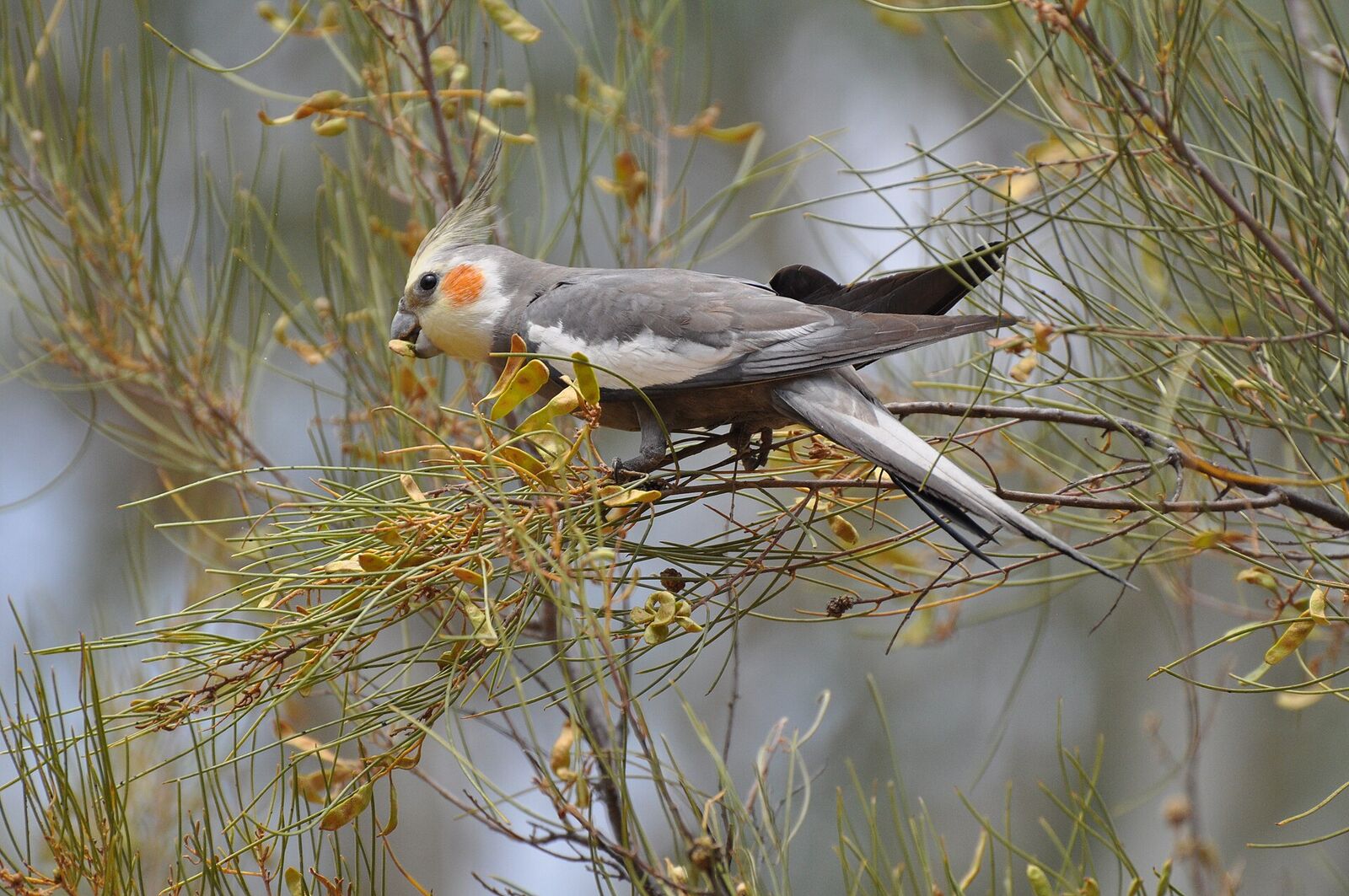
Cockatiel
Nymphicus hollandicus
Crested, affectionate and great whistlers.
Pet trade

Galah
Eolophus roseicapilla
Pet trade

Goffin's cockatoo (Tanimbar corella)
Cacatua goffiniana
Pet trade

Little corella (bare-eyed cockatoo)
Cacatua sanguinea
Pet trade

Red-tailed black cockatoo
Calyptorhynchus banksii
Pet trade

Solomons corella
Cacatua ducorpsii
Zoos & aquariums