Home / Birds / Ducks, geese and swans / White-winged duck
Federal restrictions applyWhite-winged duck
Asarcornis scutulata
Birds › Ducks, geese and swans (Anseriformes) › Anatidae (Ducks, geese and swans)
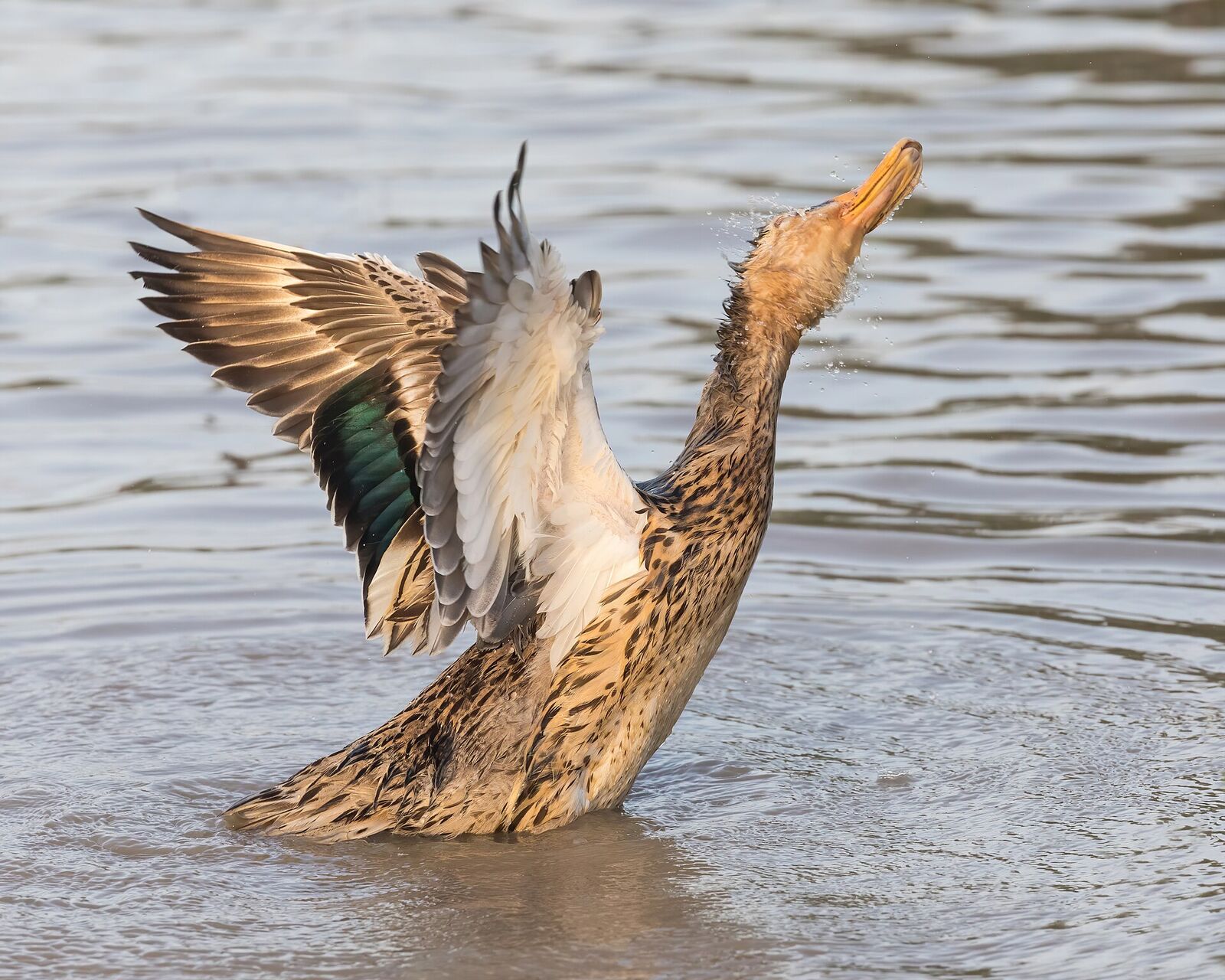
The white-winged duck or white-winged wood duck (Asarcornis scutulata) is a large species of duck, formerly placed in the genus Cairina with the Muscovy duck (Cairina moschata) and considered allied to the dabbling ducks.

Care at a glance
Species-specific values
Values researched for this exact species. Where they differ from the group guide below, follow these. Air, surface and water temperatures are listed separately, and each source is kept as published rather than averaged.
| Social | Manage compatible pairs or carefully planned small groups; avoid two mature males in one enclosure. Captive territorial-management guidance; not a universal duck flock rule. | 324 |
| Pond layout | Shaded pond with gentle access slopes, shallow dabbling areas and water circulation; avoid hard concrete edges that damage feet. | 324 |
| Minimum isolation enclosure | length: 3 m; width: 2 m; height: 2 m Indoor temporary isolation enclosure with water point; not the permanent aviary size. | 324 |
Warnings
Care guide
Ducks, geese and swans
Applies to most species in this group. Habitat: Wetlands. Individual species can differ, so compare with the species numbers above and the linked sources.
Housing & setup
- Secure, predator-proof night housing, a pond or deep water for bathing and mating, and grazing space.
- Provide clean head-dipping or bathing water and drain wet areas to preserve dry resting substrate. Duckling water access needs age-appropriate protection against soaking and chilling.
Diet
- Waterfowl pellets plus grass and greens; ducklings need niacin-adequate feed.
Social life
- Use species-specific social housing. Many domestic waterfowl are flock-kept, but adult white-winged ducks require careful pair/group management and should not be treated as unrestricted flock birds.
Health watch
- Angel wing, linked to fast growth and unbalanced, energy-rich diets (limit bread and treats); bumblefoot on hard surfaces.
- Most native North American waterfowl need federal (MBTA) permits; domestic breeds don't.
Understanding the animal
About this animal
About this animal
However, two genetic studies have indicated that the anatomical similarity to the Muscovy duck is deceiving, with the species appropriately placed in a monotypic genus, as Asarcornis scutulata; it proved evolutionarily closest to a clade containing the diving duck genera Netta and Aythya, while Cairina resolved as close to the genus Aix in a very different part of the family tree.
Quoted from the Wikipedia article “White-winged duck” (CC BY-SA 4.0) 174
In the wild
In the wild
Quoted from the matching sections of reputable sources for this exact species. Specialist databases are used first; Wikipedia (community-edited, CC BY-SA 4.0) only fills gaps. Other sources are short credited quotes.
| Overview | The white-winged duck or white-winged wood duck (Asarcornis scutulata) is a large species of duck, formerly placed in the genus Cairina with the Muscovy duck (Cairina moschata) and considered allied to the dabbling ducks. — Wikipedia (community-edited) |
| Where it lives | Historically the white-winged duck was widely distributed from northeastern India and Bangladesh, throughout South-East Asia to Java and Sumatra. It is now extinct on Java (no records for over 50 years) and probably extinct in Bangladesh, Lao PDR, Vietnam and Peninsular Malaysia. — Wikipedia (community-edited) |
| Appearance and size | This is one of the largest living species of duck next only to the steamer ducks which are heavier. The Muscovy duck also attains sizes that nearly rival the white-winged duck, but may average a bit smaller in a wild state. Length is 66–81 cm and wingspan is 116–153 cm. — Wikipedia (community-edited) |
| Conservation | In the October 2024 IUCN Red List update (version 2024-2), the white-winged duck was uplisted from Endangered to Critically Endangered under criteria A2bcde+3bcde+4bcde and C1+2a(i), reflecting a global decline of an estimated 70–90% over the past three generations (26 years; 1997–2023). It had previously been listed as Endangered continuously since 1994. — Wikipedia (community-edited) |
Native climate (measured)
Native climate (measured)
| Warm-season highs | about 89°F (up to 92°F in the hottest sampled areas) |
| Cool-season lows | about 57°F (down to 45°F in the coldest sampled areas) |
| Average temperature | 68–80°F across sampled records |
| Relative humidity | 74–81% on average (driest month about 68%) |
| Rainfall | about 2279 mm a year, with strong wet and dry seasons |
Measured at 51 wild occurrence records sampled against WorldClim 2.1 climate data (1970–2000 averages). Air conditions in the range are ecological context, not enclosure settings: microhabitats such as burrows, leaf litter or basking rocks can be cooler, warmer or more humid.
Data and studies
The numbers
The numbers
Each bar is what one source reports. Where several sources weigh in, the dashed gold band marks their average.
Typical adult weight
Average adult body mass in each database (FishBase gives the maximum recorded weight).
Incubation
Sources for this sheet
- Myhrvold et al. (2015). An amniote life-history database. Ecology 96: 3109 Peer-reviewed researchPeer-reviewed compilation of life-history data for over 21,000 birds, mammals and reptiles.
- Species+ (UNEP-WCMC and the CITES Secretariat) Zoo, university or veterinaryThe official database of species listed under CITES.
- USFWS International Affairs: CITES Zoo, university or veterinaryFederal agency that issues CITES permits.
- Merck Veterinary Manual: Poultry Zoo, university or veterinaryThe Merck Veterinary Manual: a standard veterinary reference written and reviewed by veterinary specialists.
- Royal Veterinary College Exotics Service: Duck care Zoo, university or veterinaryVet-school exotics hospital factsheet, reviewed 2021–2024.
- EAZA White-winged Duck Best Practice Guidelines (2025) Zoo, university or veterinaryAdded in the 2026 source-checked care-guide review.
- EFSA — Welfare of farmed ducks, geese and quail (2023) Zoo, university or veterinaryAdded in the 2026 source-checked care-guide review.
- University of Kentucky Cooperative Extension — Brooding Poultry Hatchlings Zoo, university or veterinaryAdded in the 2026 source-checked care-guide review.
- MSD Veterinary Manual — Nutritional Requirements of Poultry Zoo, university or veterinaryAdded in the 2026 source-checked care-guide review.
- GBIF Backbone Taxonomy (Global Biodiversity Information Facility) Peer-reviewed researchInternational scientific taxonomy used here for classification.
- Wikipedia (species article) Community referenceFree encyclopedia; useful overviews with their own citations. Intro text is quoted under CC BY-SA 4.0.
- The eBird/Clements Checklist of Birds of the World (Cornell Lab of Ornithology) Peer-reviewed researchThe standard global bird checklist maintained by the Cornell Lab of Ornithology; used here for complete species lists of widely kept bird families.
- iNaturalist (captive observations) Community referenceCommunity observation platform run by the California Academy of Sciences and National Geographic; observations marked captive show animals living in homes, zoos and aquariums.