
Home / Amphibians / Frogs and toads / Yellow-bellied toad
No federal permit to keepYellow-bellied toad
Bombina variegata
Amphibians › Frogs and toads (Anura) › Bombinatoridae (Fire-bellied toads)
The yellow-bellied toad (Bombina variegata) belongs to the order Anura, the archaeobatrachial family Bombinatoridae, and the genus of fire-bellied toads.
From Wikipedia: Yellow-bellied toad, CC BY-SA 4.0 (excerpt)

Care at a glance
Species-specific values
Values researched for this exact species. Air, surface and water temperatures are listed separately, and each source is kept as published rather than averaged.
| Minimum enclosure | A low tank with a base of at least 18 x 18 inches should be sufficient. Source: joshsfrogs.com | |
| Warm side air temperature | In captivity, temperatures should be in the low to mid 70s. Source: joshsfrogs.com | |
| Humidity | 50–70 % Source: joshsfrogs.com | |
| Social housing | They do well in groups, but can get aggressive while feeding; keep them similar in size. Source: joshsfrogs.com |
Understanding the animal
About this animal
About this animal
The toad is distributed mainly across western Europe as well as a handful of countries in eastern Europe. While the population of the toad is steadily decreasing over time, its numbers are not critical enough to be considered threatened or extinct.
From Wikipedia: Yellow-bellied toad, CC BY-SA 4.0 (excerpt)
In the wild
In the wild
| Overview | The yellow-bellied toad (Bombina variegata) belongs to the order Anura, the family Bombinatoridae, and the genus of fire-bellied toads. The toad is distributed mainly across western Europe as well as a handful of countries in eastern Europe. While the population of the toad is steadily decreasing over time, its numbers are not critical enough to be considered threatened or extinct. Conservation efforts in Germany are taking place to remedy the declining population before it is too late. — From Wikipedia: Yellow-bellied toad, CC BY-SA 4.0 (excerpt) |
| Where it lives | The yellow-bellied toad is found in mountainous regions, typically in Western Europe. Within Europe, two species of Bombina exist, Bombina variegata and Bombina bombina. Due to postglacial advance of the latter, Bombina variegata has been found in lower numbers in comparison. — From Wikipedia: Yellow-bellied toad, CC BY-SA 4.0 (excerpt) |
| Behavior | To maximize mating for a male, some yellow-bellied male toads will engage in water-wave-producing behavior. This is where a male will kick its hind legs into a small body of water, generating a wave-like pattern. This pattern not only attracts females but is a mechanism of making a male's territory known. — From Wikipedia: Yellow-bellied toad, CC BY-SA 4.0 (excerpt) |
| Reproduction | Female yellow-bellied toads have the ability to produce offspring multiple times each mating season and long-lived individuals are possible. However, to find a female actually producing offspring multiple times per year is rare. Female reproductive output is also very low, having the capacity to lay over 200 eggs at a given time, but typically seen to only lay about 40. — From Wikipedia: Yellow-bellied toad, CC BY-SA 4.0 (excerpt) |
| Appearance and size | Specimens range from 28–56 mm, typically weighing between 2.3 and 12 g. This places them among the smaller members of the family Bombinatoridae, which can reach sizes of 7 cm. Their top side is grey-brown, often with washed-out, bright spots. — From Wikipedia: Yellow-bellied toad, CC BY-SA 4.0 (excerpt) |
| Conservation | Factors associated with climate change, including habitat loss, loss of genetic variation and increase in disease spread have all greatly contributed to the decline of the Yellow-bellied toad. It is important to obtain accurate information about the exact issues plaguing the population at a local, regional, and continental scale. — From Wikipedia: Yellow-bellied toad, CC BY-SA 4.0 (excerpt) |
Native climate (measured)
Native climate (measured)
| Warm-season highs | about 75°F (up to 80°F in the hottest sampled areas) |
| Cool-season lows | about 26°F (down to 21°F in the coldest sampled areas) |
| Average temperature | 45–53°F across sampled records |
| Relative humidity | 73–78% on average (driest month about 69%) |
| Rainfall | about 838 mm a year, spread fairly evenly |
| Winters | Cool to cold winters (lows around 26°F) in much of its native range. Seasonal slowdown may be relevant, but species-specific biology determines whether brumation or hibernation occurs. |
Measured at 184 wild occurrence records sampled against WorldClim 2.1 climate data (1970–2000 averages). Air conditions in the range are ecological context, not enclosure settings: microhabitats such as burrows, leaf litter or basking rocks can be cooler, warmer or more humid.
Data and studies
Researched care notes
Researched care notes
Findings checked against veterinary, zoo, welfare, keeper and peer-reviewed sources. Air, basking-surface and water temperatures are kept separate, and where sources disagree both are shown. “Study” notes report what a paper measured, not a universal rule.
Fire-Bellied Toad
Researched for this genus; applies to its species unless a species note says otherwise.
- Provide both accessible land and shallow water, with a slope or other safe transition between them.1
- For the Oriental fire-bellied toad described, PetMD recommends a semi-aquatic setup with approximately half land and half water; this is design guidance, not a universal measured optimum.1
- Compatible same-species groups may be housed together, but introductions require observation and fighting animals require separation.1
- PetMD gives 75–78°F for enclosure temperature and 65–82°F as broader limits; it does not provide separately measured air, water and surface temperatures.1
- Minimize handling and avoid transferring skin secretions to eyes, mouth or open wounds.1
- Feed varied appropriately sized invertebrates on the dry part of the habitat; PetMD recommends prey no wider than the toad's head.1
The numbers
The numbers
Each bar is what one source reports. Where several sources weigh in, the dashed gold band marks their average.
Maximum recorded lifespan
Longest recorded lifespan reported by each database; typical lifespans are usually shorter. The AnAge record comes from an animal in human care.
Veterinary & husbandry research
Veterinary & husbandry research
- Studies on transplantation immunity of the yellow-bellied toad Bombina variegata Góralik E et al., Archivum immunologiae et therapiae experimentalis 1994
Peer-reviewed papers that mention this species alongside captivity, zoos, veterinary care or aquaculture. Some cover several species or mention it only in passing, so check the abstract. See all 4 on PubMed → PubMed
Sources for this sheet
- AnAge: The Animal Ageing and Longevity Database (Human Ageing Genomic Resources) (CC BY 3.0) Peer-reviewed researchCurated, referenced longevity and life-history records for thousands of species; maximum lifespans are often from zoo animals.
- AmphibiaWeb (University of California, Berkeley) (CC BY-NC) Peer-reviewed researchUniversity-hosted database of amphibian biology and conservation.
- GBIF Backbone Taxonomy (Global Biodiversity Information Facility) (CC BY 4.0) Peer-reviewed researchInternational scientific taxonomy used here for classification. GBIF Secretariat (2023). GBIF Backbone Taxonomy. Checklist dataset https://doi.org/10.15468/39omei, accessed via GBIF.org.
- Wikipedia (species article) (CC BY-SA 4.0) Community referenceFree encyclopedia; useful overviews with their own citations. Short excerpts are quoted under CC BY-SA 4.0, each credited with a link to its article.
- PubMed (U.S. National Library of Medicine) Peer-reviewed researchIndex of peer-reviewed veterinary, zoo and husbandry research.
- iNaturalist (captive observations) Community referenceCommunity observation platform run by the California Academy of Sciences and National Geographic; observations marked captive show animals living in homes, zoos and aquariums.
More fire-bellied toads
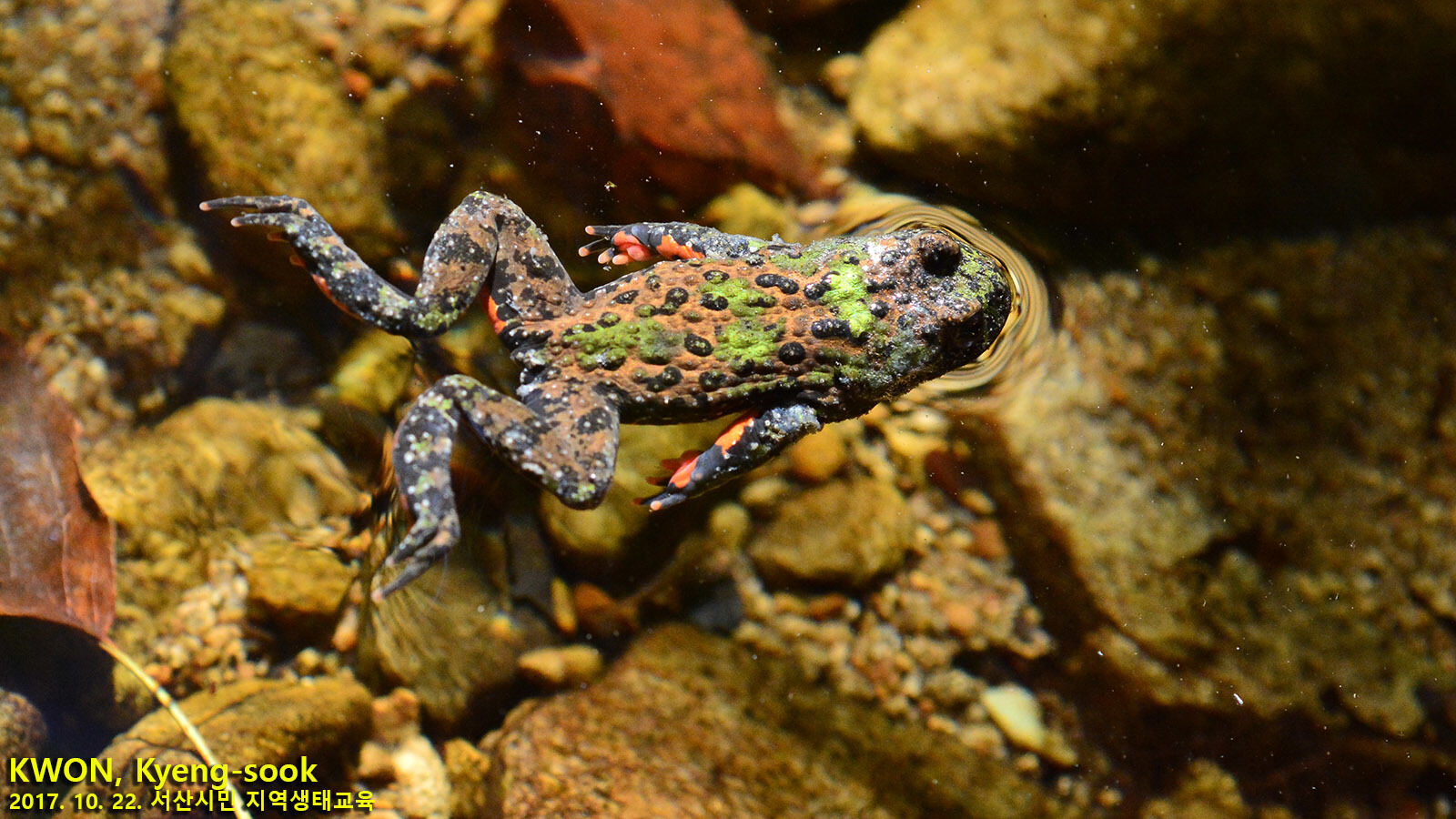
Oriental fire-bellied toad
Bombina orientalis
A tough little toad with a warning-red belly.
Pet trade

European fire-bellied toad
Bombina bombina
Pet trade
Small-webbed bell toad
Bombina microdeladigitora
Pet trade