Home / Amphibians / Frogs and toads / African dwarf frog
No federal permit to keepAfrican dwarf frog
Hymenochirus boettgeri
Amphibians › Frogs and toads (Anura) › Pipidae (Clawed frogs, dwarf frogs, Surinam toads)
Hymenochirus boettgeri, also known as the Zaire dwarf clawed frog or the Congo dwarf clawed frog, is a species of frog in the family Pipidae.
From Wikipedia: Hymenochirus boettgeri, CC BY-SA 4.0 (excerpt)

Care at a glance
Species-specific values
Values researched for this exact species. Air, surface and water temperatures are listed separately, and each source is kept as published rather than averaged.
| Water temperature | 72–78 °F Source: reptilesmagazine.com | |
| Substrate | Use large aquarium gravel or sand; substrate is recommended but optional. Source: reptilesmagazine.com | |
| Uvb lighting | UVB is unnecessary; provide 10–12 hours of aquarium lighting daily. Source: reptilesmagazine.com | |
| Diet | High-protein balanced diet of aquatic frog pellets, bloodworms, brine shrimp, daphnia, and blackworms, in small pieces. Source: reptilesmagazine.com | |
| Feeding frequency | Feed once daily or every other day, preferably in the evening. Source: reptilesmagazine.com | |
| Minimum enclosure | A 2.5-gallon aquarium for one frog, 5 gallons for two, and 10–20 gallons for more than two; avoid depth over 12 inches. Source: reptilesmagazine.com |
Understanding the animal
About this animal
About this animal
It is found in Nigeria, Cameroon, Equatorial Guinea, Gabon, and east to the Central African Republic and to eastern Democratic Republic of the Congo. It presumably occurs in the Republic of the Congo but has not been recorded there.
From Wikipedia: Hymenochirus boettgeri, CC BY-SA 4.0 (excerpt)
In the wild
In the wild
| Overview | Hymenochirus boettgeri, also known as the Zaire dwarf clawed frog or the Congo dwarf clawed frog, is a species of frog in the family Pipidae. It is found in Nigeria, Cameroon, Equatorial Guinea, Gabon, and east to the Central African Republic and to eastern Democratic Republic of the Congo. It presumably occurs in the Republic of the Congo but has not been recorded there. It is a common species over most of its wide range and the International Union for Conservation of Nature has assessed its conservation status as being of least concern. — From Wikipedia: Hymenochirus boettgeri, CC BY-SA 4.0 (excerpt) |
| Where it lives | Hymenochirus boettgeri is an aquatic frog that generally occurs in still, shaded water in lowland rainforest and in pools by slow-flowing rivers. — From Wikipedia: Hymenochirus boettgeri, CC BY-SA 4.0 (excerpt) |
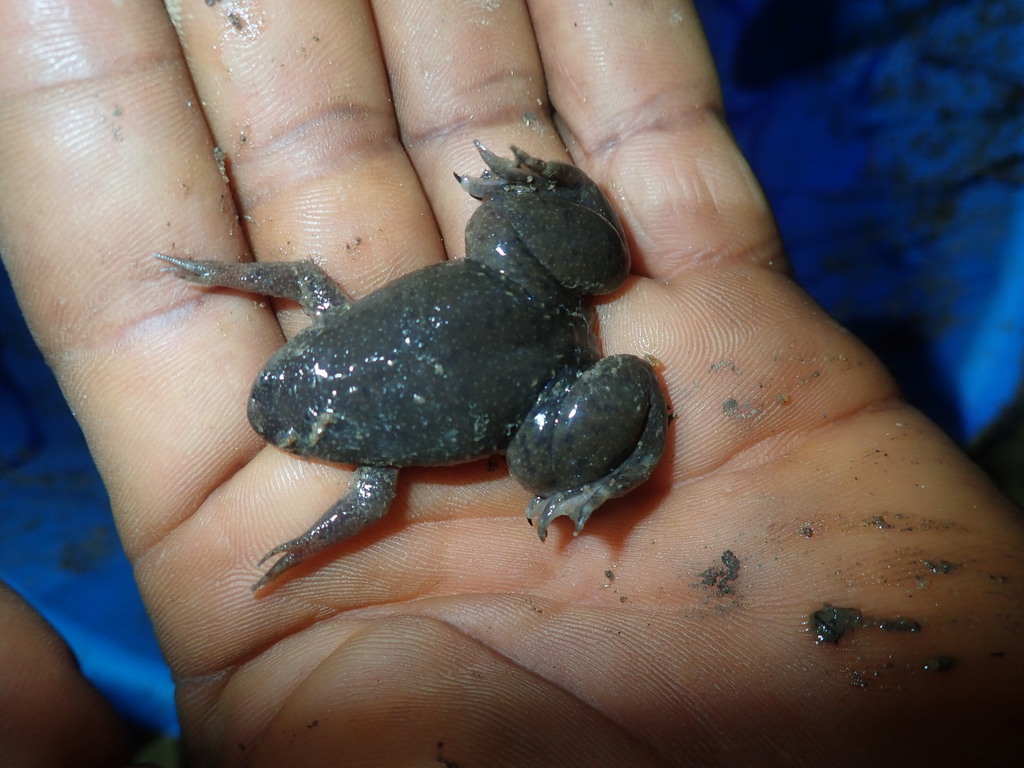
| Appearance and size | This aquatic frog is generally some shade of brown or grey, speckled with darker spots. The head is narrow and tapering, it lacks a tongue and eyelids. The legs are long and there are claws on the hind feet. — From Wikipedia: Hymenochirus boettgeri, CC BY-SA 4.0 (excerpt) |
| History and naming | The specific name boettgeri honours Oskar Boettger, a German zoologist. — From Wikipedia: Hymenochirus boettgeri, CC BY-SA 4.0 (excerpt) |
Native climate (measured)
Native climate (measured)
| Warm-season highs | about 87°F (up to 89°F in the hottest sampled areas) |
| Cool-season lows | about 66°F (down to 63°F in the coldest sampled areas) |
| Average temperature | 73–78°F across sampled records |
| Relative humidity | 82–86% on average (driest month about 80%) |
| Rainfall | about 1896 mm a year |
Measured at 27 wild occurrence records sampled against WorldClim 2.1 climate data (1970–2000 averages). Air conditions in the range are ecological context, not enclosure settings: microhabitats such as burrows, leaf litter or basking rocks can be cooler, warmer or more humid.
Profile
Profile
Researched for this exact species. Sources are listed under In the wild above.
History
The specific name boettgeri honours Oskar Boettger, a German zoologist.
From Wikipedia: Hymenochirus boettgeri, CC BY-SA 4.0 (excerpt)
Data and studies
Care articles for this species
Care articles for this species
- Caring For The African Dwarf Frog (Reptiles Magazine)
Written by keepers, breeders and vets Reptiles MagazineReptiFiles
Veterinary & husbandry research
Veterinary & husbandry research
- Amphibian Hymenochirus boettgeri as an experimental model for infection studies with the chytrid fungus Batrachochytrium dendrobatidis Carvalho T et al., Virulence 2023
- High-mortality epizootic Mycobacterium ulcerans ecovar Liflandii in a colony of Zaire Dwarf Clawed Frogs (Hymenochirus boettgeri) Boulanger M et al., Veterinary pathology 2024
Peer-reviewed papers that mention this species alongside captivity, zoos, veterinary care or aquaculture. Some cover several species or mention it only in passing, so check the abstract. See all 3 on PubMed → PubMed
Sources for this sheet
- AmphibiaWeb (University of California, Berkeley) (CC BY-NC) Peer-reviewed researchUniversity-hosted database of amphibian biology and conservation.
- GBIF Backbone Taxonomy (Global Biodiversity Information Facility) (CC BY 4.0) Peer-reviewed researchInternational scientific taxonomy used here for classification. GBIF Secretariat (2023). GBIF Backbone Taxonomy. Checklist dataset https://doi.org/10.15468/39omei, accessed via GBIF.org.
- Wikipedia (species article) (CC BY-SA 4.0) Community referenceFree encyclopedia; useful overviews with their own citations. Short excerpts are quoted under CC BY-SA 4.0, each credited with a link to its article.
- PubMed (U.S. National Library of Medicine) Peer-reviewed researchIndex of peer-reviewed veterinary, zoo and husbandry research.
- iNaturalist (captive observations) Community referenceCommunity observation platform run by the California Academy of Sciences and National Geographic; observations marked captive show animals living in homes, zoos and aquariums.
- Reptiles Magazine (care articles) Experienced keeper or breederEstablished reptile and amphibian hobby magazine; care articles are written by breeders, keepers and veterinarians.