
Home / Amphibians / Frogs and toads / Barking tree frog
No federal permit to keepBarking tree frog
Dryophytes gratiosus
Amphibians › Frogs and toads (Anura) › Hylidae (Tree frogs)
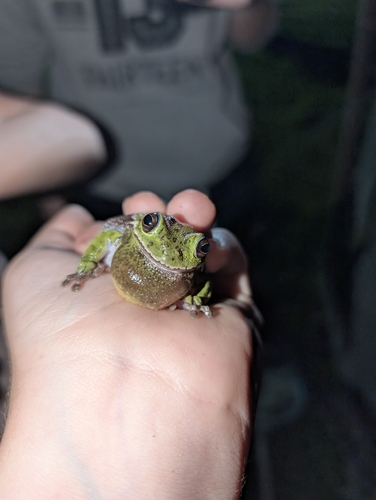
Dryophytes gratiosus, commonly known as the barking tree frog, is a species of tree frog endemic to the south-eastern United States.
From Wikipedia: Dryophytes gratiosus, CC BY-SA 4.0 (excerpt)
Care at a glance
Species-specific values
Values researched for this exact species. Air, surface and water temperatures are listed separately, and each source is kept as published rather than averaged.
| Basking surface temperature | 75–79 °F (24–26 °C) Source: exotic-pets.co.uk | |
| Warm side air temperature | 72 °F (22 °C) Source: exotic-pets.co.uk | |
| Uvb lighting | The article recommends UVB for its amphibians, with most requiring Ferguson index zone 1. Source: exotic-pets.co.uk | |
| Substrate | Use tropical mix for forest species containing soil, forest bark, and moss. Source: exotic-pets.co.uk |
Understanding the animal
About this animal
About this animal
Formerly known as Hyla gratiosa.
From Wikipedia: Dryophytes gratiosus, CC BY-SA 4.0 (excerpt)
In the wild
In the wild
| Overview | Dryophytes gratiosus, commonly known as the barking tree frog, is a species of tree frog endemic to the south-eastern United States. Formerly known as Hyla gratiosa. — From Wikipedia: Dryophytes gratiosus, CC BY-SA 4.0 (excerpt) |
| Where it lives | Adult Dryophytes gratiosus usually live in trees or bushes. They can also burrow deep into mud and logs for added protection from predators. Barking treefrogs need shallow, semi-permanent pools with open canopies or ponds dominated by grasses, which have at least some open water for suitable breeding habitat. — From Wikipedia: Dryophytes gratiosus, CC BY-SA 4.0 (excerpt) |
| Behavior | The barking tree frog is known for its loud, strident, barking call. It may also utter a repetitive single-syllable mating call. The calls of the barking tree frog sound like a church bell and have been described as "tonk" and "doonk". — From Wikipedia: Dryophytes gratiosus, CC BY-SA 4.0 (excerpt) |
| Reproduction | Dryophytes gratiosus is a polygynous species, the female choosing the male on the basis of his call. They use multiple call characteristics concurrently to select a mate and can be quite choosy. One study researched that for the males to win over a female, the males will arrive at the breeding ponds earlier in the night. — From Wikipedia: Dryophytes gratiosus, CC BY-SA 4.0 (excerpt) |
| Appearance and size | Dryophytes gratiosus is the largest native tree frog in the United States, acquiring its name from the raucous and explosive call. It is 5 to 7 cm in head-body length. It is variable in color, but easily recognizable due to the characteristic dark, round markings on its dorsum. — From Wikipedia: Dryophytes gratiosus, CC BY-SA 4.0 (excerpt) |
| Conservation | Dryophytes gratiosus is listed as least concern on the IUCN Red List. Through research studies it was learned that agriculture landscapes show the biggest threats to this species and amphibians in general, and juvenile amphibians feel the worst of the effects of the agricultural industry. D. gratiosus is more sensitive to environmental change than other Dryophytes species in its range. — From Wikipedia: Dryophytes gratiosus, CC BY-SA 4.0 (excerpt) |
Native climate (measured)
Native climate (measured)
| Warm-season highs | about 91°F (up to 92°F in the hottest sampled areas) |
| Cool-season lows | about 38°F (down to 30°F in the coldest sampled areas) |
| Average temperature | 61–69°F across sampled records |
| Relative humidity | 70–72% on average (driest month about 66%) |
| Rainfall | about 1402 mm a year, spread fairly evenly |
| Winters | Cool to cold winters (lows around 38°F) in much of its native range. Seasonal slowdown may be relevant, but species-specific biology determines whether brumation or hibernation occurs. |
Measured at 312 wild occurrence records sampled against WorldClim 2.1 climate data (1970–2000 averages). Air conditions in the range are ecological context, not enclosure settings: microhabitats such as burrows, leaf litter or basking rocks can be cooler, warmer or more humid.
Sources for this sheet
- AmphibiaWeb (University of California, Berkeley) (CC BY-NC) Peer-reviewed researchUniversity-hosted database of amphibian biology and conservation.
- GBIF Backbone Taxonomy (Global Biodiversity Information Facility) (CC BY 4.0) Peer-reviewed researchInternational scientific taxonomy used here for classification. GBIF Secretariat (2023). GBIF Backbone Taxonomy. Checklist dataset https://doi.org/10.15468/39omei, accessed via GBIF.org.
- Wikipedia (species article) (CC BY-SA 4.0) Community referenceFree encyclopedia; useful overviews with their own citations. Short excerpts are quoted under CC BY-SA 4.0, each credited with a link to its article.
- iNaturalist (captive observations) Community referenceCommunity observation platform run by the California Academy of Sciences and National Geographic; observations marked captive show animals living in homes, zoos and aquariums.
More tree frogs

Amazon milk frog
Trachycephalus resinifictrix
Pet trade

American green tree frog
Dryophytes cinereus
Pet trade
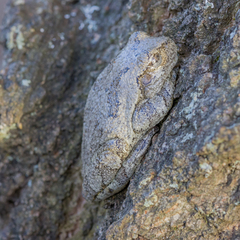
Cope's gray tree frog
Dryophytes chrysoscelis
Pet trade

Cuban tree frog
Osteopilus septentrionalis
Pet trade

European tree frog
Hyla arborea
Zoos & aquariums

Gray tree frog
Dryophytes versicolor
Pet trade