
Home / Reptiles / Lizards / Diplodactylidae / Robust Forest Bavayia
No federal permit to keepRobust Forest Bavayia
Bavayia robusta
Reptiles › Lizards (Lacertilia) › Diplodactylidae (Crested and related geckos)
Bavayia robusta, also known as the robust forest bavayia, is a species of geckos endemic to Grande Terre and Île des Pins in New Caledonia. It belongs to the family Diplodactylidae and is the largest known species in the Bavayia genus.
From Wikipedia: Bavayia robusta, CC BY-SA 4.0 (excerpt)

Care at a glance
Species-specific values
Values researched for this exact species. Air, surface and water temperatures are listed separately, and each source is kept as published rather than averaged.
| Minimum enclosure | At least 60 × 45 × 90 cm (L × W × H) for one adult. Source: interaquaristik.de | |
| Basking surface temperature | 79–81 °F (26–27 °C) Source: interaquaristik.de | |
| Warm side air temperature | 72–77 °F (22–25 °C) Source: interaquaristik.de | |
| Cool side air temperature | Keep cooler zones available. Source: interaquaristik.de | |
| Night temperature | 64–72 °F (18–22 °C) Source: interaquaristik.de | |
| Humidity | 60–80 % Source: interaquaristik.de | |
| Uvb lighting | Use weak, suitably shielded UVB lighting. Source: interaquaristik.de | |
| Diet | Small live feeder animals; complete fruit food for New Caledonian geckos may also be offered. Source: interaquaristik.de | |
| Feeding frequency | Adults receive small portions on several evenings per week; juveniles more frequently. Source: interaquaristik.de | |
| Social housing | Prefer individual housing; compatible pairs may be kept with close monitoring. Source: interaquaristik.de | |
| Substrate | Use drainage and at least 8–10 cm of loose forest substrate. Source: interaquaristik.de | |
| Seasonal cooling | No pronounced winter rest; a mild seasonal phase with shorter lighting, slightly lower temperatures, and reduced feeding may be used. Source: interaquaristik.de |
Understanding the animal
In the wild
In the wild
| Overview | Bavayia robusta, also known as the robust forest bavayia, is a species of geckos endemic to Grande Terre and Île des Pins in New Caledonia. It belongs to the family Diplodactylidae and is the largest known species in the Bavayia genus. — From Wikipedia: Bavayia robusta, CC BY-SA 4.0 (excerpt) |
| Where it lives | This species inhabits a variety of wooded areas, including mangroves, coastal forests, and humid forests at low to mid-elevations. It is found mainly along the west coast of Grande Terre, though there are other populations scattered in suitable habitats across the island. Additionally, B. robusta is present on Île des Pins and a few surrounding islands. — From Wikipedia: Bavayia robusta, CC BY-SA 4.0 (excerpt) |
| Wild diet | Bavayia robusta- is an omnivorous species, although it primarily feeds on insects and other small invertebrates. It may occasionally consume other organic material such as fruit, nectar, and pollen. — From Wikipedia: Bavayia robusta, CC BY-SA 4.0 (excerpt) |
| Behavior | Bavayia robusta is a nocturnal and primarily arboreal gecko, being mostly active during the night and spending most of its time on higher surfaces, typically on trees and shrubs. During the daytime, it seeks shelter in tree bark crevices, under leaf litter, or within rocky outcrops to avoid predators and desiccation. Due to its slim build, it is able to hide in hard to reach places, making it even harder to detect. — From Wikipedia: Bavayia robusta, CC BY-SA 4.0 (excerpt) |
| Reproduction | Bavayia robusta is oviparous, meaning it reproduces by laying eggs. Females typically lay a clutch of two eggs, which is common among New Caledonian geckos. These eggs are usually laid in moist sheltered areas, such as under bark or leaf litter, where they are protected from predators and desiccation. — From Wikipedia: Bavayia robusta, CC BY-SA 4.0 (excerpt) |
| Appearance and size | Bavayia robusta, typically reaches a total length of 15–20 cm (6–7 inches). This species is named for its relatively robust build, with a stockier body and broader head compared to other members of the genus. Its limbs are well-developed, and the toes are equipped with expanded pads that aid in climbing. — From Wikipedia: Bavayia robusta, CC BY-SA 4.0 (excerpt) |
Read about this species in the wild at The Reptile Database.
Profile
Profile
Researched for this exact species. Sources are listed under In the wild above.
History
Named after the Latin word for strong and powerful.
Sources for this sheet
- Myhrvold et al. (2015). An amniote life-history database. Ecology 96: 3109 Peer-reviewed researchPeer-reviewed compilation of life-history data for over 21,000 birds, mammals and reptiles.
- The Reptile Database Peer-reviewed researchScientist-curated catalog of every reptile species, with taxonomy and literature.
- GBIF Backbone Taxonomy (Global Biodiversity Information Facility) (CC BY 4.0) Peer-reviewed researchInternational scientific taxonomy used here for classification. GBIF Secretariat (2023). GBIF Backbone Taxonomy. Checklist dataset https://doi.org/10.15468/39omei, accessed via GBIF.org.
- Wikipedia (species article) (CC BY-SA 4.0) Community referenceFree encyclopedia; useful overviews with their own citations. Short excerpts are quoted under CC BY-SA 4.0, each credited with a link to its article.
More crested and related geckos
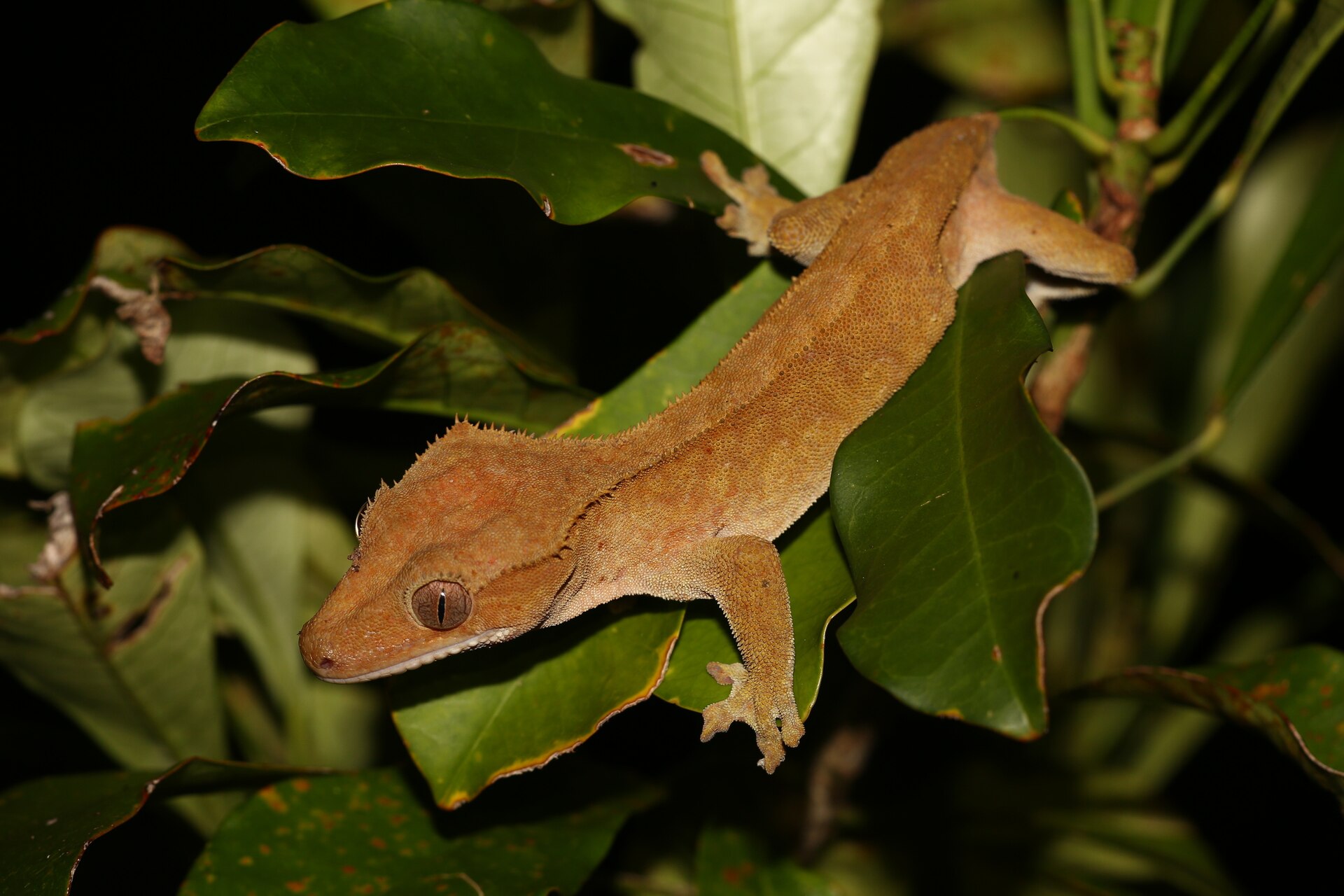
Crested gecko
Correlophus ciliatus
A sticky-toed fruit-lover that hates heat.
Pet trade

Bauer's chameleon gecko
Eurydactylodes agricolae
Pet trade

Chahoua gecko
Mniarogekko chahoua
Pet trade
Dotted Velvet Gecko
Oedura gemmata
Pet trade

Gargoyle gecko
Rhacodactylus auriculatus
Pet trade

Golden-tailed gecko
Strophurus taenicauda
Pet trade