
Home / Reptiles / Crocodilians / Broad-snouted caiman
Some federal rules applyBroad-snouted caiman
Caiman latirostris
Reptiles › Crocodilians (Crocodylia) › Alligatoridae (Alligators and caimans)
The broad-snouted caiman is a crocodilian in the family Alligatoridae found in eastern and central South America, including the Pantanal habitat of Bolivia, Southeast Brazil, and Paraguay, as well as northern Argentina and Uruguay.

Care at a glance
Setup
One answer per setting. Where sources differ, the smaller figure is the minimum and the larger is what we recommend.
| Adult enclosure | For a pair: dry land at least three times by four times the final length of the largest animal | gov.scot |
| Hot spot | 97°F Provide a temperature gradient | gov.scot |
| Cool side | 79°F Provide a temperature gradient | gov.scot |
| Lighting | At least 11 hours Preferably 13 hours | gov.scot |
| Water | Water area four times by five times the length, at least 0.3 times the length of the reptile deep | gov.scot |
| Food | Whole prey including skin and bones; chicken portions including the bones are suitable | gov.scot |
| Supplements | Fish can be fed but must be supplemented with vitamins | gov.scot |
| Housing | Can be kept in groups only with enough room for the whole group | gov.scot |
Understanding the animal
About this animal
About this animal
Behind the black caiman, it is the second-largest caiman species; it is the third-largest alligatorid behind the American alligator and the aforementioned black caiman.
From Wikipedia: Broad-snouted caiman, CC BY-SA 4.0 (excerpt)
In the wild
In the wild
Researched for this exact species, not its family. Wild conditions are context, not enclosure settings.1
Profile
Profile
Researched for this exact species. Sources are listed under In the wild above.
Keeper tips
- Crocodilians can move surprisingly quickly over land; do not enter the enclosure on your own.
Sources for this sheet
- 50 CFR 17.11: Endangered and threatened wildlife Zoo, university or veterinaryCurrent federal Endangered Species Act list.
- Species+ (UNEP-WCMC and the CITES Secretariat) Zoo, university or veterinaryThe official database of species listed under CITES. UNEP (2026). The Species+ Website. Nairobi, Kenya. Compiled by UNEP-WCMC, Cambridge, UK. Available at: www.speciesplus.net. [Accessed 04/10/2026].
- USFWS International Affairs: CITES Zoo, university or veterinaryFederal agency that issues CITES permits.
- Crocodilians (gov.scot) Community referenceWeb page.
- Wikipedia: Caiman latirostris (CC BY-SA 4.0) Community referenceEncyclopedia article.
- The Reptile Database: Caiman latirostris Zoo, university or veterinaryTaxonomy, distribution and literature for every reptile species.
- The Reptile Database Peer-reviewed researchScientist-curated catalog of every reptile species, with taxonomy and literature.
- GBIF Backbone Taxonomy (Global Biodiversity Information Facility) (CC BY 4.0) Peer-reviewed researchInternational scientific taxonomy used here for classification. GBIF Secretariat (2023). GBIF Backbone Taxonomy. Checklist dataset https://doi.org/10.15468/39omei, accessed via GBIF.org.
- Wikipedia (species article) (CC BY-SA 4.0) Community referenceFree encyclopedia; useful overviews with their own citations. Short excerpts are quoted under CC BY-SA 4.0, each credited with a link to its article.
More alligators and caimans
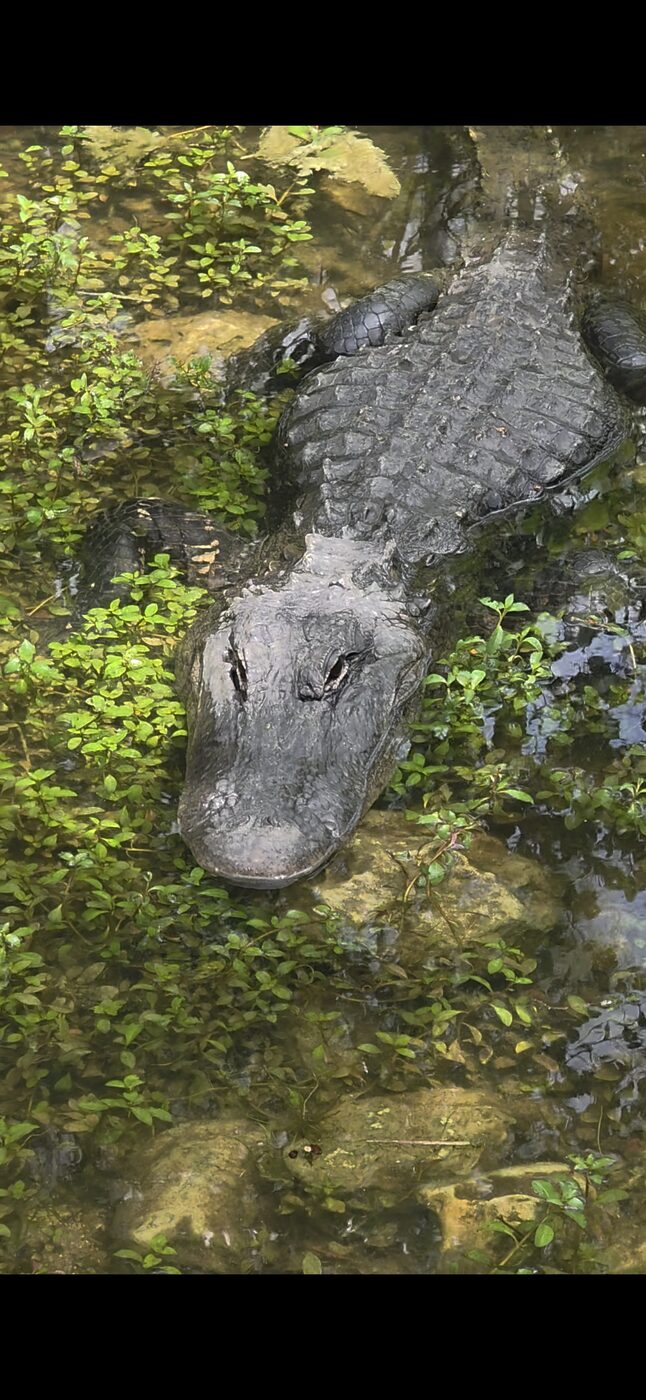
American alligator
Alligator mississippiensis
A 50-year, 10-foot commitment.
Zoos & aquariums

Black caiman
Melanosuchus niger
Zoos & aquariums

Chinese alligator
Alligator sinensis
Zoos & aquariums

Cuvier's dwarf caiman
Paleosuchus palpebrosus
Pet trade

Smooth-fronted caiman
Paleosuchus trigonatus
Zoos & aquariums

Spectacled caiman
Caiman crocodilus
Pet trade