
Home / Reptiles / Crocodilians / Smooth-fronted caiman
Some federal rules applySmooth-fronted caiman
Paleosuchus trigonatus
Reptiles › Crocodilians (Crocodylia) › Alligatoridae (Alligators and caimans)
The smooth-fronted caiman, also known as Schneider's dwarf caiman or Schneider's smooth-fronted caiman, is a crocodilian from South America, where it is native to the Amazon and Orinoco Basins.

Care at a glance
Setup
One answer per setting. Where sources differ, the smaller figure is the minimum and the larger is what we recommend.
| Adult enclosure | For a pair: dry land at least three times by four times the final length of the largest animal | gov.scot |
| Hot spot | 97°F Provide a temperature gradient | gov.scot |
| Cool side | 79°F Provide a temperature gradient | gov.scot |
| Lighting | At least 11 hours Preferably 13 hours | gov.scot |
| Water | Water area four times by five times the length, at least 0.3 times the length of the reptile deep | gov.scot |
| Food | Whole prey including skin and bones; chicken portions including the bones are suitable | gov.scot |
| Supplements | Fish can be fed but must be supplemented with vitamins | gov.scot |
| Housing | Can be kept in groups only with enough room for the whole group | gov.scot |
Care guide
By age
| Hatchling | Feeding: Insects and other arthropods for the first few weeks, then small fish, birds and reptiles | Wikipedia |
Understanding the animal
About this animal
About this animal
It is the second-smallest species of the family Alligatoridae, the smallest being Cuvier's dwarf caiman, also from tropical South America and in the same genus. An adult typically grows to around 1.2 to 1.6 m in length and weighs between 9 and 20 kg. Exceptionally large males can reach as much as 2.3 m (7.5 ft) in length and 36 kg (79 lb) in weight.
From Wikipedia: Smooth-fronted caiman, CC BY-SA 4.0 (excerpt)
In the wild
In the wild
Researched for this exact species, not its family. Wild conditions are context, not enclosure settings.12
| Where it lives | Small streams in forested areas, where the water may be too shallow to completely submerge itself. |
| Social life | Males are territorial; females have small home ranges. |
| Wild diet | Adults are semiterrestrial and eat porcupines, pacas, snakes, birds and lizards, with few fish or molluscs. |
| Behavior to plan for | Hides by day in underwater burrows, hollow logs, under fallen trees or in dense undergrowth, sometimes up to 100 m from water. |
Profile
Profile
Researched for this exact species. Sources are listed under In the wild above.
Keeper tips
- Shy and secretive: seldom in the open, and it does not usually bask in the sun, even in captivity.
- Crocodilians can move surprisingly quickly over land; do not enter the enclosure on your own.
Remarkable facts
- Adults typically 1.2 to 1.6 m (3.9 to 5.2 ft), 9 to 20 kg.
Data and studies
Veterinary & husbandry research
Veterinary & husbandry research
- Detecting population structure of Paleosuchus trigonatus (Alligatoridae: Caimaninae) through microsatellites markers developed by next generation sequencing. et al., Molecular biology reports 2019
- I got it from my mother: Inter-nest variation of mercury concentration in neonate Smooth-fronted Caiman (Paleosuchus trigonatus) suggests maternal transfer and possible phenotypical effects. et al., Environmental research 2021
- Evidence of cryptic lineages within a small South American crocodilian: the Schneider's dwarf caiman Paleosuchus trigonatus (Alligatoridae: Caimaninae). et al., PeerJ 2019
- Assessing abundance-suitability models to prioritize conservation areas for the dwarf caimans in South America. et al., Ecology and evolution 2024
Peer-reviewed papers that mention this species alongside captivity, zoos, veterinary care or aquaculture. Some cover several species or mention it only in passing, so check the abstract. PubMed
Sources for this sheet
- Species+ (UNEP-WCMC and the CITES Secretariat) Zoo, university or veterinaryThe official database of species listed under CITES. UNEP (2026). The Species+ Website. Nairobi, Kenya. Compiled by UNEP-WCMC, Cambridge, UK. Available at: www.speciesplus.net. [Accessed 04/10/2026].
- USFWS International Affairs: CITES Zoo, university or veterinaryFederal agency that issues CITES permits.
- Crocodilians (gov.scot) Community referenceWeb page.
- Wikipedia: Paleosuchus trigonatus (CC BY-SA 4.0) Community referenceEncyclopedia article.
- The Reptile Database: Paleosuchus trigonatus Zoo, university or veterinaryTaxonomy, distribution and literature for every reptile species.
- The Reptile Database Peer-reviewed researchScientist-curated catalog of every reptile species, with taxonomy and literature.
- GBIF Backbone Taxonomy (Global Biodiversity Information Facility) (CC BY 4.0) Peer-reviewed researchInternational scientific taxonomy used here for classification. GBIF Secretariat (2023). GBIF Backbone Taxonomy. Checklist dataset https://doi.org/10.15468/39omei, accessed via GBIF.org.
- Wikipedia (species article) (CC BY-SA 4.0) Community referenceFree encyclopedia; useful overviews with their own citations. Short excerpts are quoted under CC BY-SA 4.0, each credited with a link to its article.
- PubMed (U.S. National Library of Medicine) Peer-reviewed researchIndex of peer-reviewed veterinary, zoo and husbandry research.
More alligators and caimans
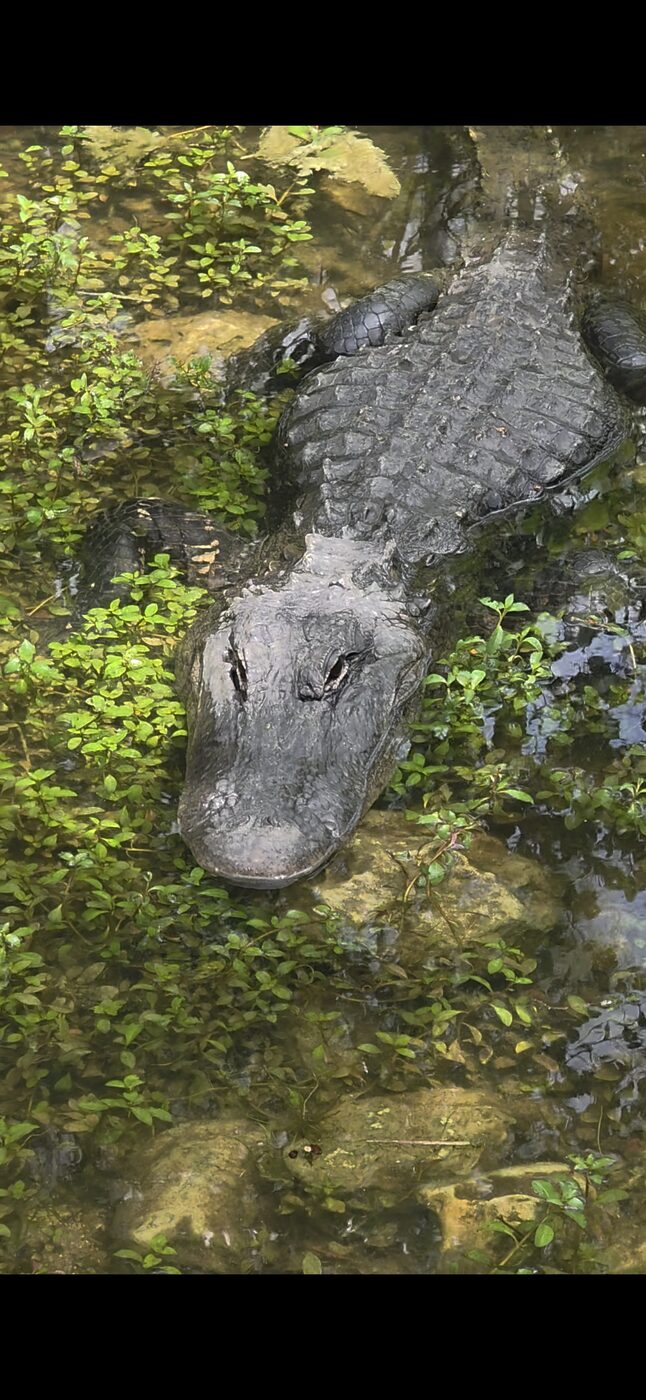
American alligator
Alligator mississippiensis
A 50-year, 10-foot commitment.
Zoos & aquariums

Black caiman
Melanosuchus niger
Zoos & aquariums

Broad-snouted caiman
Caiman latirostris
Zoos & aquariums

Chinese alligator
Alligator sinensis
Zoos & aquariums

Cuvier's dwarf caiman
Paleosuchus palpebrosus
Pet trade

Spectacled caiman
Caiman crocodilus
Pet trade