
Home / Reptiles / Crocodilians / Cuvier's dwarf caiman
Some federal rules applyCuvier's dwarf caiman
Paleosuchus palpebrosus
Reptiles › Crocodilians (Crocodylia) › Alligatoridae (Alligators and caimans)
Cuvier's dwarf caiman (Paleosuchus palpebrosus) is a small crocodilian in the alligator family from northern and central South America.

Care at a glance
Species-specific values
Values researched for this exact species. Air, surface and water temperatures are listed separately, and each source is kept as published rather than averaged.
| Minimum enclosure | Absolute minimum of 400 x 200 x 100 cm for one adult. Source: reptinode.fr | |
| Basking surface temperature | 86–91 °F (30–33 °C) Source: reptinode.fr | |
| Warm side air temperature | 82–88 °F (28–31 °C) Source: reptinode.fr | |
| Cool side air temperature | 75–81 °F (24–27 °C) Source: reptinode.fr | |
| Night temperature | 72 °F (at least 22 °C) Source: reptinode.fr | |
| Humidity | 70–90 % Source: reptinode.fr | |
| Water temperature | 77–82 °F (25–28 °C) Source: reptinode.fr | |
| Uvb lighting | A moderate-index UVB tube above the dry area paired with the hotspot is recommended. Source: reptinode.fr | |
| Diet | Whole fish, crustaceans, amphibians, small rodents and chicks; insects for juveniles. Source: reptinode.fr | |
| Feeding frequency | Several meals a week for juveniles and 1 to 2 a week for adults. Source: reptinode.fr | |
| Substrate | Soft, smooth land substrate such as river sand, untreated soil or smooth pebbles; aquatic section may be bare. Source: reptinode.fr | |
| Minimum enclosure | New hatchlings need at least a 20-gallon-long vivarium; growing animals should be staged up to enclosures at least four times their length. Source: reptiletalk.net | |
| Night temperature | 75–95 °F (24–35 °C) Source: reptiletalk.net | |
| Basking surface temperature | For indoor enclosures, a basking site can reach approximately 37.5 °C (100 °F). Source: reptiletalk.net | |
| Uvb lighting | Natural UV lighting is not needed when diet and temperature are appropriate; the article says it can help ensure proper temperatures and health. Source: reptiletalk.net | |
| Substrate | Substrate can be small rocks, or dirt covered by small or medium rock or mulch. Source: reptiletalk.net | |
| Diet | The article lists varied prey and foods by age: hatchlings, juveniles, and adults have different options. Source: reptiletalk.net | |
| Feeding frequency | Young animals can eat prey daily; older animals tend to eat larger items less often. Source: reptiletalk.net | |
| Social housing | Shared housing can cause wounds; the article recommends adding cover, hides, or visual barriers. Source: reptiletalk.net |
Understanding the animal
About this animal
About this animal
It is found in Bolivia, Brazil, Colombia, Ecuador, French Guiana, Guyana, Paraguay, Peru, Suriname, Trinidad and Venezuela. It lives in riverine forests, flooded forests near lakes, and near fast-flowing rivers and streams.
From Wikipedia: Cuvier's dwarf caiman, CC BY-SA 4.0 (excerpt)
In the wild
In the wild
Researched for this exact species, not its family. Wild conditions are context, not enclosure settings.1
| Where it lives | Forested waterways and flooded savannas of northern and central South America, including the Amazon, Orinoco and upper Paraguay drainages. It uses shallow stream margins, banks, woody debris and terrestrial burrows. |
| Ground it lives on | Streambank soil, rocks and decaying wood; excavated bank burrows. |
| Climate | Tropical to subtropical; cooler southern conditions occur. Typical wild air temperatures and relative humidity were not established. |
| Active | Nocturnal hunting; daytime resting and basking. |
| Social life | Generally solitary and reclusive. |
| Wild diet | Young take shoreline and aquatic insects, snails, crustaceans, tadpoles and small fish; adults also take frogs, fish, birds, reptiles and small mammals. |
| Behavior to plan for | It moves between water and land and uses substantial burrows. Its secretive habits make sheltered resting places important. |
Native climate (measured)
Native climate (measured)
| Warm-season highs | about 91°F (up to 95°F in the hottest sampled areas) |
| Cool-season lows | about 70°F (down to 69°F in the coldest sampled areas) |
| Average temperature | 78–80°F across sampled records |
| Relative humidity | 77–84% on average (driest month about 67%) |
| Rainfall | about 2727 mm a year |
Measured at 98 wild occurrence records sampled against WorldClim 2.1 climate data (1970–2000 averages). Air conditions in the range are ecological context, not enclosure settings: microhabitats such as burrows, leaf litter or basking rocks can be cooler, warmer or more humid.
Data and studies
The numbers
The numbers
Each bar is what one source reports. Where several sources weigh in, the dashed gold band marks their average.
Maximum recorded lifespan
Longest recorded lifespan reported by each database; typical lifespans are usually shorter. The AnAge record comes from an animal in human care.
Typical adult weight
Average adult body mass in each database (FishBase gives the maximum recorded weight).
Incubation
Female maturity
Veterinary & husbandry research
Veterinary & husbandry research
- A PUFFERFISH (TETRADON NIGROVIRIDIS) AVAILABLE IN THE COMMON PET TRADE HARBORS LETHAL CONCENTRATIONS OF TETRODOTOXIN: A CASE STUDY OF POISONING IN A CUVIER'S DWARF CAIMAN (PALEOSUCHUS PALPEBROSUS) Williams BL et al., Journal of zoo and wildlife medicine: official publication of the American Association of Zoo Veterinarians 2016
Peer-reviewed papers that mention this species alongside captivity, zoos, veterinary care or aquaculture. Some cover several species or mention it only in passing, so check the abstract. See all 2 on PubMed → PubMed
Sources for this sheet
- AnAge: The Animal Ageing and Longevity Database (Human Ageing Genomic Resources) (CC BY 3.0) Peer-reviewed researchCurated, referenced longevity and life-history records for thousands of species; maximum lifespans are often from zoo animals.
- Myhrvold et al. (2015). An amniote life-history database. Ecology 96: 3109 Peer-reviewed researchPeer-reviewed compilation of life-history data for over 21,000 birds, mammals and reptiles.
- Species+ (UNEP-WCMC and the CITES Secretariat) Zoo, university or veterinaryThe official database of species listed under CITES. UNEP (2026). The Species+ Website. Nairobi, Kenya. Compiled by UNEP-WCMC, Cambridge, UK. Available at: www.speciesplus.net. [Accessed 04/10/2026].
- USFWS International Affairs: CITES Zoo, university or veterinaryFederal agency that issues CITES permits.
- Clint's Reptiles (YouTube): Cuvier's Dwarf Caiman, The Best Pet Crocodilian? Expert educator & keeperClint Laidlaw, PhD in Biology Education and MS in Evolutionary Ecology; owner of Clint's Reptile Room and a longtime keeper. His "Best Pet?" series reviews each species' care in depth.
- The Reptile Database Peer-reviewed researchScientist-curated catalog of every reptile species, with taxonomy and literature.
- GBIF Backbone Taxonomy (Global Biodiversity Information Facility) (CC BY 4.0) Peer-reviewed researchInternational scientific taxonomy used here for classification. GBIF Secretariat (2023). GBIF Backbone Taxonomy. Checklist dataset https://doi.org/10.15468/39omei, accessed via GBIF.org.
- Wikipedia (species article) (CC BY-SA 4.0) Community referenceFree encyclopedia; useful overviews with their own citations. Short excerpts are quoted under CC BY-SA 4.0, each credited with a link to its article.
- PubMed (U.S. National Library of Medicine) Peer-reviewed researchIndex of peer-reviewed veterinary, zoo and husbandry research.
- iNaturalist (captive observations) Community referenceCommunity observation platform run by the California Academy of Sciences and National Geographic; observations marked captive show animals living in homes, zoos and aquariums.
More alligators and caimans
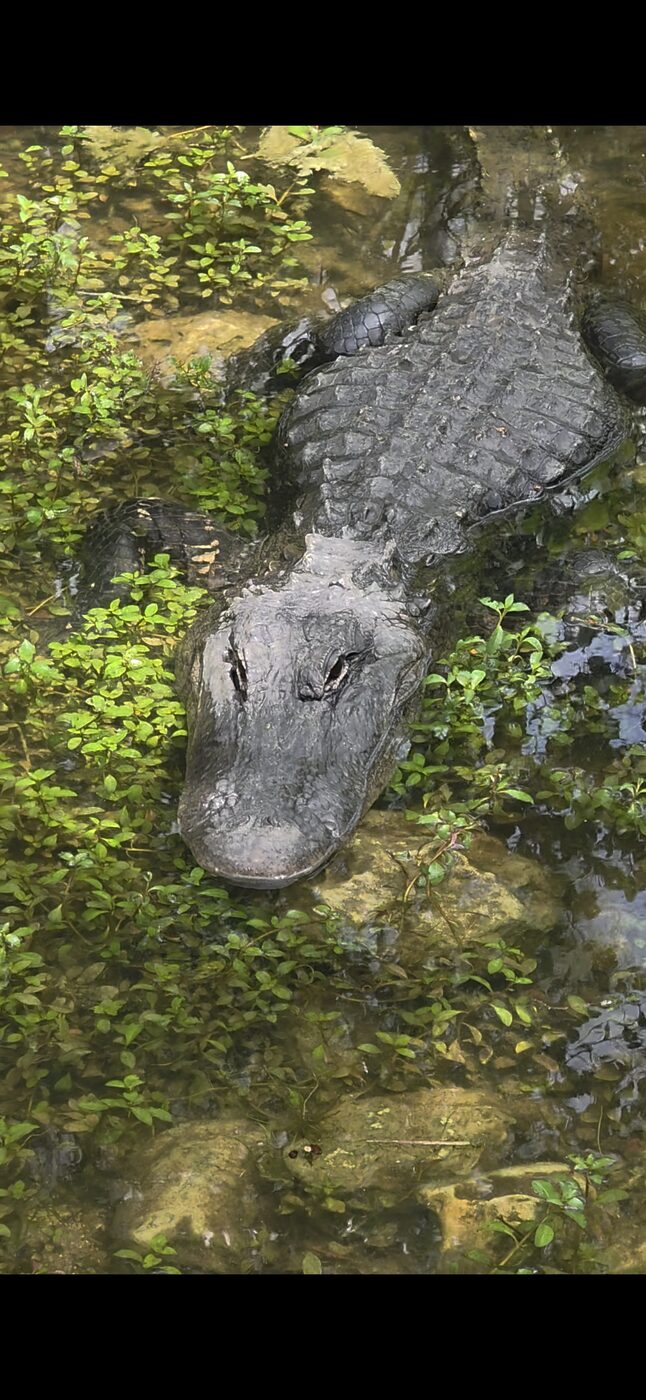
American alligator
Alligator mississippiensis
A 50-year, 10-foot commitment.
Zoos & aquariums

Black caiman
Melanosuchus niger
Zoos & aquariums

Broad-snouted caiman
Caiman latirostris
Zoos & aquariums

Chinese alligator
Alligator sinensis
Zoos & aquariums

Smooth-fronted caiman
Paleosuchus trigonatus
Zoos & aquariums

Spectacled caiman
Caiman crocodilus
Pet trade