
Home / Birds / Songbirds and perching birds / Domestic canary
No federal permit to keepDomestic canary
Serinus canaria
Birds › Songbirds and perching birds (Passeriformes) › Fringillidae (Finches and canaries)
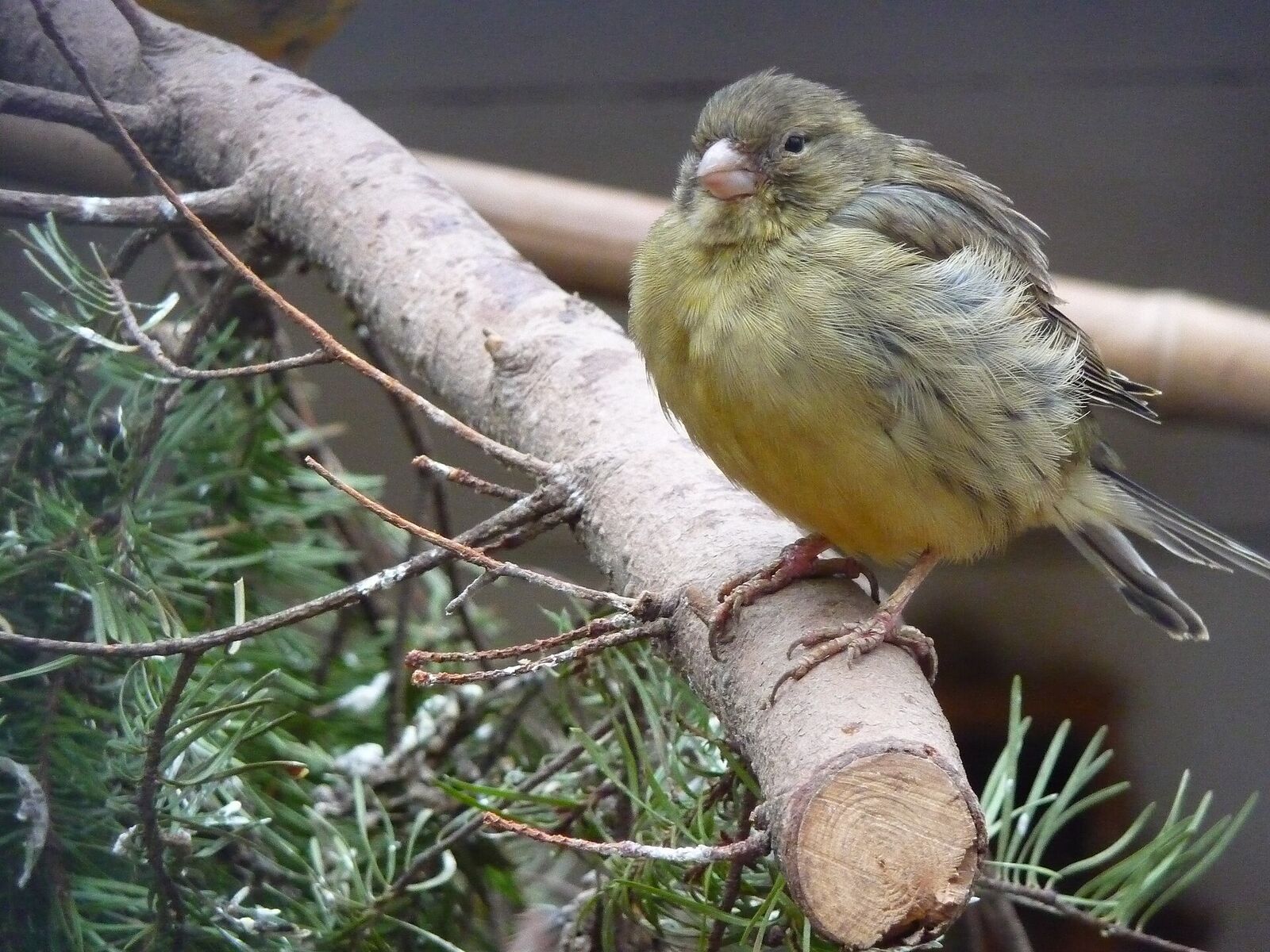
Canaries have been bred since at least the 1400s for song and color. They prefer to be watched and heard rather than handled.
Care at a glance
Species-specific values
Values researched for this exact species. Air, surface and water temperatures are listed separately, and each source is kept as published rather than averaged.
| Diet | Balanced canary pellets or pellet-based mash, with appropriately planned supplements and fresh foods; seed alone is deficient. | msdvetmanual.com |
| Diet pellet fraction | 75–80 % VCA recommendation; source does not specify weight or offered-food basis. | vcahospitals.com |
| Diet fresh produce fraction | 20–25 % Approximate VCA recommendation, not a separately additive exact recipe. | vcahospitals.com |
| Digestive grit | Do not offer insoluble grit or gravel; canaries remove seed hulls. | vcahospitals.com |
| Diet crude protein | 18–22 % Formulated breeding diets described by MSD; not an adult-maintenance target. | msdvetmanual.com |
| Diet fat | 5–8 % Formulated breeding diets described by MSD; percentage basis not specified. | msdvetmanual.com |
Care guide
Care
- Roomy flight cage or aviary, cleaned regularly with a bird-safe disinfectant.
Sources rvc.ac.uk
Understanding the animal
In the wild
In the wild
Researched for this exact species, not its family. Wild conditions are context, not enclosure settings.1
| Where it lives | Wild Atlantic canaries occur in the Canary Islands, Madeira and Azores; wooded edges, scrub, orchards and gardens provide feeding and nesting sites. Recorded from sea level to approximately 6,560 feet. |
| Ground it lives on | branches and shrubs; also low vegetation and seed-bearing plants |
| Social life | Pairs nest near other pairs with limited territoriality; adults and young form wandering flocks after breeding. |
| Wild diet | Primarily seeds, shoots and buds, with smaller amounts of insects. |
| Behavior to plan for | Builds cup nests on outer tree or shrub branches. Post-breeding flocks move through wooded and open feeding areas. |
Native climate (measured)
Native climate (measured)
| Warm-season highs | about 77°F (up to 84°F in the hottest sampled areas) |
| Cool-season lows | about 53°F (down to 48°F in the coldest sampled areas) |
| Average temperature | 60–68°F across sampled records |
| Relative humidity | 65–71% on average (driest month about 62%) |
| Rainfall | about 369 mm a year |
Measured at 127 wild occurrence records sampled against WorldClim 2.1 climate data (1970–2000 averages). Air conditions in the range are ecological context, not enclosure settings: microhabitats such as burrows, leaf litter or basking rocks can be cooler, warmer or more humid.
Data and studies
Researched care notes
Researched care notes
Findings checked against veterinary, zoo, welfare, keeper and peer-reviewed sources. Air, basking-surface and water temperatures are kept separate, and where sources disagree both are shown. “Study” notes report what a paper measured, not a universal rule.
Canary
- An all-seed diet is nutritionally incomplete; VCA recommends a balanced canary-formulated diet with limited seed and suitable fresh greens.1
- Provide flight space and securely spaced bars; PetMD gives a maximum bar gap of 3/8 inch, approximately 9.5 mm.2
- Male canaries may fight when housed together; monitor any proposed pair or group and retain the ability to separate incompatible birds.2
- Provide varied perch sizes and textures, avoiding abrasive sandpaper or gravel coatings and positioning perches away from food and water below.2
- Provide a clean bathing opportunity and wash food and water dishes daily.2
The numbers
The numbers
Each bar is what one source reports. Where several sources weigh in, the dashed gold band marks their average.
Maximum recorded lifespan
Longest recorded lifespan reported by each database; typical lifespans are usually shorter. The AnAge record comes from an animal in human care.
Typical adult weight
Average adult body mass in each database (FishBase gives the maximum recorded weight).
Incubation
Veterinary & husbandry research
Veterinary & husbandry research
- Domestic canaries (Serinus canaria forma domestica) are susceptible to low pathogenic avian influenza virus infections Marché S et al., Avian pathology: journal of the W.V.P.A 2018
- Detection and molecular characterization of Cryptosporidium spp. in captive canaries (Serinus canaria) using different diagnostic methods Camargo VDS et al., Revista brasileira de parasitologia veterinaria = Brazilian journal of veterinary parasitology: Orgao Oficial do Colegio Brasileiro de Parasitologia Veterinaria 2018
Peer-reviewed papers that mention this species alongside captivity, zoos, veterinary care or aquaculture. Some cover several species or mention it only in passing, so check the abstract. See all 35 on PubMed → PubMed
Sources for this sheet
- Royal Veterinary College Exotics Service: Canary care Zoo, university or veterinaryVet-school exotics hospital factsheet, reviewed 2021–2024.
- AnAge: The Animal Ageing and Longevity Database (Human Ageing Genomic Resources) (CC BY 3.0) Peer-reviewed researchCurated, referenced longevity and life-history records for thousands of species; maximum lifespans are often from zoo animals.
- Myhrvold et al. (2015). An amniote life-history database. Ecology 96: 3109 Peer-reviewed researchPeer-reviewed compilation of life-history data for over 21,000 birds, mammals and reptiles.
- GBIF Backbone Taxonomy (Global Biodiversity Information Facility) (CC BY 4.0) Peer-reviewed researchInternational scientific taxonomy used here for classification. GBIF Secretariat (2023). GBIF Backbone Taxonomy. Checklist dataset https://doi.org/10.15468/39omei, accessed via GBIF.org.
- Wikipedia (species article) (CC BY-SA 4.0) Community referenceFree encyclopedia; useful overviews with their own citations. Short excerpts are quoted under CC BY-SA 4.0, each credited with a link to its article.
- PubMed (U.S. National Library of Medicine) Peer-reviewed researchIndex of peer-reviewed veterinary, zoo and husbandry research.
- iNaturalist (captive observations) Community referenceCommunity observation platform run by the California Academy of Sciences and National Geographic; observations marked captive show animals living in homes, zoos and aquariums.
More finches and canaries

Black siskin
Spinus atratus
Aviary

Black-chinned siskin
Spinus barbatus
Aviary

Black-headed siskin
Spinus notatus
Aviary

Eurasian chaffinch
Fringilla coelebs
Zoos & aquariums

European goldfinch
Carduelis carduelis
Pet trade

European greenfinch
Chloris chloris
Pet trade