
Home / Amphibians / Frogs and toads / Cane toad
No federal permit to keepCane toad
Rhinella marina
Amphibians › Frogs and toads (Anura) › Bufonidae (Toads)
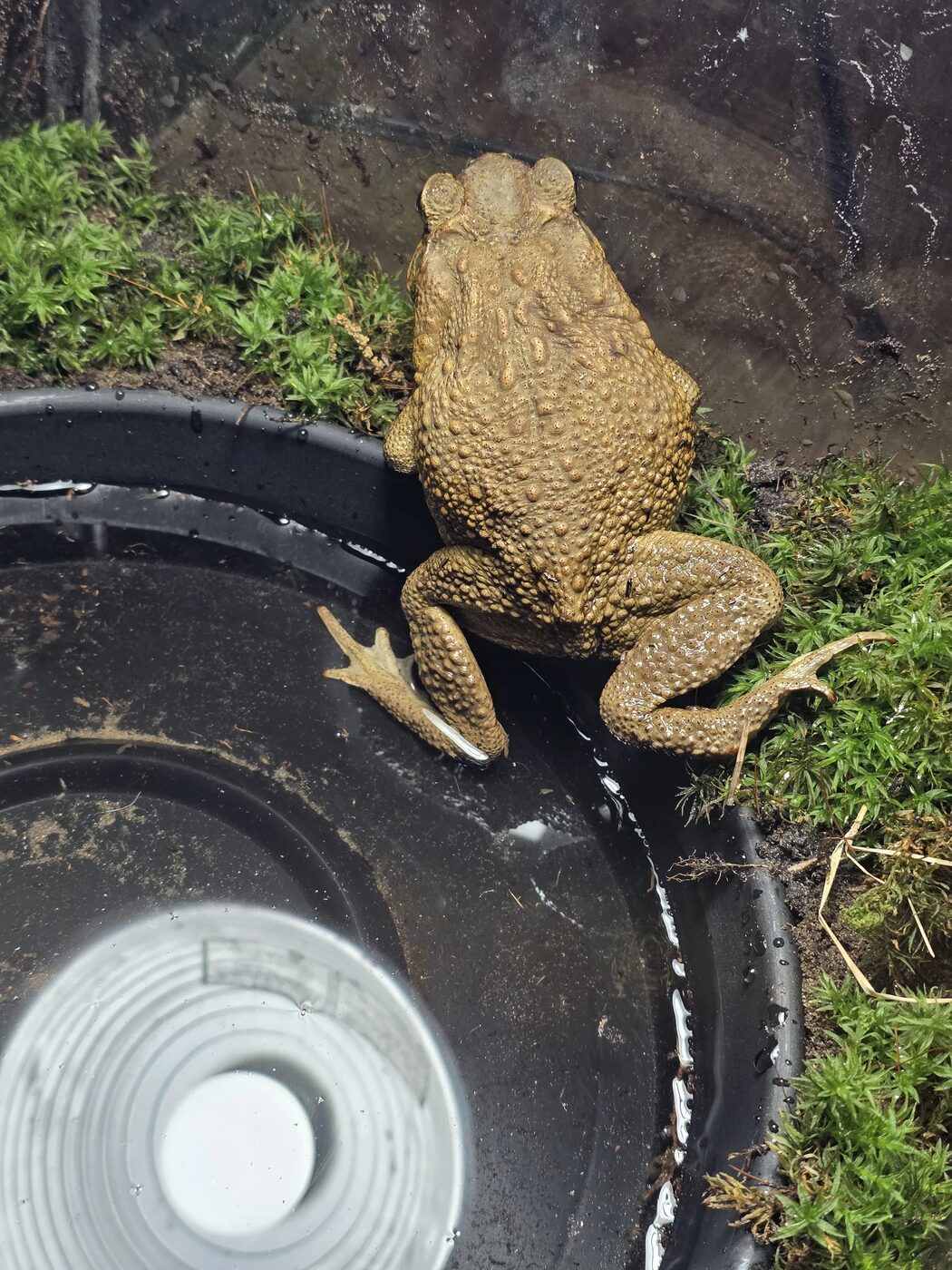
The cane toad (Rhinella marina), also known as the giant neotropical toad or marine toad, is a large, terrestrial true toad native to South and mainland Central America, but which has been introduced to various islands throughout Oceania and the…
From Wikipedia: Cane toad, CC BY-SA 4.0 (excerpt)
Care at a glance
Species-specific values
Values researched for this exact species. Air, surface and water temperatures are listed separately, and each source is kept as published rather than averaged.
| Minimum enclosure | At least 600 mm in length and 300 mm in height. Source: reptilecentre.com | |
| Warm side air temperature | 75 °F Source: reptilecentre.com | |
| Basking surface temperature | 75–80 °F Source: reptilecentre.com | |
| Uvb lighting | Provide UVB: a wide covering of 5% or a smaller covering of 6–7%. Source: reptilecentre.com | |
| Substrate | Line the floor with bark chips and damp moss; resoak or replace as needed. Source: reptilecentre.com | |
| Diet | Mainly live foods, with crickets preferred; other bugs, pinky mice or earthworms can be offered. Source: reptilecentre.com | |
| Feeding frequency | Offer pinky mice or earthworms once a week for added protein. Source: reptilecentre.com | |
| Social housing | A male and female kept together may breed. Source: reptilecentre.com |
Understanding the animal
About this animal
About this animal
It is a member of the genus Rhinella, which includes many true toad species found throughout Central and South America, but it was formerly assigned to the genus Bufo. A fossil toad (specimen UCMP 41159) from the La Venta fauna of the late Miocene in Colombia is morphologically indistinguishable from modern cane toads from northern South America.
From Wikipedia: Cane toad, CC BY-SA 4.0 (excerpt)
In the wild
In the wild
| Overview | The cane toad (Rhinella marina), also known as the giant neotropical toad or marine toad, is a large, terrestrial true toad native to South and mainland Central America, but which has been introduced to various islands throughout Oceania and the Caribbean, as well as Northern Australia. It is a member of the genus Rhinella, which includes many true toad species found throughout Central and South America, but it was formerly assigned to the genus Bufo. — From Wikipedia: Cane toad, CC BY-SA 4.0 (excerpt) |
| History and naming | Historically, the cane toad was used to eradicate pests from sugarcane, giving rise to its common name. The cane toad has many other common names, including "giant toad" and "marine toad"; the former refers to its size, and the latter to the binomial name, R. marina. It was one of many species described by Carl Linnaeus in his 18th-century work Systema Naturae (1758). — From Wikipedia: Cane toad, CC BY-SA 4.0 (excerpt) |
Read about this species in the wild at Animal Diversity Web.
Native climate (measured)
Native climate (measured)
| Warm-season highs | about 86°F (up to 89°F in the hottest sampled areas) |
| Cool-season lows | about 48°F (down to 44°F in the coldest sampled areas) |
| Average temperature | 65–76°F across sampled records |
| Relative humidity | 68–74% on average (driest month about 66%) |
| Rainfall | about 1274 mm a year |
Measured at 83 wild occurrence records sampled against WorldClim 2.1 climate data (1970–2000 averages). Air conditions in the range are ecological context, not enclosure settings: microhabitats such as burrows, leaf litter or basking rocks can be cooler, warmer or more humid.
Profile
Profile
Researched for this exact species. Sources are listed under In the wild above.
History
Historically, the cane toad was used to eradicate pests from sugarcane, giving rise to its common name. The cane toad has many other common names, including "giant toad" and "marine toad"; the former refers to its size, and the latter to the binomial name, R. marina. It was one of many species described by Carl Linnaeus in his 18th-century work Systema Naturae (1758).
From Wikipedia: Cane toad, CC BY-SA 4.0 (excerpt)
Data and studies
The numbers
The numbers
Each bar is what one source reports. Where several sources weigh in, the dashed gold band marks their average.
Maximum recorded lifespan
Longest recorded lifespan reported by each database; typical lifespans are usually shorter. The AnAge record comes from an animal in human care.
Typical adult weight
Average adult body mass in each database (FishBase gives the maximum recorded weight).
Incubation
Female maturity
Care articles for this species
Care articles for this species
- Herp Queries: Are People Still Keeping Horny Toads? (Reptiles Magazine)
- Care and Breeding Fire-bellied Toads (Reptiles Magazine)
- The Solution For Keeping Monitor Lizards From Raiding Sea Turtle Nests? Cane Toads (Reptiles Magazine)
- Breeding Oriental Fire-Bellied Toads (Reptiles Magazine)
Written by keepers, breeders and vets Reptiles MagazineReptiFiles
Veterinary & husbandry research
Veterinary & husbandry research
- Corticosterone-immune interactions during captive stress in invading Australian cane toads (Rhinella marina) Graham SP et al., Hormones and behavior 2012
- Adrenocortical function in cane toads from different environments Hernández SE et al., Comparative biochemistry and physiology. Part A, Molecular & integrative physiology 2016
- Do changes in body mass alter white blood cell profiles and immune function in Australian cane toads (Rhinella marina)? Brown GP et al., Philosophical transactions of the Royal Society of London. Series B, Biological sciences 2023
Peer-reviewed papers that mention this species alongside captivity, zoos, veterinary care or aquaculture. Some cover several species or mention it only in passing, so check the abstract. See all 31 on PubMed → PubMed
Sources for this sheet
- AnAge: The Animal Ageing and Longevity Database (Human Ageing Genomic Resources) (CC BY 3.0) Peer-reviewed researchCurated, referenced longevity and life-history records for thousands of species; maximum lifespans are often from zoo animals.
- AmphibiaWeb (University of California, Berkeley) (CC BY-NC) Peer-reviewed researchUniversity-hosted database of amphibian biology and conservation.
- GBIF Backbone Taxonomy (Global Biodiversity Information Facility) (CC BY 4.0) Peer-reviewed researchInternational scientific taxonomy used here for classification. GBIF Secretariat (2023). GBIF Backbone Taxonomy. Checklist dataset https://doi.org/10.15468/39omei, accessed via GBIF.org.
- Wikipedia (species article) (CC BY-SA 4.0) Community referenceFree encyclopedia; useful overviews with their own citations. Short excerpts are quoted under CC BY-SA 4.0, each credited with a link to its article.
- PubMed (U.S. National Library of Medicine) Peer-reviewed researchIndex of peer-reviewed veterinary, zoo and husbandry research.
- Reptiles Magazine (care articles) Experienced keeper or breederEstablished reptile and amphibian hobby magazine; care articles are written by breeders, keepers and veterinarians.
More toads
American toad
Anaxyrus americanus
Pet trade

Asian common toad
Duttaphrynus melanostictus
Pet trade

Colorado river toad
Incilius alvarius
Pet trade

Common European toad
Bufo bufo
Pet trade

Cuban toad
Peltophryne peltocephala
Zoos & aquariums

Great Plains toad
Anaxyrus cognatus
Zoos & aquariums