
Home / Reptiles / Snakes / Pythonidae / Children's python
Some federal rules applyChildren's python
Antaresia childreni
Reptiles › Snakes (Serpentes) › Pythonidae (Pythons)
Children's python (Antaresia childreni) is a species of nonvenomous snake in the family Pythonidae.

Care at a glance
Species-specific values
Values researched for this exact species. Air, surface and water temperatures are listed separately, and each source is kept as published rather than averaged.
| Diet | Strict carnivore; can eat frozen or live prey. Babies start with newborn pinky mice; adults eat adult mice to weaned rats. Source: thetyedyediguana.com | |
| Feeding frequency | Feed babies 1–2 times a week; at 2–3 months, reduce to once weekly. Adults can eat weekly or every other week. Source: thetyedyediguana.com | |
| Social housing | Best kept alone; if housed together, snakes should be similar in size. Source: thetyedyediguana.com | |
| Minimum enclosure | Adults need a minimum cage size of 30 inches long × 12 inches deep × 12 inches high; babies can start in 10-gallon tanks. Source: thetyedyediguana.com | |
| Substrate | Shredded aspen is recommended; provide 3–6 inches for burrowing and cleaning. Source: thetyedyediguana.com | |
| Basking surface temperature | 80–85 °F Source: thetyedyediguana.com | |
| Cool side air temperature | 65–70 °F Source: thetyedyediguana.com | |
| Humidity | 45–55 % Source: thetyedyediguana.com | |
| Uvb lighting | The article says UVB is not currently proven necessary, though some keepers choose to provide it. Source: thetyedyediguana.com | |
| Social housing | Pairs or trios are kept in a spacious terrarium; monitor them to prevent feeding-response attacks. Source: australianaddiction.com | |
| Substrate | Sand is used as the substrate and spot cleaned weekly. Source: australianaddiction.com | |
| Diet | Hatchlings may be offered pink mice; adults eat full-grown adult mice. Source: australianaddiction.com | |
| Feeding frequency | There is no set feeding regimen; breeder snakes are fed heavily before and after breeding season. Source: australianaddiction.com | |
| Seasonal cooling | Winter temperature drops occur naturally at the author's facility; snakes still have access to digestion-suitable temperatures. Source: australianaddiction.com |
Understanding the animal
About this animal
About this animal
The species is named after John George Children. It is a nocturnal species occurring in the northern half of Australia and generally found on the ground, although it often climbs trees.
From Wikipedia: Children's python, CC BY-SA 4.0 (excerpt)
In the wild
In the wild
Researched for this exact species, not its family. Wild conditions are context, not enclosure settings.1234
| Where it lives | Northern Australian populations occupy coastal woodland, plains, monsoon forest, river courses and arid interior habitats. They shelter in rock crevices and caves and also use trees. |
| Ground it lives on | woodland or savanna soil with rocky crevices, caves and protected cover; also climbs |
| Climate | Habitat spans arid interior and seasonally wet tropical environments; northern populations experience wet and dry seasons. Numeric wild temperature and relative humidity ranges were not established. |
| Active | Nocturnal; species-specific brumation or aestivation timing was not established. |
| Wild diet | Rodents, bats, finches and other birds, hylid and myobatrachid frogs, skinks and geckos; scavenging road-killed prey is documented. |
| Behavior to plan for | Uses protected terrestrial and elevated retreats; females coil around and brood eggs laid near the end of the dry season. |
Native climate (measured)
Native climate (measured)
| Warm-season highs | about 99°F (up to 102°F in the hottest sampled areas) |
| Cool-season lows | about 54°F (down to 44°F in the coldest sampled areas) |
| Average temperature | 70–82°F across sampled records |
| Relative humidity | 36–57% on average (driest month about 32%) |
| Rainfall | about 549 mm a year, with strong wet and dry seasons |
Measured at 132 wild occurrence records sampled against WorldClim 2.1 climate data (1970–2000 averages). Air conditions in the range are ecological context, not enclosure settings: microhabitats such as burrows, leaf litter or basking rocks can be cooler, warmer or more humid.
Profile
Profile
Researched for this exact species. Sources are listed under In the wild above.
History
John Edward Gray published the original description in 1842. The species is the type species of the genus Antaresia.
Data and studies
The numbers
The numbers
Each bar is what one source reports. Where several sources weigh in, the dashed gold band marks their average.
Maximum recorded lifespan
Longest recorded lifespan reported by each database; typical lifespans are usually shorter. The AnAge record comes from an animal in human care.
Typical adult weight
Average adult body mass in each database (FishBase gives the maximum recorded weight).
Incubation
Veterinary & husbandry research
Veterinary & husbandry research
- Effect of nest temperature on egg-brooding dynamics in Children's pythons Stahlschmidt ZR et al., Physiology & behavior 2009
Peer-reviewed papers that mention this species alongside captivity, zoos, veterinary care or aquaculture. Some cover several species or mention it only in passing, so check the abstract. See all 2 on PubMed → PubMed
Sources for this sheet
- AnAge: The Animal Ageing and Longevity Database (Human Ageing Genomic Resources) (CC BY 3.0) Peer-reviewed researchCurated, referenced longevity and life-history records for thousands of species; maximum lifespans are often from zoo animals.
- Myhrvold et al. (2015). An amniote life-history database. Ecology 96: 3109 Peer-reviewed researchPeer-reviewed compilation of life-history data for over 21,000 birds, mammals and reptiles.
- Species+ (UNEP-WCMC and the CITES Secretariat) Zoo, university or veterinaryThe official database of species listed under CITES. UNEP (2026). The Species+ Website. Nairobi, Kenya. Compiled by UNEP-WCMC, Cambridge, UK. Available at: www.speciesplus.net. [Accessed 04/10/2026].
- USFWS International Affairs: CITES Zoo, university or veterinaryFederal agency that issues CITES permits.
- Clint's Reptiles (YouTube): Children's Python, The Best Pet Snake? Expert educator & keeperClint Laidlaw, PhD in Biology Education and MS in Evolutionary Ecology; owner of Clint's Reptile Room and a longtime keeper. His "Best Pet?" series reviews each species' care in depth.
- The Reptile Database Peer-reviewed researchScientist-curated catalog of every reptile species, with taxonomy and literature.
- GBIF Backbone Taxonomy (Global Biodiversity Information Facility) (CC BY 4.0) Peer-reviewed researchInternational scientific taxonomy used here for classification. GBIF Secretariat (2023). GBIF Backbone Taxonomy. Checklist dataset https://doi.org/10.15468/39omei, accessed via GBIF.org.
- Wikipedia (species article) (CC BY-SA 4.0) Community referenceFree encyclopedia; useful overviews with their own citations. Short excerpts are quoted under CC BY-SA 4.0, each credited with a link to its article.
- PubMed (U.S. National Library of Medicine) Peer-reviewed researchIndex of peer-reviewed veterinary, zoo and husbandry research.
- iNaturalist (captive observations) Community referenceCommunity observation platform run by the California Academy of Sciences and National Geographic; observations marked captive show animals living in homes, zoos and aquariums.
More pythons
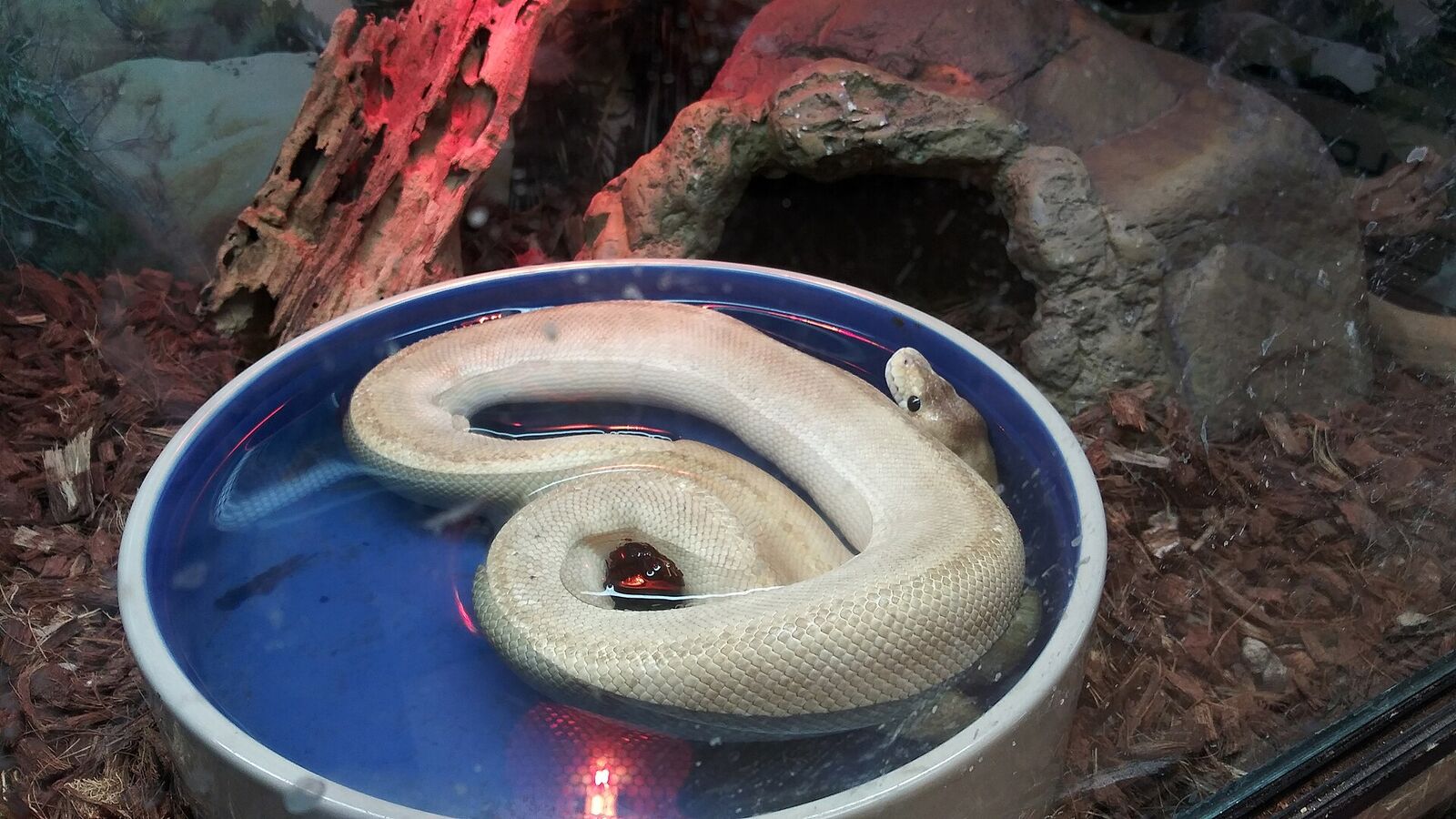
Ball python
Python regius
The calm, curl-up classic of pet snakes.
Pet trade
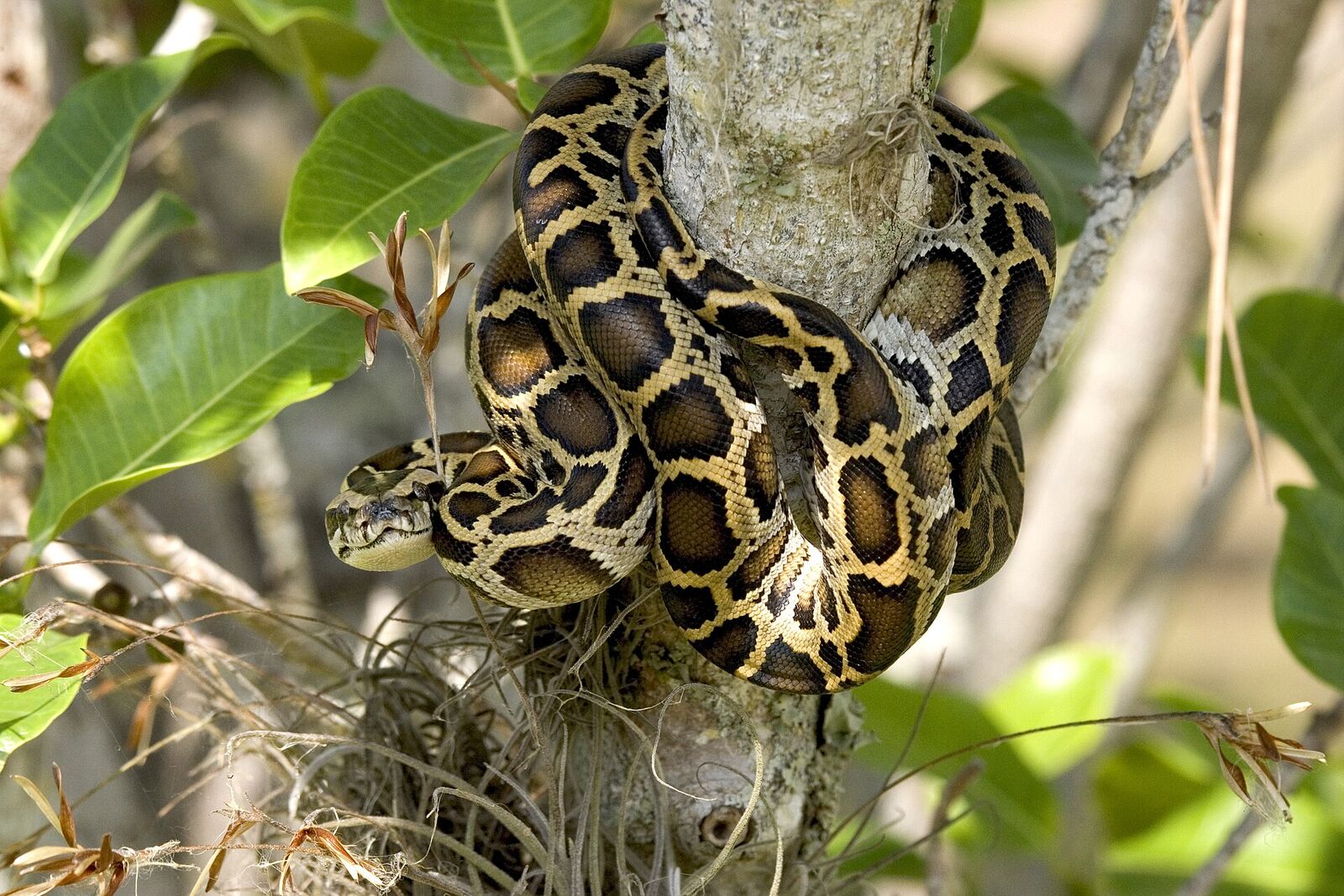
Burmese python
Python bivittatus
A heavy-bodied giant with a famously calm reputation.
Pet trade
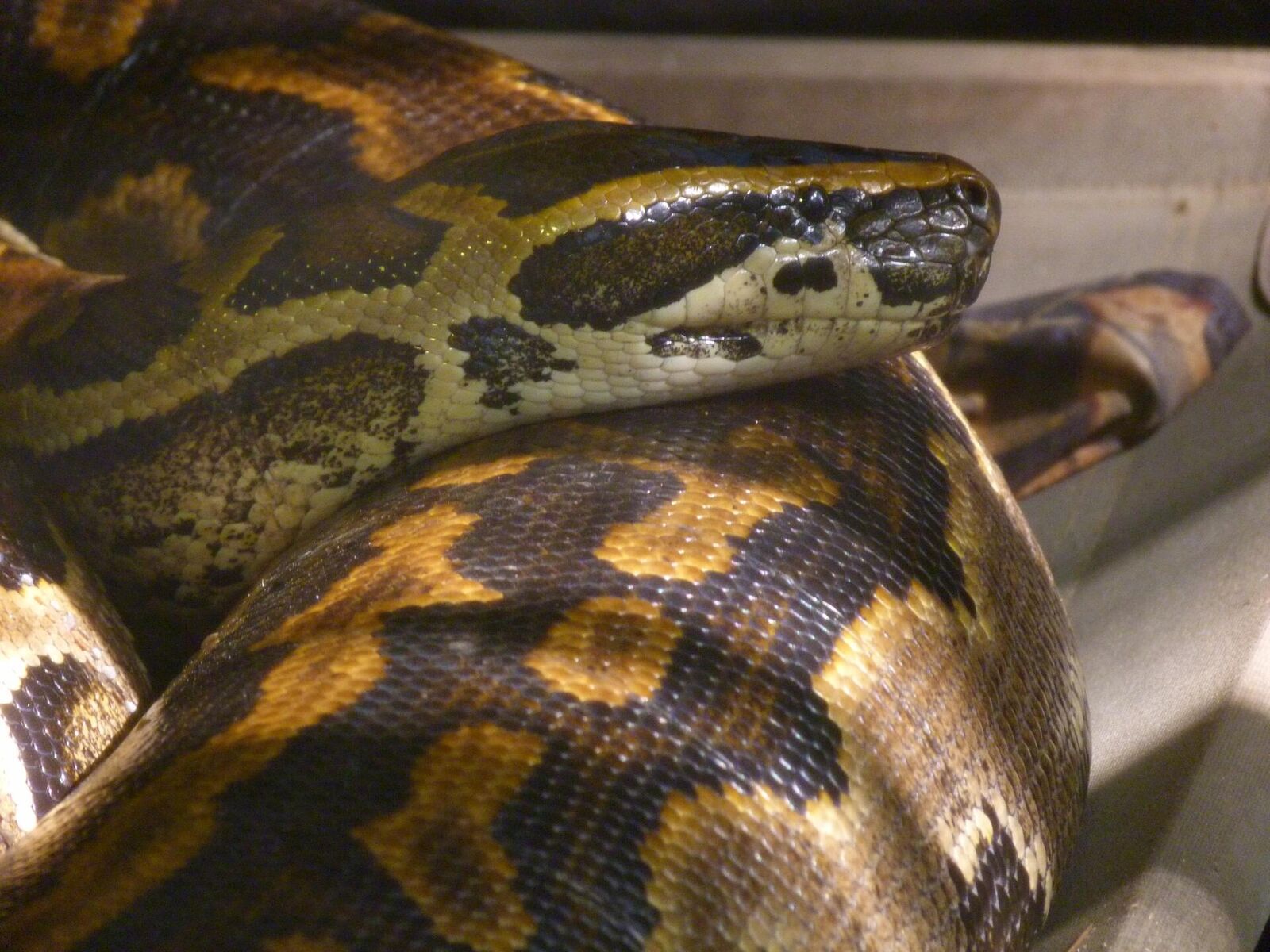
Central African rock python
Python sebae
Africa's largest snake, powerful and spirited.
Pet trade
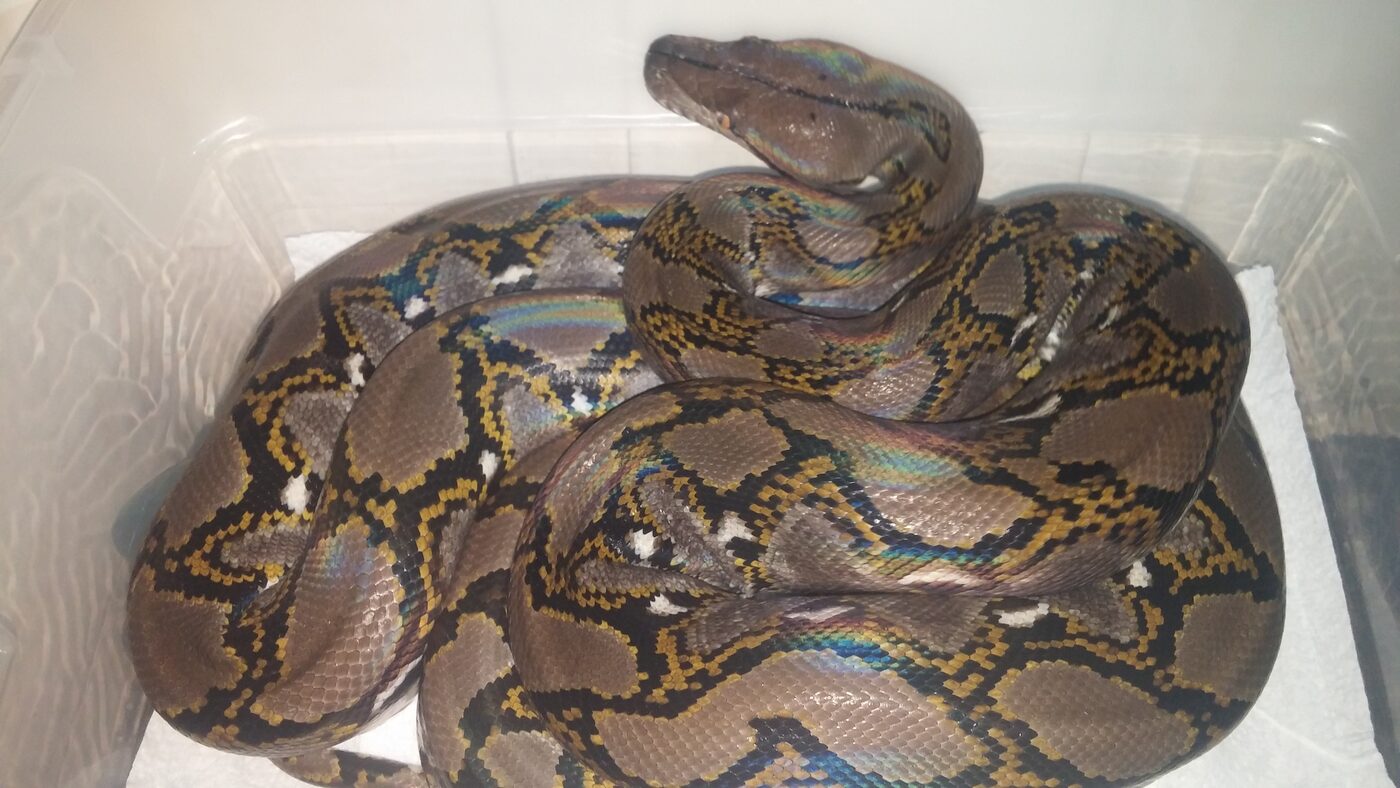
Reticulated python
Malayopython reticulatus
The world's longest snake, and a brilliant, active giant.
Pet trade

Amethystine python
Simalia amethistina
Pet trade

Angolan python
Python anchietae
Pet trade