
Home / Amphibians / Salamanders and newts / Chinese fire-bellied newt
Federal restrictions applyChinese fire-bellied newt
Hypselotriton orientalis
Amphibians › Salamanders and newts (Caudata) › Salamandridae (Newts and fire salamanders)
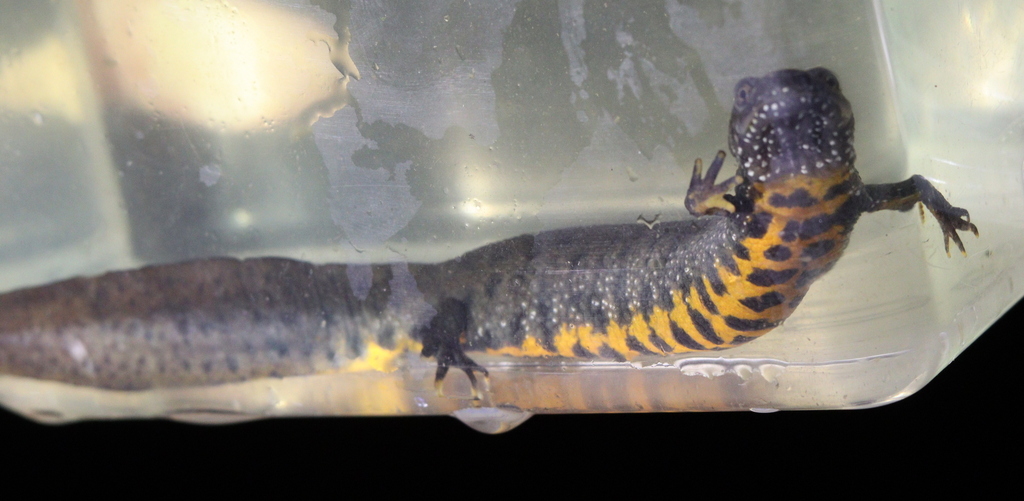
The Chinese fire belly newt (Cynops orientalis) is a small (2.2–4.0 inches (5.6–10.2 cm)) black newt, with bright-orange aposematic coloration on their ventral sides.
From Wikipedia: Chinese fire belly newt, CC BY-SA 4.0 (excerpt)

Care at a glance
Species-specific values
Values researched for this exact species. Air, surface and water temperatures are listed separately, and each source is kept as published rather than averaged.
| Diet | After cooling, feed tubifex, blood worms and earthworms. Source: reptilesmagazine.com | |
| Diet | During cooling, stop feeding or restrict food to living items that spoil slowly, such as blood worms and small crustaceans. Source: reptilesmagazine.com | |
| Substrate | Adults lay eggs wrapped in elodea and other aquatic plant leaves. Source: reptilesmagazine.com | |
| Diet | Larvae feed on daphnia, crushed fish food flakes and finely chopped worms. Source: reptilesmagazine.com | |
| Substrate | Terrestrial young are kept in a wet terrarium with moss on the bottom. Source: reptilesmagazine.com | |
| Minimum enclosure | Adults: 60 x 30 x 30 cm aquarium for a small group. Source: academy.herpeton.net | |
| Uvb lighting | Low-level UVB may be used cautiously over part of the enclosure if shaded water and hides remain available. Source: academy.herpeton.net | |
| Diet | Feed earthworms, blackworms where legal and clean, bloodworms, daphnia, small aquatic invertebrates, and soft chopped foods. Source: academy.herpeton.net | |
| Feeding frequency | Juveniles feed more often; adults usually eat a few times per week depending on temperature and body condition. Source: academy.herpeton.net | |
| Substrate | Use smooth surfaces. Source: academy.herpeton.net | |
| Seasonal cooling | Breeding is usually encouraged by seasonal cooling and stable water. Source: academy.herpeton.net | |
| Minimum enclosure | Aquarium from 60 × 30 cm for three to four animals, with water depth 15–25 cm. Source: repticare.ch | |
| Night temperature | 61–72 °F (16–22 °C) Source: repticare.ch | |
| Humidity | Aquatic humidity. Source: repticare.ch | |
| Uvb lighting | Dim lighting; avoid strong lighting. Source: repticare.ch | |
| Substrate | Fine sand or gravel large enough not to be swallowed. Source: repticare.ch | |
| Diet | Water fleas, mosquito larvae, and small worms. Source: repticare.ch | |
| Feeding frequency | Feed two to three times a week. Source: repticare.ch | |
| Social housing | House groups of equally sized animals. Source: repticare.ch | |
| Seasonal cooling | 46–54 °F (8–12 °C) Source: repticare.ch |
Warnings
Understanding the animal
About this animal
About this animal
C. orientalis is commonly seen in pet stores, where it is frequently confused with the Japanese fire belly newt (C. pyrrhogaster) due to similarities in size and coloration. C. orientalis typically exhibits smoother skin and a rounder tail than C. pyrrhogaster, and has less obvious parotoid glands.
From Wikipedia: Chinese fire belly newt, CC BY-SA 4.0 (excerpt)
In the wild
In the wild
| Overview | The Chinese fire belly newt (Cynops orientalis) is a small (2.2–4.0 in) black newt, with bright-orange aposematic coloration on their ventral sides. C. orientalis is commonly seen in pet stores, where it is frequently confused with the Japanese fire belly newt (C. pyrrhogaster) due to similarities in size and coloration. C. orientalis typically exhibits smoother skin and a rounder tail than C. pyrrhogaster, and has less obvious parotoid glands. — From Wikipedia: Chinese fire belly newt, CC BY-SA 4.0 (excerpt) |
| Where it lives | Chinese fire belly newts typically spawn in ponds, ditches, wells, and fields, ideally with a water temperature within 15-23°C. Eggs are often deposited on aquatic plants and have a typical incubation time of 13-24 days. Breeding takes place from March to July, with the most spawning occurring in April and May. After the female takes the spermatophore from the male, spawning generally occurs within 65 days. — From Wikipedia: Chinese fire belly newt, CC BY-SA 4.0 (excerpt) |
Native climate (measured)
Native climate (measured)
| Warm-season highs | about 89°F (up to 90°F in the hottest sampled areas) |
| Cool-season lows | about 33°F (down to 29°F in the coldest sampled areas) |
| Average temperature | 59–63°F across sampled records |
| Relative humidity | 75–77% on average (driest month about 70%) |
| Rainfall | about 1333 mm a year |
| Winters | Cool to cold winters (lows around 33°F) in much of its native range. Seasonal slowdown may be relevant, but species-specific biology determines whether brumation or hibernation occurs. |
Measured at 39 wild occurrence records sampled against WorldClim 2.1 climate data (1970–2000 averages). Air conditions in the range are ecological context, not enclosure settings: microhabitats such as burrows, leaf litter or basking rocks can be cooler, warmer or more humid.
Data and studies
Care articles for this species
Care articles for this species
- Breeding Chinese Fire-Bellied Newts (Reptiles Magazine)
Written by keepers, breeders and vets Reptiles MagazineReptiFiles
Sources for this sheet
- 50 CFR Part 16: Injurious wildlife (Lacey Act) Zoo, university or veterinaryCurrent federal regulation, read from eCFR.
- U.S. Association of Reptile Keepers v. Zinke (D.C. Cir. 2017) Zoo, university or veterinaryAppeals ruling that the Lacey Act's shipping ban does not cover moves between the continental states.
- AmphibiaWeb (University of California, Berkeley) (CC BY-NC) Peer-reviewed researchUniversity-hosted database of amphibian biology and conservation.
- GBIF Backbone Taxonomy (Global Biodiversity Information Facility) (CC BY 4.0) Peer-reviewed researchInternational scientific taxonomy used here for classification. GBIF Secretariat (2023). GBIF Backbone Taxonomy. Checklist dataset https://doi.org/10.15468/39omei, accessed via GBIF.org.
- Wikipedia (species article) (CC BY-SA 4.0) Community referenceFree encyclopedia; useful overviews with their own citations. Short excerpts are quoted under CC BY-SA 4.0, each credited with a link to its article.
- iNaturalist (captive observations) Community referenceCommunity observation platform run by the California Academy of Sciences and National Geographic; observations marked captive show animals living in homes, zoos and aquariums.
- Reptiles Magazine (care articles) Experienced keeper or breederEstablished reptile and amphibian hobby magazine; care articles are written by breeders, keepers and veterinarians.
More newts and fire salamanders

Algerian newt
Pleurodeles poireti
Zoos & aquariums

Algerian ribbed newt
Pleurodeles nebulosus
Pet trade

Alpine newt
Ichthyosaura alpestris
Pet trade

California newt
Taricha torosa
Pet trade

Chinese warty newt
Paramesotriton chinensis
Zoos & aquariums
Danube crested newt
Triturus dobrogicus
Pet trade