
Home / Reptiles / Turtles and tortoises / Chinese softshell turtle
Some federal rules applyChinese softshell turtle
Pelodiscus sinensis
Reptiles › Turtles and tortoises (Testudines) › Trionychidae (Softshell turtles)
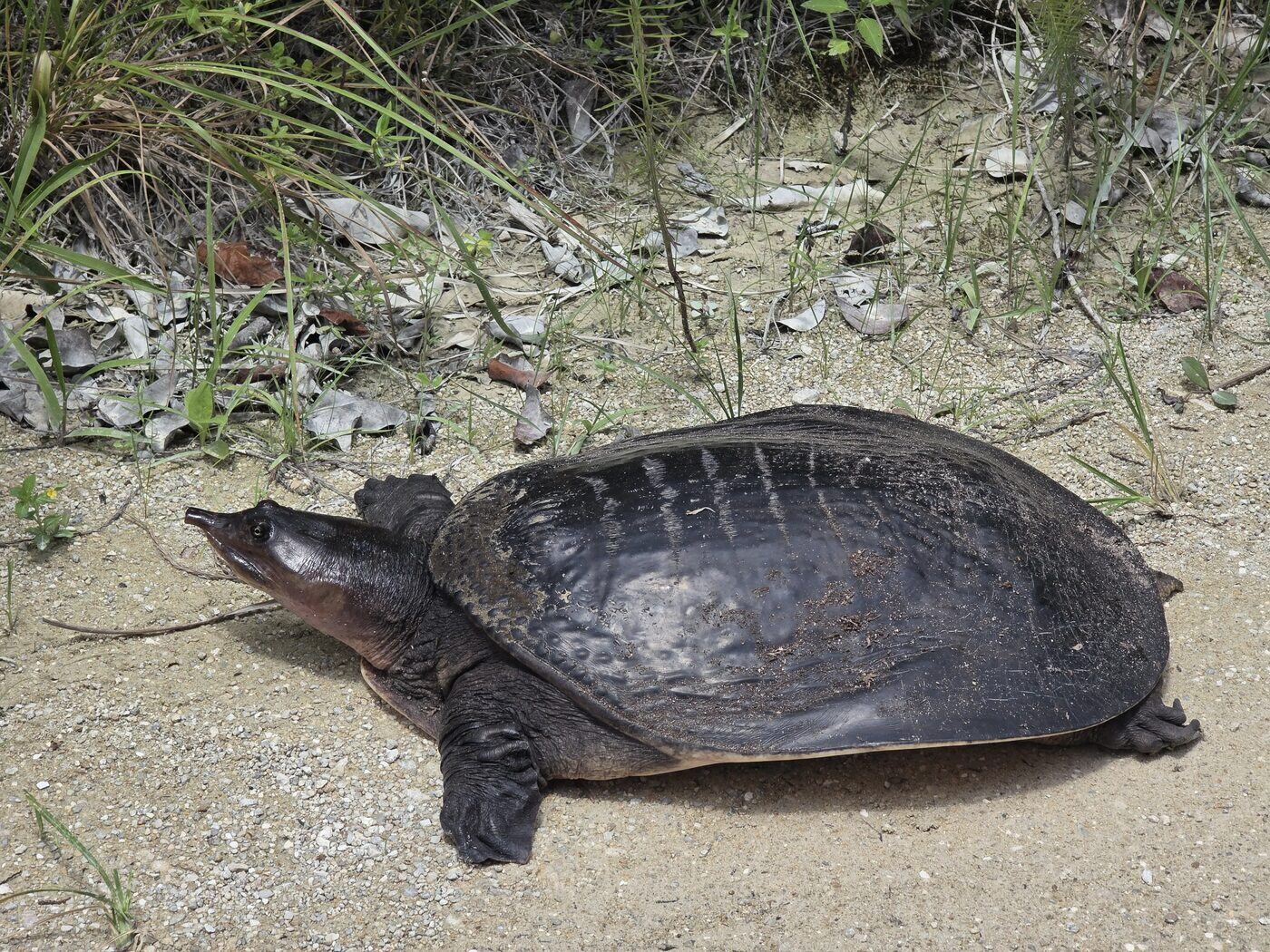
The Chinese softshell turtle (Pelodiscus sinensis) is a species of softshell turtle that is native to mainland China (Inner Mongolia to Guangxi, including Hong Kong) and Taiwan, with records of escapees—some of which have established introduced…
From Wikipedia: Chinese softshell turtle, CC BY-SA 4.0 (excerpt)

Care at a glance
Species-specific values
Values researched for this exact species. Air, surface and water temperatures are listed separately, and each source is kept as published rather than averaged.
| Minimum enclosure | About 1.1 m² minimum footprint. Source: academy.herpeton.net | |
| Basking surface temperature | 86–90 °F (30–32 °C) Source: academy.herpeton.net | |
| Warm side air temperature | 75–82 °F (24–28 °C) Source: academy.herpeton.net | |
| Cool side air temperature | 72–75 °F (22–24 °C) Source: academy.herpeton.net | |
| Night temperature | 68–75 °F (20–24 °C) Source: academy.herpeton.net | |
| Humidity | 50–80 % Source: academy.herpeton.net | |
| Uvb lighting | Plan UVB around Ferguson Zone 1, with a measured basking zone and shaded retreats. Source: academy.herpeton.net | |
| Diet | Feed fish, earthworms, aquatic invertebrates, quality pellets, and occasional whole prey; avoid fatty meat and dirty live feeders. Source: academy.herpeton.net | |
| Feeding frequency | For established adults, a meal every 2-4 days is a practical starting point. Source: academy.herpeton.net | |
| Social housing | Avoid turtle tankmates unless the enclosure is very large and conflict can be managed. Source: academy.herpeton.net | |
| Substrate | Provide a deep, smooth sand area for burying; avoid gravel and sharp or abrasive materials. Source: academy.herpeton.net | |
| Basking surface temperature | Basking temperature should be in the mid to high 80s F. Source: austinsturtlepage.com | |
| Warm side air temperature | Air temperature should be in the mid 80s F. Source: austinsturtlepage.com | |
| Water temperature | Water temperature should be in the mid to high 70s F. Source: austinsturtlepage.com | |
| Diet | Adults eat fish, snails, crustaceans, invertebrates, and commercial pellets; greens can be offered. Source: austinsturtlepage.com | |
| Feeding frequency | Feed to diminish appetite without gorging for the first 6 months; then every other day, and after around a year a couple times weekly. Source: austinsturtlepage.com | |
| Uvb lighting | Good UVB lighting is needed over the basking spot. Source: austinsturtlepage.com | |
| Substrate | A sand substrate is required. Source: austinsturtlepage.com | |
| Social housing | They are not recommended for community housing, and keeping softshells together is discouraged unless there is a very large enclosure. Source: austinsturtlepage.com | |
| Minimum enclosure | A single adult does best in a 120-gallon tank or larger. Source: austinsturtlepage.com | |
| Water temperature | 78–80 °F Source: austinsturtlepage.com |
Understanding the animal
About this animal
About this animal
Furthermore, localized populations in Guangxi and Hunan (where the Chinese softshell turtle also is present), as well as Vietnam, are recognized as the lesser Chinese softshell turtle (P. parviformis) and Hunan softshell turtle (P. axenaria).
From Wikipedia: Chinese softshell turtle, CC BY-SA 4.0 (excerpt)
In the wild
In the wild
| Overview | The Chinese softshell turtle (Pelodiscus sinensis) is a species of softshell turtle that is native to mainland China (Inner Mongolia to Guangxi, including Hong Kong) and Taiwan, with records of escapees—some of which have established introduced populations—in a wide range of other Asian countries, as well as Spain, Brazil and Hawaii. Populations native to Northeast China, Russia, Korea and Japan were formerly included in this species, but are now regarded as separate as the northern Chinese softshell turtle (P. maackii). — From Wikipedia: Chinese softshell turtle, CC BY-SA 4.0 (excerpt) |
| Where it lives | The Chinese softshell turtle lives in fresh and brackish water. In China it is found in rivers, lakes, ponds, canals and creeks with slow currents, and in Hawaii they can be found in marshes and drainage ditches. — From Wikipedia: Chinese softshell turtle, CC BY-SA 4.0 (excerpt) |
| Wild diet | P. sinensis is predominantly carnivorous and the remains of fish, crustaceans, mollusks, insects, and seeds of marsh plants have been found in its stomach. — From Wikipedia: Chinese softshell turtle, CC BY-SA 4.0 (excerpt) |
| Conservation | Wild populations are listed as vulnerable on the IUCN Red List. In contrast, the mass farming and release of P. sinensis has been known to lead to hybridization producing several other unique Pelodiscus lineages, some of which may be distinct species, which in turn threaten the gene pool. — From Wikipedia: Chinese softshell turtle, CC BY-SA 4.0 (excerpt) |
Read about this species in the wild at The Reptile Database.
Native climate (measured)
Native climate (measured)
| Warm-season highs | about 88°F (up to 90°F in the hottest sampled areas) |
| Cool-season lows | about 52°F (down to 17°F in the coldest sampled areas) |
| Average temperature | 54–74°F across sampled records |
| Relative humidity | 75–81% on average (driest month about 76%) |
| Rainfall | about 1878 mm a year |
Measured at 84 wild occurrence records sampled against WorldClim 2.1 climate data (1970–2000 averages). Air conditions in the range are ecological context, not enclosure settings: microhabitats such as burrows, leaf litter or basking rocks can be cooler, warmer or more humid.
Profile
Profile
Researched for this exact species. Sources are listed under In the wild above.
Data and studies
The numbers
The numbers
Each bar is what one source reports. Where several sources weigh in, the dashed gold band marks their average.
Maximum recorded lifespan
Longest recorded lifespan reported by each database; typical lifespans are usually shorter.
Typical adult weight
Average adult body mass in each database (FishBase gives the maximum recorded weight).
Incubation
Veterinary & husbandry research
Veterinary & husbandry research
- De novo transcriptome analysis reveals insights into different mechanisms of growth and immunity in a Chinese soft-shelled turtle hybrid and the parental varieties Zhang H et al., Gene 2017
- Knockdown of R-spondin1 leads to partial sex reversal in genetic female Chinese soft-shelled turtle Pelodiscus sinensis Zhang Y et al., General and comparative endocrinology 2021
- Seasonal spermatogenesis, epididymal storage, and creatine kinase expression in Pelodiscus sinensis Yang YF et al., Animal reproduction science 2023
Peer-reviewed papers that mention this species alongside captivity, zoos, veterinary care or aquaculture. Some cover several species or mention it only in passing, so check the abstract. See all 48 on PubMed → PubMed
Sources for this sheet
- Myhrvold et al. (2015). An amniote life-history database. Ecology 96: 3109 Peer-reviewed researchPeer-reviewed compilation of life-history data for over 21,000 birds, mammals and reptiles.
- 21 CFR 1240.62: Turtles under 4 inches (FDA) Zoo, university or veterinaryFederal ban on selling small turtles.
- The Reptile Database Peer-reviewed researchScientist-curated catalog of every reptile species, with taxonomy and literature.
- GBIF Backbone Taxonomy (Global Biodiversity Information Facility) (CC BY 4.0) Peer-reviewed researchInternational scientific taxonomy used here for classification. GBIF Secretariat (2023). GBIF Backbone Taxonomy. Checklist dataset https://doi.org/10.15468/39omei, accessed via GBIF.org.
- Species+ (UNEP-WCMC and the CITES Secretariat) Zoo, university or veterinaryThe official database of species listed under CITES. UNEP (2026). The Species+ Website. Nairobi, Kenya. Compiled by UNEP-WCMC, Cambridge, UK. Available at: www.speciesplus.net. [Accessed 04/10/2026].
- Wikipedia (species article) (CC BY-SA 4.0) Community referenceFree encyclopedia; useful overviews with their own citations. Short excerpts are quoted under CC BY-SA 4.0, each credited with a link to its article.
- PubMed (U.S. National Library of Medicine) Peer-reviewed researchIndex of peer-reviewed veterinary, zoo and husbandry research.
- iNaturalist (captive observations) Community referenceCommunity observation platform run by the California Academy of Sciences and National Geographic; observations marked captive show animals living in homes, zoos and aquariums.
More softshell turtles

Asiatic softshell turtle
Amyda cartilaginea
Pet trade
Florida softshell turtle
Apalone ferox
Pet trade

Spiny softshell turtle
Apalone spinifera
Pet trade

Wattle-necked softshell turtle
Palea steindachneri
Zoos & aquariums