
Home / Reptiles / Turtles and tortoises / Wattle-necked softshell turtle
Some federal rules applyWattle-necked softshell turtle
Palea steindachneri
Reptiles › Turtles and tortoises (Testudines) › Trionychidae (Softshell turtles)
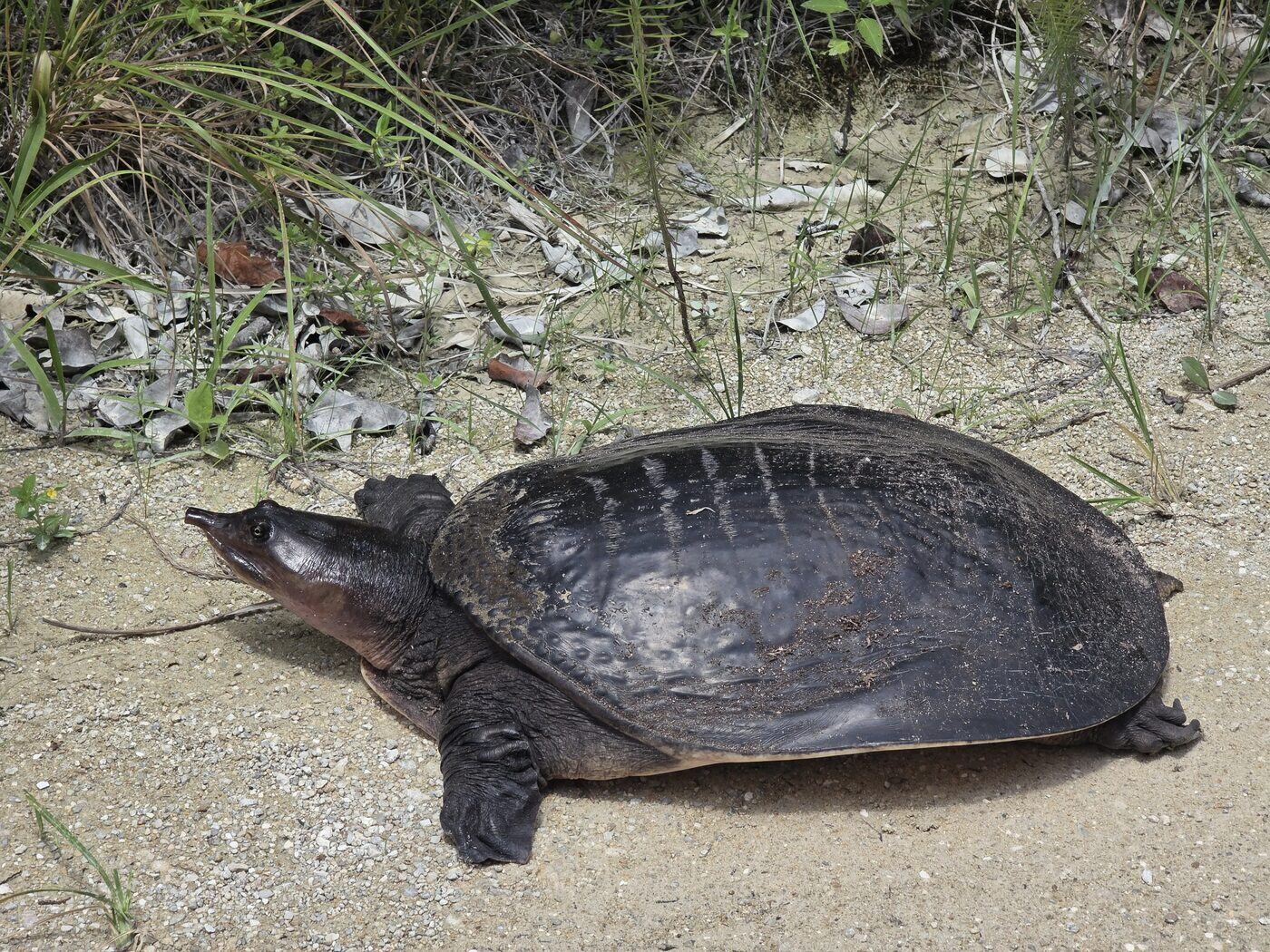
The wattle-necked softshell turtle (Palea steindachneri), also commonly known as Steindachner's soft-shelled turtle, is an endangered Asian species of softshell turtle in the family Trionychidae.
From Wikipedia: Wattle-necked softshell turtle, CC BY-SA 4.0 (excerpt)

Care at a glance
Species-specific values
Values researched for this exact species. Air, surface and water temperatures are listed separately, and each source is kept as published rather than averaged.
| Minimum enclosure | Use a cement pond with circulating filtration, anti-escape fencing, deep and shallow water zones, dry basking area, and nesting sand plot. Source: sinorept.com | |
| Basking surface temperature | Provide a dry basking platform with shaded shelters. Source: sinorept.com | |
| Night temperature | 50–57 °F (10–14 °C) Source: sinorept.com | |
| Water temperature | 77–88 °F (25–31 °C) Source: sinorept.com | |
| Diet | Use premium softshell turtle pellets as staple food, with snail meat, small fish, earthworms, silkworm pupae, and fresh seafood as supplements. Source: sinorept.com | |
| Feeding frequency | Feed daily above 26℃ and every other day at lower temperatures. Source: sinorept.com | |
| Social housing | Isolate new arrivals for 15–30 days of quarantine before group housing. Source: sinorept.com | |
| Substrate | For breeding stock, provide at least 25 cm of moist loose river sand in the nesting zone. Source: sinorept.com | |
| Seasonal cooling | 50–57 °F (10–14 °C) Source: sinorept.com |
Warnings
Understanding the animal
About this animal
About this animal
The species is the only member of the genus Palea.
From Wikipedia: Wattle-necked softshell turtle, CC BY-SA 4.0 (excerpt)
In the wild
In the wild
| Overview | The wattle-necked softshell turtle (Palea steindachneri), also commonly known as Steindachner's soft-shelled turtle, is an endangered Asian species of softshell turtle in the family Trionychidae. The species is the only member of the genus Palea. — From Wikipedia: Wattle-necked softshell turtle, CC BY-SA 4.0 (excerpt) |
| Where it lives | P. steindachneri is native to southeastern China (Guangdong, Guangxi, Guizhou, Hainan, Yunnan), Laos, and Vietnam, but has also been introduced to Hawaii and Mauritius. — From Wikipedia: Wattle-necked softshell turtle, CC BY-SA 4.0 (excerpt) |
| Appearance and size | P. steindachneri exhibits sexual dimorphism. Females of this freshwater turtle reach up to 44.5 cm in straight carapace length, while males only reach up to 36 cm. However, males have a longer tail than the females. — From Wikipedia: Wattle-necked softshell turtle, CC BY-SA 4.0 (excerpt) |
| Conservation | P. steindachneri is endangered by poaching for human consumption. Although pressure on the wild population continues, several thousand are hatched and raised each year on turtle farms in China and Vietnam for food and traditional medicine. — From Wikipedia: Wattle-necked softshell turtle, CC BY-SA 4.0 (excerpt) |
Read about this species in the wild at The Reptile Database.
Native climate (measured)
Native climate (measured)
| Warm-season highs | about 85°F (up to 90°F in the hottest sampled areas) |
| Cool-season lows | about 59°F (down to 53°F in the coldest sampled areas) |
| Average temperature | 72–74°F across sampled records |
| Relative humidity | 74–79% on average (driest month about 72%) |
| Rainfall | about 1977 mm a year |
Measured at 11 wild occurrence records sampled against WorldClim 2.1 climate data (1970–2000 averages). Air conditions in the range are ecological context, not enclosure settings: microhabitats such as burrows, leaf litter or basking rocks can be cooler, warmer or more humid.
Profile
Profile
Researched for this exact species. Sources are listed under In the wild above.
Data and studies
The numbers
The numbers
Each bar is what one source reports. Where several sources weigh in, the dashed gold band marks their average.
Maximum recorded lifespan
Longest recorded lifespan reported by each database; typical lifespans are usually shorter. The AnAge record comes from an animal in human care.
Sources for this sheet
- AnAge: The Animal Ageing and Longevity Database (Human Ageing Genomic Resources) (CC BY 3.0) Peer-reviewed researchCurated, referenced longevity and life-history records for thousands of species; maximum lifespans are often from zoo animals.
- Myhrvold et al. (2015). An amniote life-history database. Ecology 96: 3109 Peer-reviewed researchPeer-reviewed compilation of life-history data for over 21,000 birds, mammals and reptiles.
- Species+ (UNEP-WCMC and the CITES Secretariat) Zoo, university or veterinaryThe official database of species listed under CITES. UNEP (2026). The Species+ Website. Nairobi, Kenya. Compiled by UNEP-WCMC, Cambridge, UK. Available at: www.speciesplus.net. [Accessed 04/10/2026].
- USFWS International Affairs: CITES Zoo, university or veterinaryFederal agency that issues CITES permits.
- 21 CFR 1240.62: Turtles under 4 inches (FDA) Zoo, university or veterinaryFederal ban on selling small turtles.
- The Reptile Database Peer-reviewed researchScientist-curated catalog of every reptile species, with taxonomy and literature.
- Wikipedia (species article) (CC BY-SA 4.0) Community referenceFree encyclopedia; useful overviews with their own citations. Short excerpts are quoted under CC BY-SA 4.0, each credited with a link to its article.
More softshell turtles

Asiatic softshell turtle
Amyda cartilaginea
Pet trade

Chinese softshell turtle
Pelodiscus sinensis
Pet trade
Florida softshell turtle
Apalone ferox
Pet trade

Spiny softshell turtle
Apalone spinifera
Pet trade