
Home / Reptiles / Turtles and tortoises / Spiny softshell turtle
Some federal rules applySpiny softshell turtle
Apalone spinifera
Reptiles › Turtles and tortoises (Testudines) › Trionychidae (Softshell turtles)
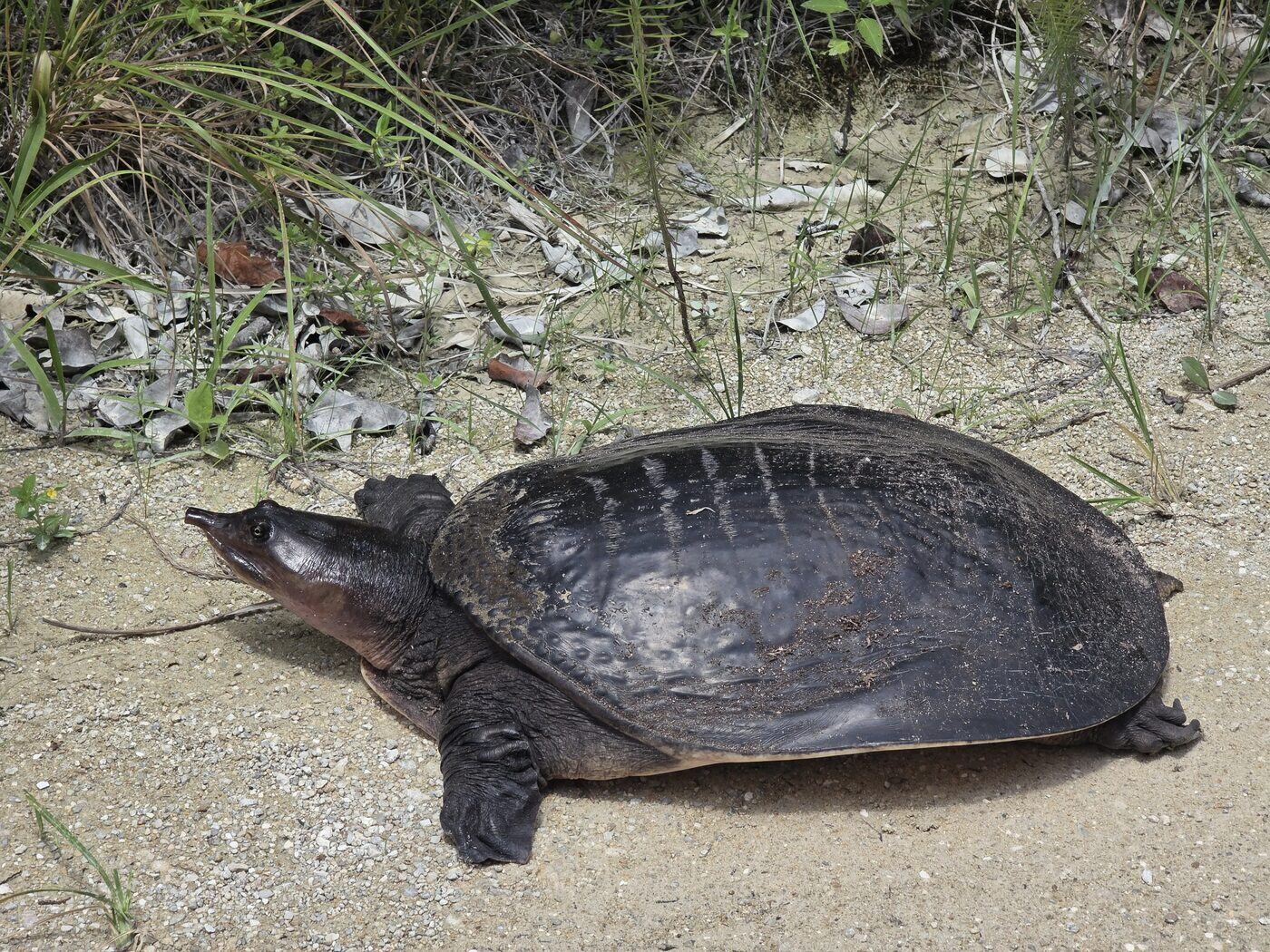
The spiny softshell turtle (Apalone spinifera) is a species of softshell turtle, one of the largest freshwater turtle species in North America.
From Wikipedia: Spiny softshell turtle, CC BY-SA 4.0 (excerpt)

Care at a glance
Species-specific values
Values researched for this exact species. Air, surface and water temperatures are listed separately, and each source is kept as published rather than averaged.
| Basking surface temperature | Mid to High 80's Source: austinsturtlepage.com | |
| Warm side air temperature | Low to Mid 80's Source: austinsturtlepage.com | |
| Water temperature | Mid 70's Source: austinsturtlepage.com | |
| Diet | Captive foods include aquatic turtle pellets, insects, crustaceans, small fish, worms, and algae wafers. Source: austinsturtlepage.com | |
| Feeding frequency | Feed juveniles once daily for the first six months, then every other day; greens may be offered daily. Source: austinsturtlepage.com | |
| Social housing | Keep singly or in spacious enclosures without crowding or aggressive tank mates; monitor closely when mixing. Source: austinsturtlepage.com | |
| Substrate | Play sand is commonly used; keep the filter intake at least five inches above the sand bed and ideally use a pre-filter sponge. Source: austinsturtlepage.com | |
| Minimum enclosure | A single adult male should have at least a 75-gallon aquarium; a 400-gallon stock tank is the minimum for females. Source: austinsturtlepage.com |
Understanding the animal
About this animal
About this animal
Both the common name, spiny softshell, and the specific name, spinifera (spine-bearing), refer to the spiny, cone-like projections on the leading edge of the carapace, which are not scutes (scales).
From Wikipedia: Spiny softshell turtle, CC BY-SA 4.0 (excerpt)
In the wild
In the wild
| Overview | The spiny softshell turtle (Apalone spinifera) is a species of softshell turtle, one of the largest freshwater turtle species in North America. Both the common name, spiny softshell, and the specific name, spinifera (spine-bearing), refer to the spiny, cone-like projections on the leading edge of the carapace, which are not scutes (scales). — From Wikipedia: Spiny softshell turtle, CC BY-SA 4.0 (excerpt) |
Read about this species in the wild at Animal Diversity Web · The Reptile Database.
Native climate (measured)
Native climate (measured)
| Warm-season highs | about 94°F (up to 96°F in the hottest sampled areas) |
| Cool-season lows | about 40°F (down to 29°F in the coldest sampled areas) |
| Average temperature | 61–74°F across sampled records |
| Relative humidity | 63–71% on average (driest month about 62%) |
| Rainfall | about 846 mm a year, spread fairly evenly |
| Winters | Cool to cold winters (lows around 40°F) in much of its native range. Seasonal slowdown may be relevant, but species-specific biology determines whether brumation or hibernation occurs. |
Measured at 84 wild occurrence records sampled against WorldClim 2.1 climate data (1970–2000 averages). Air conditions in the range are ecological context, not enclosure settings: microhabitats such as burrows, leaf litter or basking rocks can be cooler, warmer or more humid.
Profile
Profile
Researched for this exact species. Sources are listed under In the wild above.
Data and studies
The numbers
The numbers
Each bar is what one source reports. Where several sources weigh in, the dashed gold band marks their average.
Maximum recorded lifespan
Longest recorded lifespan reported by each database; typical lifespans are usually shorter. The AnAge record comes from an animal in human care.
Typical adult weight
Average adult body mass in each database (FishBase gives the maximum recorded weight).
Incubation
Female maturity
Veterinary & husbandry research
Veterinary & husbandry research
- Sepsis and disseminated intravascular coagulation in an eastern spiny softshell turtle (Apalone spinifera spinifera) with acute mycobacteriosis Murray M et al., Journal of zoo and wildlife medicine: official publication of the American Association of Zoo Veterinarians 2009
Peer-reviewed papers that mention this species alongside captivity, zoos, veterinary care or aquaculture. Some cover several species or mention it only in passing, so check the abstract. See all 2 on PubMed → PubMed
Sources for this sheet
- AnAge: The Animal Ageing and Longevity Database (Human Ageing Genomic Resources) (CC BY 3.0) Peer-reviewed researchCurated, referenced longevity and life-history records for thousands of species; maximum lifespans are often from zoo animals.
- Myhrvold et al. (2015). An amniote life-history database. Ecology 96: 3109 Peer-reviewed researchPeer-reviewed compilation of life-history data for over 21,000 birds, mammals and reptiles.
- Species+ (UNEP-WCMC and the CITES Secretariat) Zoo, university or veterinaryThe official database of species listed under CITES. UNEP (2026). The Species+ Website. Nairobi, Kenya. Compiled by UNEP-WCMC, Cambridge, UK. Available at: www.speciesplus.net. [Accessed 04/10/2026].
- USFWS International Affairs: CITES Zoo, university or veterinaryFederal agency that issues CITES permits.
- 21 CFR 1240.62: Turtles under 4 inches (FDA) Zoo, university or veterinaryFederal ban on selling small turtles.
- The Reptile Database Peer-reviewed researchScientist-curated catalog of every reptile species, with taxonomy and literature.
- GBIF Backbone Taxonomy (Global Biodiversity Information Facility) (CC BY 4.0) Peer-reviewed researchInternational scientific taxonomy used here for classification. GBIF Secretariat (2023). GBIF Backbone Taxonomy. Checklist dataset https://doi.org/10.15468/39omei, accessed via GBIF.org.
- Wikipedia (species article) (CC BY-SA 4.0) Community referenceFree encyclopedia; useful overviews with their own citations. Short excerpts are quoted under CC BY-SA 4.0, each credited with a link to its article.
- PubMed (U.S. National Library of Medicine) Peer-reviewed researchIndex of peer-reviewed veterinary, zoo and husbandry research.
- iNaturalist (captive observations) Community referenceCommunity observation platform run by the California Academy of Sciences and National Geographic; observations marked captive show animals living in homes, zoos and aquariums.
More softshell turtles

Asiatic softshell turtle
Amyda cartilaginea
Pet trade

Chinese softshell turtle
Pelodiscus sinensis
Pet trade
Florida softshell turtle
Apalone ferox
Pet trade

Wattle-necked softshell turtle
Palea steindachneri
Zoos & aquariums