Home / Birds / Parrots / Cockatiel
No federal permit to keep In-depth sheetCockatiel
Nymphicus hollandicus
Birds › Parrots (Psittaciformes) › Cacatuidae (Cockatoos)
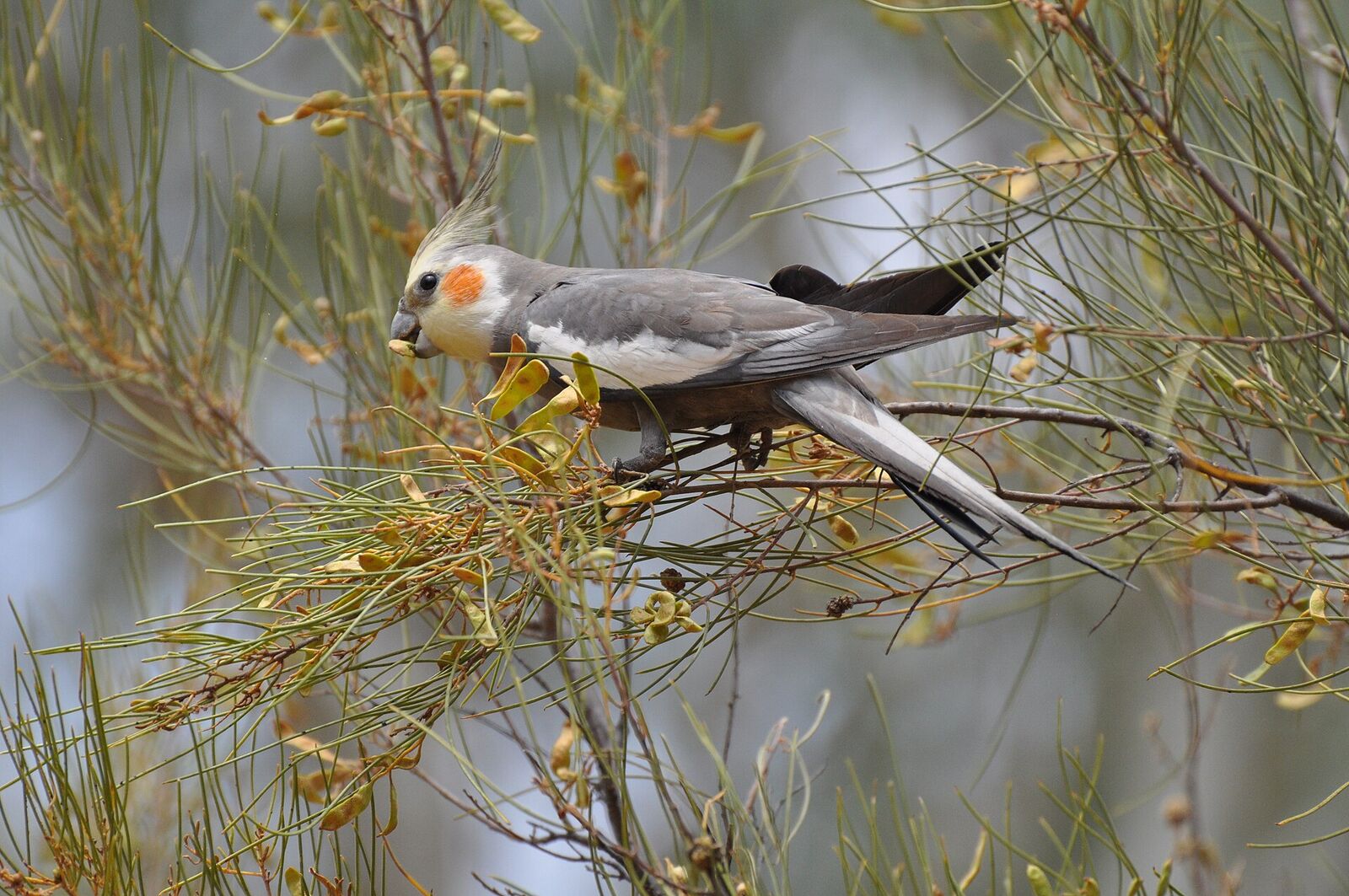
Cockatiels are gentle Australian parrots, domesticated since the 1840s, known for whistling and bonding closely with people.
Care at a glance
Species-specific values
Values researched for this exact species. Where they differ from the group guide below, follow these. Air, surface and water temperatures are listed separately, and each source is kept as published rather than averaged.
| Minimum cage dimensions | length: 20 in; width: 20 in; height: 30 in Table cage minimum; exercise space additional. | 316 |
| Maximum bar spacing | 0.5 in | 316 |
| Diet pellet fraction | 40–50 % MSD small-pet-bird recommendation; incompatible with higher VCA recommendation, retained separately. Source does not specify dry-weight versus offered-food basis. | 317 |
| Diet pellet fraction | 75–80 % VCA recommendation; retained separately from MSD. Source does not specify dry-weight versus offered-food basis. | 320 |
Care guide
Diet
- Pellets 60–80% of the diet, plus vegetables, a little sprouted seed and high-quality extras.
Sources 35
Show the group care guide for small parrots (budgies, cockatiels, parrotlets and grass parakeets)
Small parrots (budgies, cockatiels, parrotlets and grass parakeets)
Applies to most species in this group. Habitat: Australian and South American grasslands and scrub. Individual species can differ, so compare with the species numbers above and the linked sources.
Housing & setup
- A flight cage wider than it is tall, so they can fly side to side.
- Pairs or small groups for budgies and grass parakeets; parrotlets can be territorial.
Diet
- Use a balanced small-parrot diet with vegetables. Pellet proportions differ between veterinary sources; retain the source-specific recommendations and verify actual food intake during conversion.
Social life
- Flock birds; budgies do best with company.
Health watch
- Obesity and fatty liver on seed-heavy diets; egg binding in hens.
- Cockatiels are dusty birds; good ventilation helps.
Understanding the animal
In the wild
In the wild
Researched for this exact species, not its family. Good care copies these conditions.1234
| Where it lives | Native to inland mainland Australia, especially arid and semi-arid lightly wooded grasslands and open woodland. It uses river red gum, black box and coolibah woodland beside rivers, as well as partly cleared farmland, foraging on open ground and nesting in tree hollows. |
| Ground it lives on | Open ground with fallen grass, shrub and tree seeds; branches for communal roosting and tree hollows for nesting. |
| Climate | temperature f: {'winter_night': 40.1, 'summer_high': 109.4}; seasons: Their Australian habitat experiences large seasonal temperature variation. Southern populations show predictable migratory movements associated with more regular weather patterns. |
| Active | Diurnal; roosts communally at night. Nomadic over much of its range, with seasonal migration reported in southern populations. |
| Social life | Gregarious year-round, including during breeding; most flocks contain up to about 30 birds, with much larger gatherings possible. Pairs remain together throughout the year, and multiple pairs may nest in one tree. |
| Wild diet | Primarily seeds of grasses, shrubs and trees, with cereal grains especially favored; mostly fallen seeds, sometimes seeds taken directly from vegetation. |
| Behavior to plan for | Walks extensively while searching for seeds and travels in coordinated flight groups between feeding areas. Both parents incubate and feed young in tree-hollow nests. |
What this means for care
- Provide compatible social contact and flight space suited to its long wings and tail.
- Include a clean open floor or tray for walking and seed-searching enrichment within a balanced diet.
- Provide dependable drinking water; wild birds use freshwater waterholes despite their arid distribution.
- Treat enclosed tree-hollow substitutes as breeding stimuli when deciding whether to provide them.
Native climate (measured)
Native climate (measured)
| Warm-season highs | about 90°F (up to 95°F in the hottest sampled areas) |
| Cool-season lows | about 40°F (down to 37°F in the coldest sampled areas) |
| Average temperature | 60–71°F across sampled records |
| Relative humidity | 53–61% on average (driest month about 46%) |
| Rainfall | about 601 mm a year |
| Winters | Cool to cold winters (lows around 40°F) in much of its native range. Seasonal slowdown may be relevant, but species-specific biology determines whether brumation or hibernation occurs. |
Measured at 78 wild occurrence records sampled against WorldClim 2.1 climate data (1970–2000 averages). Air conditions in the range are ecological context, not enclosure settings: microhabitats such as burrows, leaf litter or basking rocks can be cooler, warmer or more humid.
Profile
Profile
Researched for this exact species. Sources are listed under In the wild above.
History
The species was described by J. F. Gmelin in 1788 and later placed in its own genus, Nymphicus, by Wagler in 1832. Its taxonomic relationship to parrots and cockatoos was historically debated until molecular studies supported its placement within the cockatoo family.
Keeper tips
- Provide regular social interaction.
- Provide toy-based enrichment.
- Allow about two hours of out-of-cage time each day.
- Use perches of varying diameters.
- Provide UV exposure.
- Arrange annual veterinary checkups and respond promptly to signs of illness or respiratory problems.
Behaviors reported
- Forms large traveling flocks.
- Congregates near freshwater.
- Shows a sociable and playful disposition.
- Uses an expressive movable crest.
Unique adaptations
- The long tapered tail can spread into a fan, and its angle can be adjusted to control flight altitude and stability.
- Nomadic movement allows flocks to use widely scattered inland resources.
- Cockatiels nest in existing tree cavities, often in dead eucalyptus trees near water.
Remarkable facts
- The cockatiel is native to mainland Australia.
- It is the sole member of the genus Nymphicus.
- It is the smallest member of the cockatoo family.
- Wild cockatiels may experience winter nights around 40.1 F and summer heat above 109.4 F.
- Nest cavities are typically located roughly one to two meters above ground.
- Pet cockatiels have been selectively bred into numerous color mutations.
Stories
- The genus name Nymphicus reflects the reaction of early European travelers who considered the birds so beautiful that they associated them with mythical nymphs.
From the sources
From the sources
Quoted from the matching sections of reputable sources for this exact species. Specialist databases are used first; Wikipedia (community-edited, CC BY-SA 4.0) only fills gaps. Other sources are short credited quotes.
| Overview | The cockatiel (Nymphicus hollandicus), also known as the weero/weiro or quarrion, is a species of small- to medium-sized parrot belonging to the cockatoo family (Cacatuidae), of which it is the smallest member. Native to Australia, it is the sole member of the genus Nymphicus. — Wikipedia (community-edited) |
| Where it lives | Cockatiels are widely distributed through the Australian mainland, tending to prefer inland areas to coastlines. — Animal Diversity Web |
| Reproduction | Cockatiels are monogamous and form relationships with a mate early on. — Animal Diversity Web |
| History and naming | Originally described by J. F. Gmelin in an edition of Systema naturae in 1788 as Psittacus novaehollandiae, and after by Scottish writer and naturalist Robert Kerr in 1792 as Psittacus hollandicus, and finally moved to its own genus, Nymphicus, by Wagler in 1832. — Wikipedia (community-edited) |
Data and studies
Researched care notes
Researched care notes
Findings checked against veterinary, zoo, welfare, keeper and peer-reviewed sources. Air, basking-surface and water temperatures are kept separate, and where sources disagree both are shown. “Study” notes report what a paper measured, not a universal rule.
Budgerigars, Cockatiels, And Lovebirds (nutrition module, not completed species sheets)
- MSD discusses a mixed formulated-food/seed strategy for these small parrots, differing from its large-parrot percentages.1
- Offered food and selected food may differ. Measure actual consumption during diet changes.1
Cockatiel
- Provide regular safe out-of-cage activity and suitable untreated wood, paper or cardboard for chewing.2
- Cockatiels are particularly prone to excessive egg laying; extended light exposure, caloric excess and reproductive stimulation can contribute.3
Budgerigar, Cockatiel And Lovebirds (Shared reproductive additions)
- Persistent laying can deplete calcium and lead to egg binding or other reproductive disease; it requires assessment beyond simply replacing a cuttlebone.3
- For birds laying excessively, veterinary management can include reducing reproductive cues such as nest boxes, extended daylight and sexualized owner interactions.3
- A weak or nonperching hen with straining or breathing difficulty may have egg binding and needs urgent veterinary attention.3
The numbers
The numbers
Each bar is what one source reports. Where several sources weigh in, the dashed gold band marks their average.
Lifespan
Maximum recorded lifespan
Longest recorded lifespan reported by each database; typical lifespans are usually shorter. The AnAge record comes from an animal in human care.
Typical adult weight
Average adult body mass in each database (FishBase gives the maximum recorded weight).
Incubation
Veterinary & husbandry research
Veterinary & husbandry research
- Eye lesions in pet birds Tsai SS et al., Avian pathology: journal of the W.V.P.A 1993
- Seroprevalence and genotype of Chlamydia in pet parrots in China Zhang NZ et al., Epidemiology and infection 2015
- Pharmacokinetic properties of gentamicin and amikacin in the cockatiel Ramsay EC et al., Avian diseases 1993
- Viral vector vaccines expressing nucleoprotein and phosphoprotein genes of avian bornaviruses ameliorate homologous challenge infections in cockatiels and common canaries Olbert M et al., Scientific reports 2016
Peer-reviewed papers that mention this species alongside captivity, zoos, veterinary care or aquaculture. Some cover several species or mention it only in passing, so check the abstract. See all 58 on PubMed → 170
Sources for this sheet
- Royal Veterinary College Exotics Service: Cockatiel care Zoo, university or veterinaryVet-school exotics hospital factsheet, reviewed 2021–2024.
- AnAge: The Animal Ageing and Longevity Database (Human Ageing Genomic Resources) Peer-reviewed researchCurated, referenced longevity and life-history records for thousands of species; maximum lifespans are often from zoo animals.
- Myhrvold et al. (2015). An amniote life-history database. Ecology 96: 3109 Peer-reviewed researchPeer-reviewed compilation of life-history data for over 21,000 birds, mammals and reptiles.
- Merck Veterinary Manual: Management of pet birds Zoo, university or veterinaryThe Merck Veterinary Manual: a standard veterinary reference written and reviewed by veterinary specialists.
- Merck Veterinary Manual: Nutritional diseases of pet birds Zoo, university or veterinaryThe Merck Veterinary Manual: a standard veterinary reference written and reviewed by veterinary specialists.
- Royal Veterinary College Exotics Service: Budgie care Zoo, university or veterinaryVet-school exotics hospital factsheet, reviewed 2021–2024.
- MSD Veterinary Manual — Management of Pet Birds Zoo, university or veterinaryAdded in the 2026 source-checked care-guide review.
- VCA Animal Hospitals — Feeding Pet Cockatiels Zoo, university or veterinaryAdded in the 2026 source-checked care-guide review.
- Clint's Reptiles (YouTube): Cockatiel, The Best Pet Dinosaur? Expert educator & keeperClint Laidlaw, PhD in Biology Education and MS in Evolutionary Ecology; owner of Clint's Reptile Room and a longtime keeper. His "Best Pet?" series reviews each species' care in depth.
- GBIF Backbone Taxonomy (Global Biodiversity Information Facility) Peer-reviewed researchInternational scientific taxonomy used here for classification.
- Species+ (UNEP-WCMC and the CITES Secretariat) Zoo, university or veterinaryThe official database of species listed under CITES.
- Wikipedia (species article) Community referenceFree encyclopedia; useful overviews with their own citations. Intro text is quoted under CC BY-SA 4.0.
- PubMed (U.S. National Library of Medicine) Peer-reviewed researchIndex of peer-reviewed veterinary, zoo and husbandry research.
- iNaturalist (captive observations) Community referenceCommunity observation platform run by the California Academy of Sciences and National Geographic; observations marked captive show animals living in homes, zoos and aquariums.