
Home / Invertebrates / Praying mantises / Deroplatys truncata
No federal permit to keepDeroplatys truncata
Deroplatys truncata
Invertebrates › Praying mantises (Mantodea) › Deroplatyidae (Dead leaf mantises)
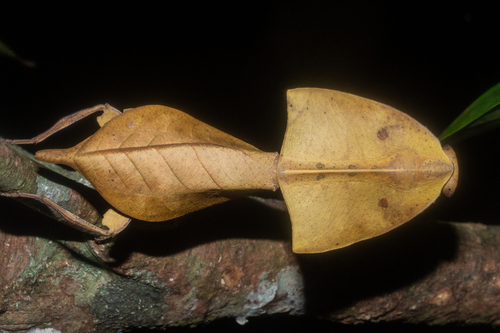
Deroplatys truncata is a species of praying mantis in the family Deroplatyidae. This "dead leaf mantis" species is native to Southeast Asia.
From Wikipedia: Deroplatys truncata, CC BY-SA 4.0 (excerpt)
Care at a glance
Species-specific values
Values researched for this exact species. Air, surface and water temperatures are listed separately, and each source is kept as published rather than averaged.
| Basking surface temperature | 68–86 °F Source: appalachiantarantulas.com | |
| Humidity | 60–80 % Source: appalachiantarantulas.com | |
| Minimum enclosure | Adult enclosure should be at least three body lengths tall and twice as wide, with good ventilation. Source: appalachiantarantulas.com | |
| Feeding frequency | Feed adults every two to three days. Source: appalachiantarantulas.com | |
| Substrate | Use coco fiber or paper towel, with light misting for humidity and drinking; substrate depth is 1–2 inches. Source: appalachiantarantulas.com | |
| Social housing | House individually. Source: appalachiantarantulas.com | |
| Humidity | 70–80 % Source: jaxmantis.wixsite.com | |
| Warm side air temperature | 75–85 °F Source: jaxmantis.wixsite.com |
Understanding the animal
About this animal
About this animal
The species show brown to deep dark brown coloration.
From Wikipedia: Deroplatys truncata, CC BY-SA 4.0 (excerpt)
In the wild
In the wild
| Overview | Deroplatys truncata is a species of praying mantis in the family Deroplatyidae. This "dead leaf mantis" species is native to Southeast Asia. The species show brown to deep dark brown coloration. The rear wings show large dark brown to black markings. — From Wikipedia: Deroplatys truncata, CC BY-SA 4.0 (excerpt) |
Native climate (measured)
Native climate (measured)
| Warm-season highs | about 88°F (up to 90°F in the hottest sampled areas) |
| Cool-season lows | about 72°F (down to 67°F in the coldest sampled areas) |
| Average temperature | 74–81°F across sampled records |
| Relative humidity | 81–84% on average (driest month about 79%) |
| Rainfall | about 2470 mm a year, spread fairly evenly |
Measured at 42 wild occurrence records sampled against WorldClim 2.1 climate data (1970–2000 averages). Air conditions in the range are ecological context, not enclosure settings: microhabitats such as burrows, leaf litter or basking rocks can be cooler, warmer or more humid.
Sources for this sheet
- GBIF Backbone Taxonomy (Global Biodiversity Information Facility) (CC BY 4.0) Peer-reviewed researchInternational scientific taxonomy used here for classification. GBIF Secretariat (2023). GBIF Backbone Taxonomy. Checklist dataset https://doi.org/10.15468/39omei, accessed via GBIF.org.
- Wikipedia (species article) (CC BY-SA 4.0) Community referenceFree encyclopedia; useful overviews with their own citations. Short excerpts are quoted under CC BY-SA 4.0, each credited with a link to its article.
- iNaturalist (captive observations) Community referenceCommunity observation platform run by the California Academy of Sciences and National Geographic; observations marked captive show animals living in homes, zoos and aquariums.


