
Home / Reptiles / Turtles and tortoises / Diamondback terrapin
Some federal rules applyDiamondback terrapin
Malaclemys terrapin
Reptiles › Turtles and tortoises (Testudines) › Emydidae (Pond turtles and box turtles)
The diamondback terrapin or simply terrapin (Malaclemys terrapin) is a species of terrapin native to the brackish coastal tidal marshes of the East Coast of the United States and the Gulf of Mexico coast, as well as in Bermuda.

Care at a glance
Species-specific values
Values researched for this exact species. Air, surface and water temperatures are listed separately, and each source is kept as published rather than averaged.
| Minimum enclosure | A 20-gallon long aquarium with 3 to 4 inches of water comfortably houses several hatchlings. Source: reptilesmagazine.com | |
| Basking surface temperature | Maintain the basking site's temperature in the mid 80 degrees Fahrenheit. Source: reptilesmagazine.com | |
| Water temperature | 76–78 °F Source: reptilesmagazine.com | |
| Uvb lighting | Use a full-spectrum UV bulb over the basking site. Source: reptilesmagazine.com | |
| Diet | Captive terrapins eat commercial turtle diets; dried brine shrimp and thawed salad shrimp are also offered. Source: reptilesmagazine.com | |
| Social housing | The cited enclosures house several hatchlings, one adult female, or two adult males; avoid overcrowding and group similar sizes. Source: reptilesmagazine.com |
Understanding the animal
About this animal
About this animal
It belongs to the monotypic genus Malaclemys. It has one of the largest ranges of all turtles in North America, stretching as far south as the Florida Keys and as far north as Cape Cod.
From Wikipedia: Diamondback terrapin, CC BY-SA 4.0 (excerpt)
In the wild
In the wild
Researched for this exact species, not its family. Wild conditions are context, not enclosure settings.12345
| Where it lives | It inhabits Atlantic and Gulf coastal salt marshes, tidal creeks and estuarine lagoons of North America. Muddy banks and marsh vegetation provide refuges, while females nest in sand above high tide. |
| Ground it lives on | Soft tidal mud and marsh vegetation; sandy banks or dunes for egg laying. |
| Climate | Strong seasonal cooling in northern populations, with winter brumation; southern populations may remain active on warm winter days. North Carolina field water ranges were 76.3–90.7 °F in summer and 47.7–63.0 °F in winter; relative humidity was not reported. |
| Active | Diurnal; winter brumation varies with latitude. |
| Wild diet | Marine and estuarine snails, clams, worms and crabs; both live prey and scavenged food. |
| Behavior to plan for | It forages with tides, basks and buries into mud when inactive. It can drown in traps and other structures that prevent access to air. |
- NatureServe Explorer: Malaclemys terrapin
- SICB: Temperature effects on metabolic enzyme activity in diamondback terrapins
- Response of juvenile diamond-backed terrapins to an aquatic thermal gradient
- CITES CoP16 Proposal 31: Malaclemys terrapin
- Total body water and water turnover rates in the estuarine diamondback terrapin during the transition from dormancy to activity
Native climate (measured)
Native climate (measured)
| Warm-season highs | about 86°F (up to 88°F in the hottest sampled areas) |
| Cool-season lows | about 27°F (down to 26°F in the coldest sampled areas) |
| Average temperature | 56–57°F across sampled records |
| Relative humidity | 68–73% on average (driest month about 64%) |
| Rainfall | about 1094 mm a year, spread fairly evenly |
| Winters | Cool to cold winters (lows around 27°F) in much of its native range. Seasonal slowdown may be relevant, but species-specific biology determines whether brumation or hibernation occurs. |
Measured at 17 wild occurrence records sampled against WorldClim 2.1 climate data (1970–2000 averages). Air conditions in the range are ecological context, not enclosure settings: microhabitats such as burrows, leaf litter or basking rocks can be cooler, warmer or more humid.
Data and studies
The numbers
The numbers
Each bar is what one source reports. Where several sources weigh in, the dashed gold band marks their average.
Maximum recorded lifespan
Longest recorded lifespan reported by each database; typical lifespans are usually shorter.
Typical adult weight
Average adult body mass in each database (FishBase gives the maximum recorded weight).
Clutch size
Average per litter or clutch.
Incubation
Female maturity
Basking spot
Species-specific values from keeper care sheets. Basking figures are often surface readings taken with an infrared thermometer, which run hotter than air.
Care articles for this species
Care articles for this species
- Florida FWC Denies Captive Breeding Request of Diamondback Terrapins (Reptiles Magazine)
- Diamondback Terrapin Natural History And Captive Care (Reptiles Magazine)
- Painted Terrapin Breeding (Reptiles Magazine)
- USARK Florida Proposes Captive Breeding of Diamondback Terrapins (Reptiles Magazine)
- Breeding Diamondback Terrapins (Reptiles Magazine)
Written by keepers, breeders and vets Reptiles MagazineReptiFiles
Veterinary & husbandry research
Veterinary & husbandry research
- HEALTH ASSESSMENT OF WILD NORTHERN DIAMOND-BACKED TERRAPINS (MALACLEMYS TERRAPIN TERRAPIN) IN NEW JERSEY, USA Lewis N et al., Journal of wildlife diseases 2023
- Levels and partitioning of genetic variation of northeastern populations of diamondback terrapin (Malaclemys terrapin) Lyons AL et al., The Journal of heredity 2026
Peer-reviewed papers that mention this species alongside captivity, zoos, veterinary care or aquaculture. Some cover several species or mention it only in passing, so check the abstract. PubMed
Sources for this sheet
- Myhrvold et al. (2015). An amniote life-history database. Ecology 96: 3109 Peer-reviewed researchPeer-reviewed compilation of life-history data for over 21,000 birds, mammals and reptiles.
- AnAge: The Animal Ageing and Longevity Database (Human Ageing Genomic Resources) (CC BY 3.0) Peer-reviewed researchCurated, referenced longevity and life-history records for thousands of species; maximum lifespans are often from zoo animals.
- Reptiles Magazine (care articles) Experienced keeper or breederEstablished reptile and amphibian hobby magazine; care articles are written by breeders, keepers and veterinarians.
- Species+ (UNEP-WCMC and the CITES Secretariat) Zoo, university or veterinaryThe official database of species listed under CITES. UNEP (2026). The Species+ Website. Nairobi, Kenya. Compiled by UNEP-WCMC, Cambridge, UK. Available at: www.speciesplus.net. [Accessed 04/10/2026].
- USFWS International Affairs: CITES Zoo, university or veterinaryFederal agency that issues CITES permits.
- 21 CFR 1240.62: Turtles under 4 inches (FDA) Zoo, university or veterinaryFederal ban on selling small turtles.
- The Reptile Database Peer-reviewed researchScientist-curated catalog of every reptile species, with taxonomy and literature.
- GBIF Backbone Taxonomy (Global Biodiversity Information Facility) (CC BY 4.0) Peer-reviewed researchInternational scientific taxonomy used here for classification. GBIF Secretariat (2023). GBIF Backbone Taxonomy. Checklist dataset https://doi.org/10.15468/39omei, accessed via GBIF.org.
- Wikipedia (species article) (CC BY-SA 4.0) Community referenceFree encyclopedia; useful overviews with their own citations. Short excerpts are quoted under CC BY-SA 4.0, each credited with a link to its article.
- PubMed (U.S. National Library of Medicine) Peer-reviewed researchIndex of peer-reviewed veterinary, zoo and husbandry research.
- iNaturalist (captive observations) Community referenceCommunity observation platform run by the California Academy of Sciences and National Geographic; observations marked captive show animals living in homes, zoos and aquariums.
More pond turtles and box turtles
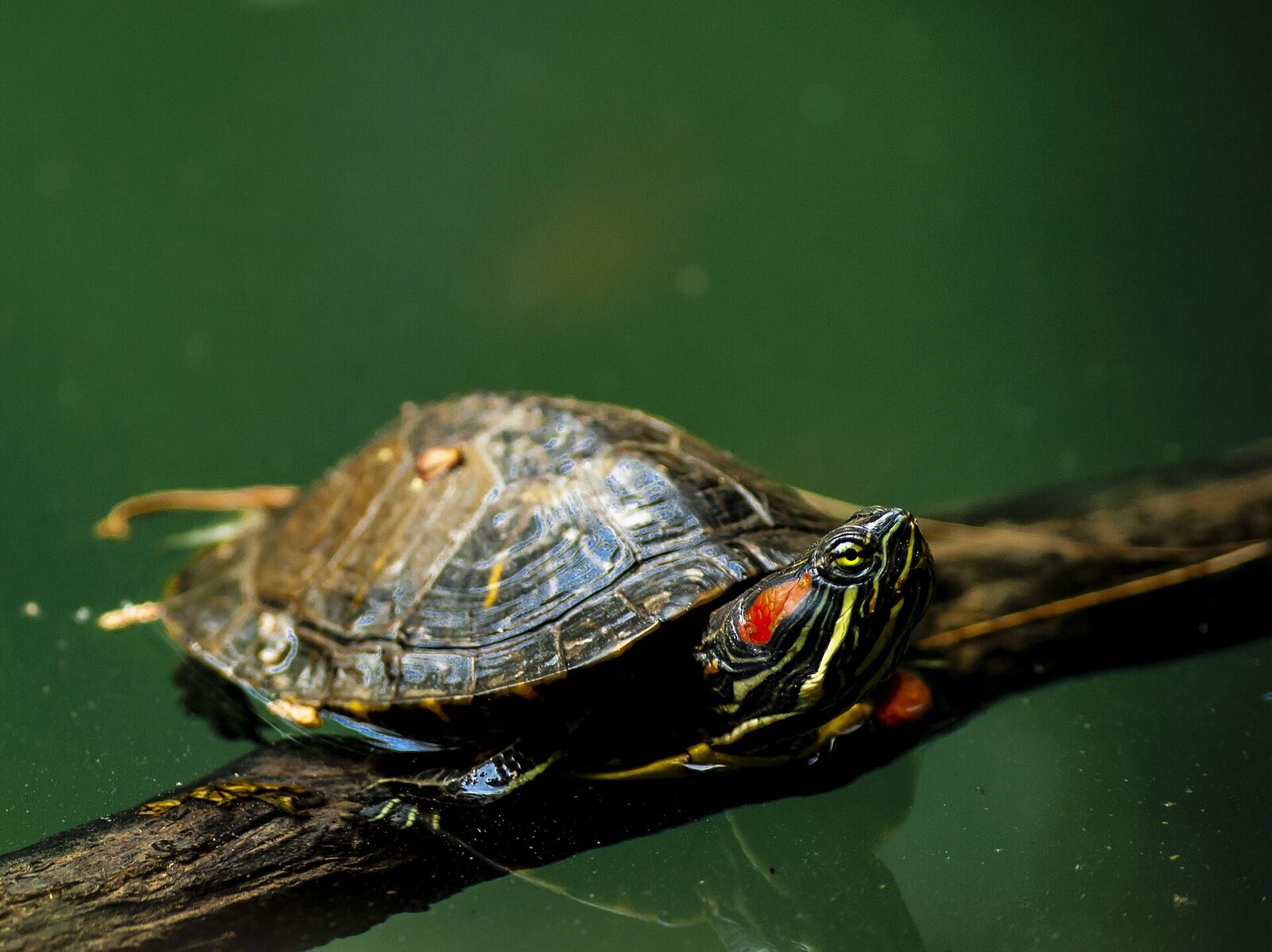
Red-eared slider
Trachemys scripta elegans
America's classic pet turtle, built to last decades.
Pet trade

Alabama map turtle
Graptemys pulchra
Zoos & aquariums

Baja California slider
Trachemys nebulosa
Pet trade

Barbour's map turtle
Graptemys barbouri
Zoos & aquariums

Black-knobbed map turtle
Graptemys nigrinoda
Pet trade

Blanding's turtle
Emydoidea blandingii
Pet trade