
Home / Reptiles / Turtles and tortoises / Eastern box turtle
Some federal rules applyEastern box turtle
Terrapene carolina
Reptiles › Turtles and tortoises (Testudines) › Emydidae (Pond turtles and box turtles)
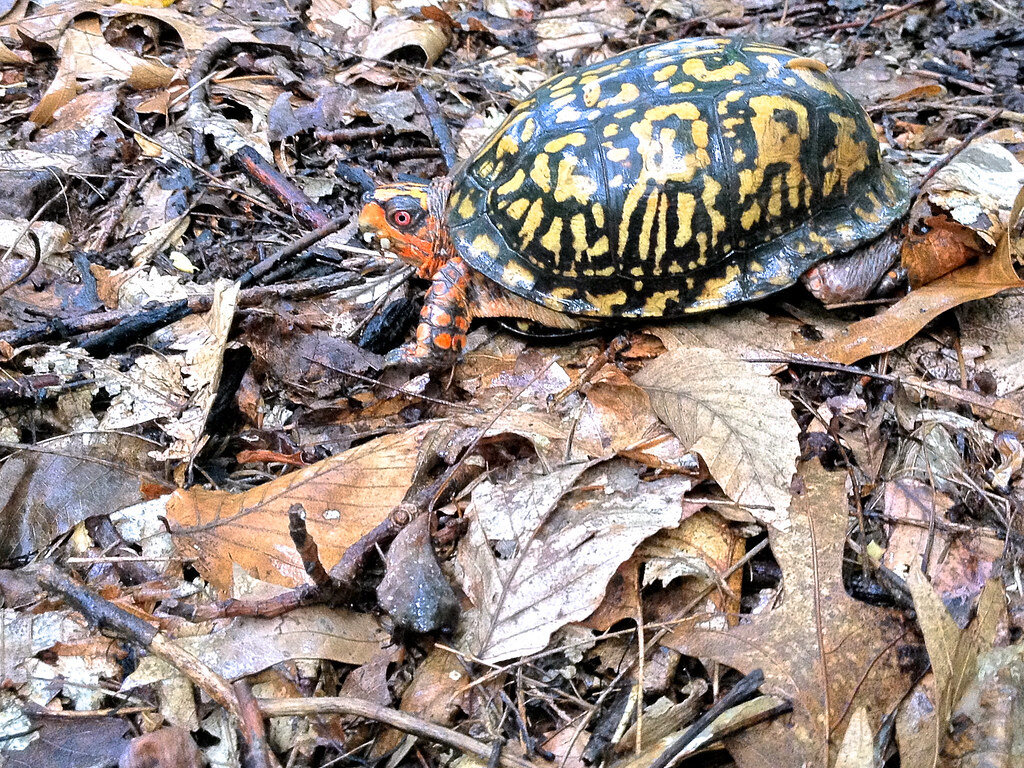
The common box turtle (Terrapene carolina) is a species of box turtle with five existing subspecies.
Care at a glance
Species-specific values
Values researched for this exact species. Air, surface and water temperatures are listed separately, and each source is kept as published rather than averaged.
| Minimum enclosure | Provide a total floor area of 14 square feet, measuring 5.5’L by 3’W by 1.5’H. Source: reptifiles.com | |
| Basking surface temperature | 84–88 °F Source: reptifiles.com | |
| Cool side air temperature | 70–75 °F Source: reptifiles.com | |
| Night temperature | at least 50 °F Source: reptifiles.com | |
| Uvb lighting | Employ a Zoo Med T5 HO ReptiSun 5.0 or Arcadia T5 HO 6%; aim for a basking spot UVI of about 3.0–4.0. Source: reptifiles.com | |
| Social housing | Keep eastern box turtles separate, unless a very large pen is provided. Source: reptifiles.com |
Understanding the animal
About this animal
About this animal
It is found throughout the Eastern United States and Mexico. The box turtle has a distinctive hinged lower shell that allows it to completely enclose itself, like a box.
From Wikipedia: Common box turtle, CC BY-SA 4.0 (excerpt)
In the wild
In the wild
Researched for this exact species, not its family. Wild conditions are context, not enclosure settings.1234
| Where it lives | Eastern United States woodlands, woodland openings and moist meadows, often near streams or ponds. Uses leaf litter, decaying logs and shallow soil shelters rather than living continuously underwater. |
| Ground it lives on | Leaf litter over loose soil, decaying wood and damp shaded ground. |
| Climate | Temperate conditions with winter cooling in northern populations; retreats from summer heat and is more active after rain. Measured environmental temperature and relative-humidity ranges were not established. |
| Active | Diurnal; summer activity often restricted to mornings and after rain. Northern populations brumate underground from autumn into spring. |
| Social life | Home ranges frequently overlap; generally independent rather than organized in social groups. |
| Wild diet | Earthworms, snails, slugs, insects, berries, fungi and carrion, with other small animals taken opportunistically. |
| Behavior to plan for | Digs shallow resting depressions and deeper winter refuges. Withdraws into its hinged shell when threatened and uses shade or shallow puddles during heat. |
Profile
Profile
Researched for this exact species. Sources are listed under In the wild above.
History
Terrapene carolina was first described by Carl Linnaeus in the 1758 tenth edition of Systema Naturae. It is the type species of the genus Terrapene, and additional subspecies were classified during the nineteenth century.
Data and studies
The numbers
The numbers
Each bar is what one source reports. Where several sources weigh in, the dashed gold band marks their average.
Maximum recorded lifespan
Longest recorded lifespan reported by each database; typical lifespans are usually shorter.
Typical adult weight
Average adult body mass in each database (FishBase gives the maximum recorded weight).
Incubation
Female maturity
Daytime air temperature
Species-specific values from keeper care sheets. Basking figures are often surface readings taken with an infrared thermometer, which run hotter than air.
Humidity
Species-specific values from keeper care sheets. Basking figures are often surface readings taken with an infrared thermometer, which run hotter than air.
Care articles for this species
Care articles for this species
- Eastern Box Turtle Care Sheet (ReptiFiles)
- Eastern Box Turtle Care Sheet (Reptiles Magazine)
- Rockalina The Eastern Box Turtle Left On House Floor For 48 Years Getting Care She Needs (Reptiles Magazine)
- Eastern Box Turtle Care (Reptiles Magazine)
Written by keepers, breeders and vets Reptiles MagazineReptiFiles
Veterinary & husbandry research
Veterinary & husbandry research
- MORBIDITY AND MORTALITY OF WILD TURTLES AT A NORTH CAROLINA WILDLIFE CLINIC: A 10-YEAR RETROSPECTIVE Sack A et al., Journal of zoo and wildlife medicine: official publication of the American Association of Zoo Veterinarians 2017
Peer-reviewed papers that mention this species alongside captivity, zoos, veterinary care or aquaculture. Some cover several species or mention it only in passing, so check the abstract. See all 40 on PubMed → PubMed
Sources for this sheet
- AnAge: The Animal Ageing and Longevity Database (Human Ageing Genomic Resources) (CC BY 3.0) Peer-reviewed researchCurated, referenced longevity and life-history records for thousands of species; maximum lifespans are often from zoo animals.
- Myhrvold et al. (2015). An amniote life-history database. Ecology 96: 3109 Peer-reviewed researchPeer-reviewed compilation of life-history data for over 21,000 birds, mammals and reptiles.
- ReptiFiles (care guides) Experienced keeper or breederWell-researched reptile care guides that cite herpetological literature and experienced keepers.
- Species+ (UNEP-WCMC and the CITES Secretariat) Zoo, university or veterinaryThe official database of species listed under CITES. UNEP (2026). The Species+ Website. Nairobi, Kenya. Compiled by UNEP-WCMC, Cambridge, UK. Available at: www.speciesplus.net. [Accessed 04/10/2026].
- USFWS International Affairs: CITES Zoo, university or veterinaryFederal agency that issues CITES permits.
- 21 CFR 1240.62: Turtles under 4 inches (FDA) Zoo, university or veterinaryFederal ban on selling small turtles.
- Clint's Reptiles (YouTube): Box Turtle, The Best Pet Turtle? Expert educator & keeperClint Laidlaw, PhD in Biology Education and MS in Evolutionary Ecology; owner of Clint's Reptile Room and a longtime keeper. His "Best Pet?" series reviews each species' care in depth.
- The Reptile Database Peer-reviewed researchScientist-curated catalog of every reptile species, with taxonomy and literature.
- GBIF Backbone Taxonomy (Global Biodiversity Information Facility) (CC BY 4.0) Peer-reviewed researchInternational scientific taxonomy used here for classification. GBIF Secretariat (2023). GBIF Backbone Taxonomy. Checklist dataset https://doi.org/10.15468/39omei, accessed via GBIF.org.
- Wikipedia (species article) (CC BY-SA 4.0) Community referenceFree encyclopedia; useful overviews with their own citations. Short excerpts are quoted under CC BY-SA 4.0, each credited with a link to its article.
- PubMed (U.S. National Library of Medicine) Peer-reviewed researchIndex of peer-reviewed veterinary, zoo and husbandry research.
- iNaturalist (captive observations) Community referenceCommunity observation platform run by the California Academy of Sciences and National Geographic; observations marked captive show animals living in homes, zoos and aquariums.
- Reptiles Magazine (care articles) Experienced keeper or breederEstablished reptile and amphibian hobby magazine; care articles are written by breeders, keepers and veterinarians.
More pond turtles and box turtles
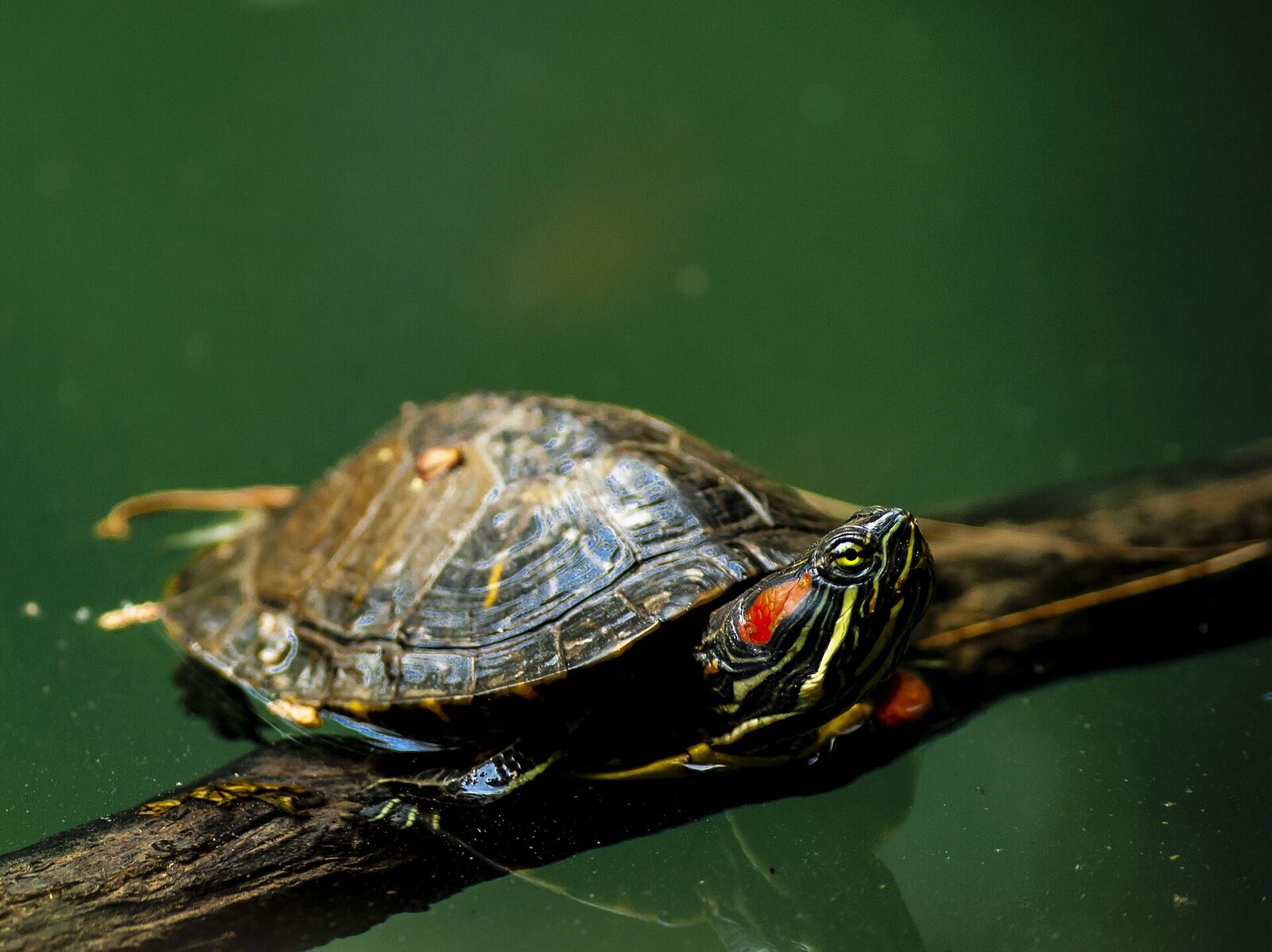
Red-eared slider
Trachemys scripta elegans
America's classic pet turtle, built to last decades.
Pet trade

Alabama map turtle
Graptemys pulchra
Zoos & aquariums

Baja California slider
Trachemys nebulosa
Pet trade

Barbour's map turtle
Graptemys barbouri
Zoos & aquariums

Black-knobbed map turtle
Graptemys nigrinoda
Pet trade

Blanding's turtle
Emydoidea blandingii
Pet trade